

A kind of fluorescent probe for detecting hydrazine hydrate and its preparation method and application
A fluorescent probe and hydrazine hydrate technology, which is applied in the preparation of organic compounds, hydrazide preparation, fluorescence/phosphorescence, etc., can solve the problems of poor sensitivity of fluorescent probes and complicated preparation methods, and achieve high sensitivity and selectivity. Convenience, rapid detection of results
- Summary
- Abstract
- Description
- Claims
- Application Information
AI Technical Summary
Problems solved by technology
Method used
Image

Examples
Embodiment 1
[0033] Embodiment 1: A kind of fluorescent probe for detecting hydrazine hydrate, this fluorescent probe is 4-(diethylamino) phthalaldehyde, its chemical structural formula is as follows: .
[0034] The method for preparing the fluorescent probe for detecting hydrazine hydrate, using 4-(diethylamino) salicylaldehyde as a starting material, reacts with an equimolar amount of formylhydrazide to obtain N-[(4-di Ethylamino-2-hydroxyphenyl) methylene]formylhydrazide, and then react with an equimolar amount of lead tetraacetate to obtain 4-(diethylamino)phthalaldehyde.
[0035] Specific steps are as follows:
[0036] (1) Preparation of N-[(4-diethylamino-2-hydroxyphenyl)methylene]formylhydrazide: Dissolve 1.93 g (10 mmol) 4-(diethylamino)salicylaldehyde in 30 mL n-propane alcohol, then add 0.60 g (10 mmol) formylhydrazide, heat to reflux for 5 hours, cool, and remove the solvent under reduced pressure to obtain N-[(4-diethylamino-2-hydroxyphenyl)methylene]formyl Hydrazine. The ...
Embodiment 2
[0038] Example 2: An experimental method for the quantitative detection of high-concentration hydrazine hydrate with a fluorescent probe of 4-(diethylamino)phthalaldehyde, the specific steps are as follows:
[0039] (1) Prepare a fluorescent probe stock solution of 2 mM 4-(diethylamino)phthalaldehyde in dimethyl sulfoxide (DMSO); prepare a 1 mM hydrazine hydrate solution in distilled water.
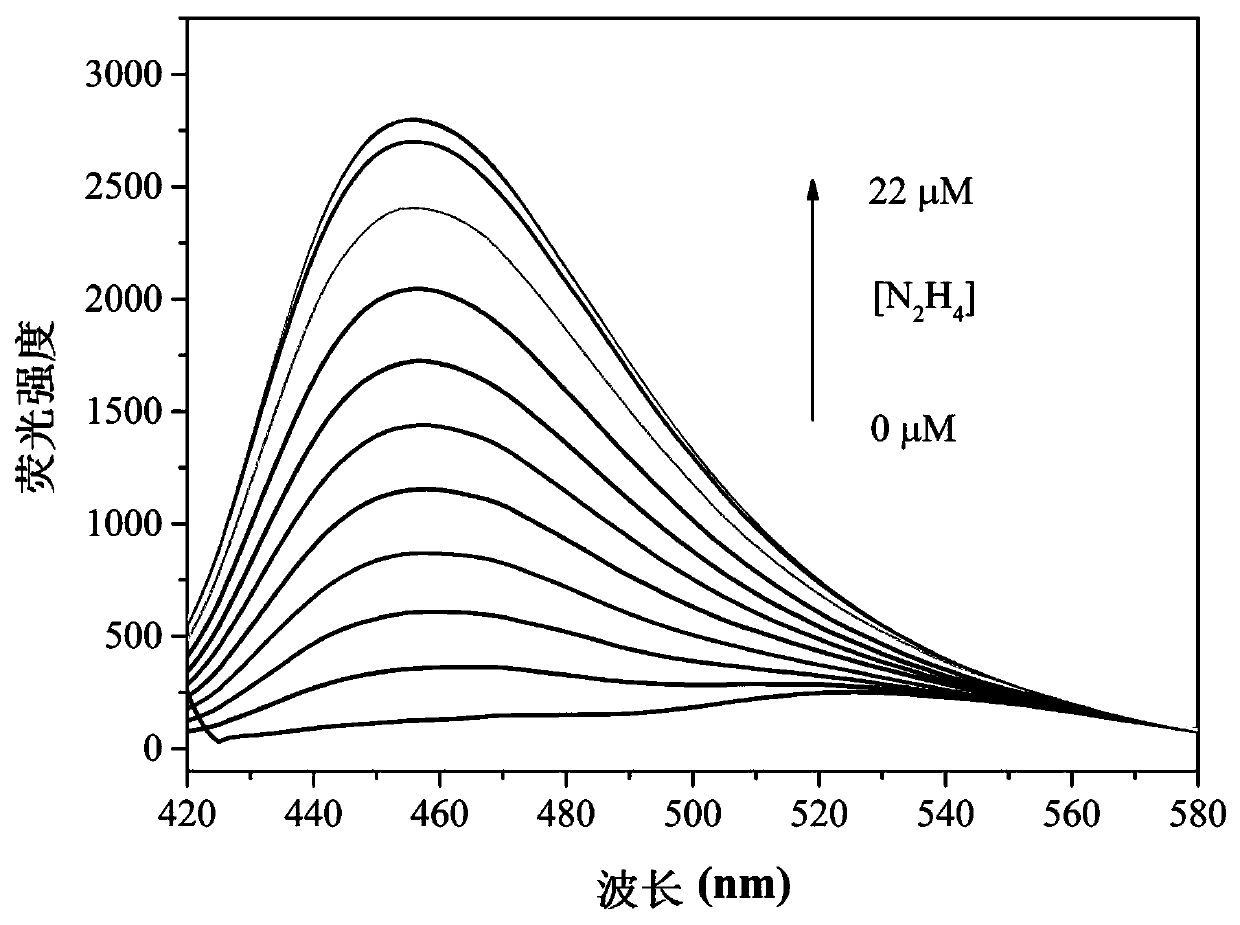
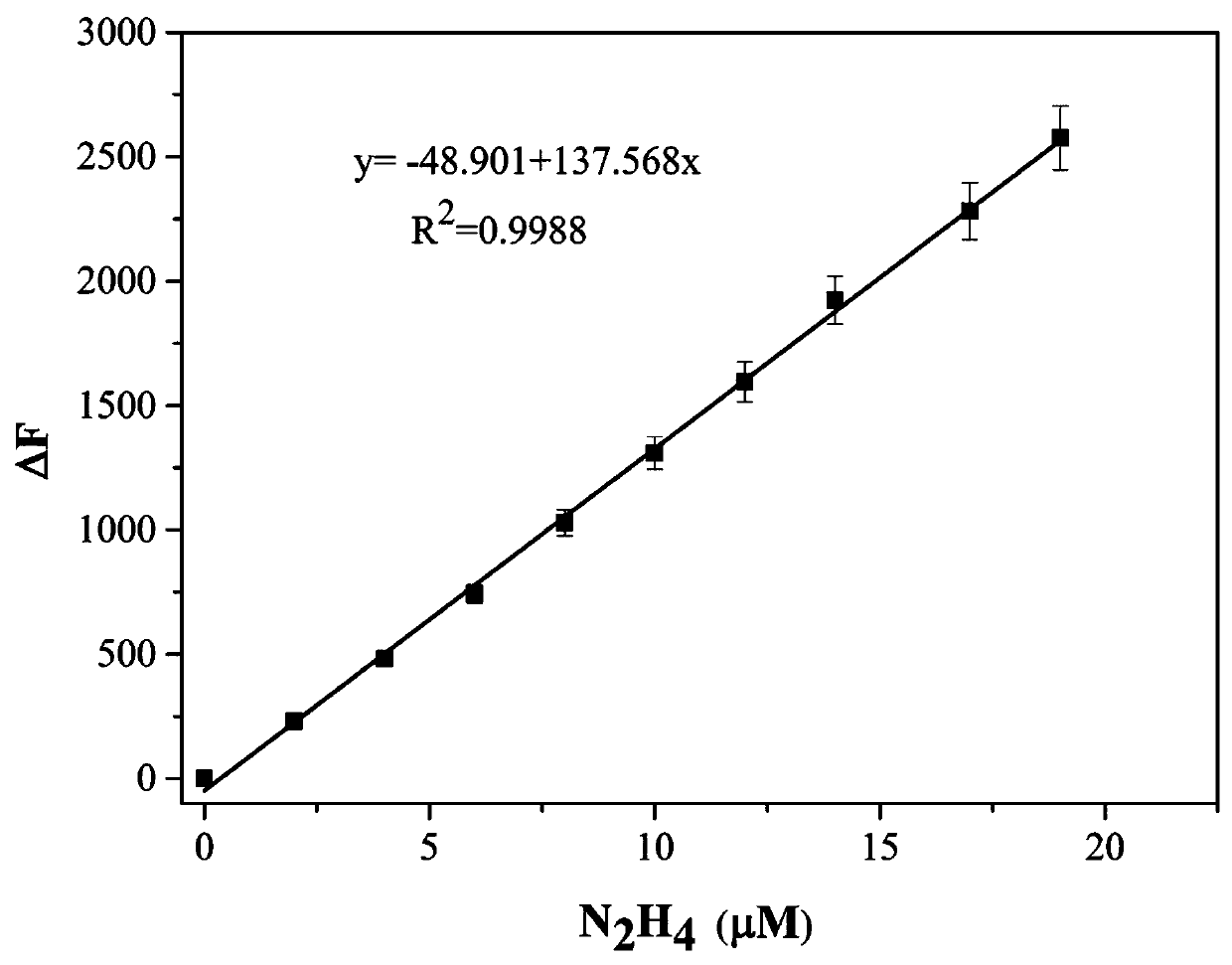
[0040] (2) Add 2 mL of DMSO / PBS buffer solution (v / v = 4 / 6, pH = 7.4) and 20 µL of fluorescent probe stock solution into a fluorescence cuvette, and measure the fluorescence of the probe on a fluorescence spectrophotometer Spectrum (excitation wavelength 410 nm), then gradually add different volumes of hydrazine hydrate solution, and measure its fluorescence spectrum on a fluorescence spectrophotometer. After adding hydrazine hydrate, the probe has a new fluorescence emission peak at 456 nm, and with the The fluorescence intensity gradually increased with the addition of hydrazine hydrate...
Embodiment 3
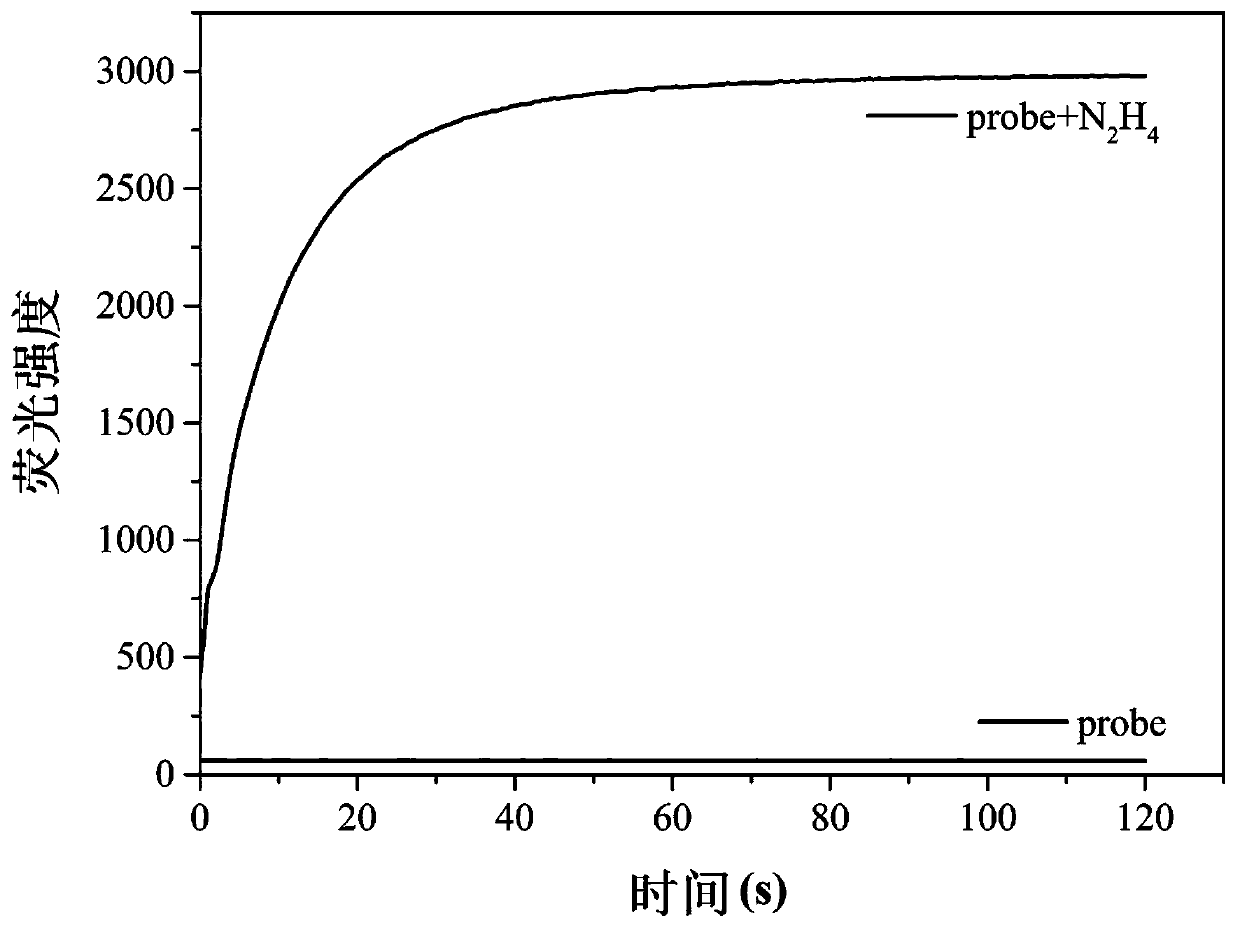
[0042] Example 3: Response time experiment of quantitative detection of high concentration hydrazine hydrate by 4-(diethylamino)phthalaldehyde fluorescent probe
[0043] In the fluorescent cuvette, add 2 mL of DMSO / PBS buffer (v / v = 4 / 6, pH = 7.4) and 20 µL of fluorescent probe stock solution, then add 1 molar equivalent of hydrazine hydrate solution, and measure The fluorescence intensity change of the probe at 456 nm (excitation wavelength 410 nm) was measured on the instrument. As the reaction time prolongs, the fluorescence intensity increases continuously. When the reaction reaches 60 s, the fluorescence intensity is basically constant (see image 3 ), indicating that the detection method is fast and can be completely detected within 1 minute.
PUM
 Login to View More
 Abstract
Description
Claims
Application Information
 Login to View More