
Adsorbent used for clearing middle and macro molecule toxin in body of uremia patients and preparation method thereof
An adsorbent and macromolecular technology, applied in the field of biomedicine, can solve problems such as poor selectivity, poor mechanical strength, and large pressure drop, and achieve the effects of excellent adsorption capacity, high adsorption selectivity, and rich mesoporous structure
- Summary
- Abstract
- Description
- Claims
- Application Information
AI Technical Summary
Problems solved by technology
Method used
Image

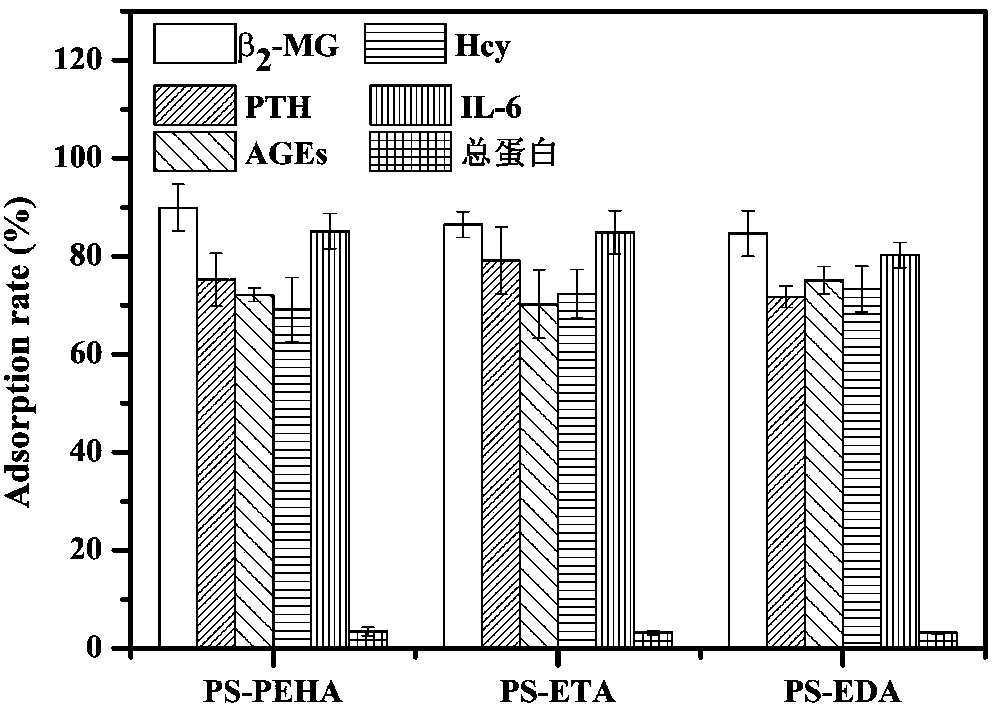
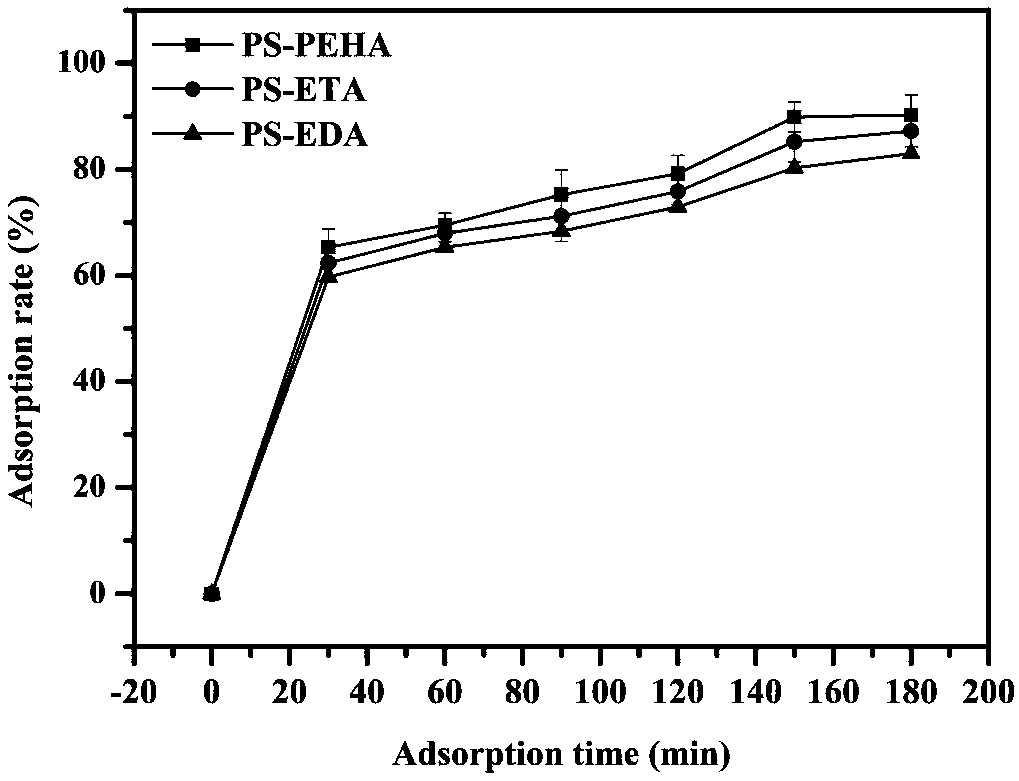
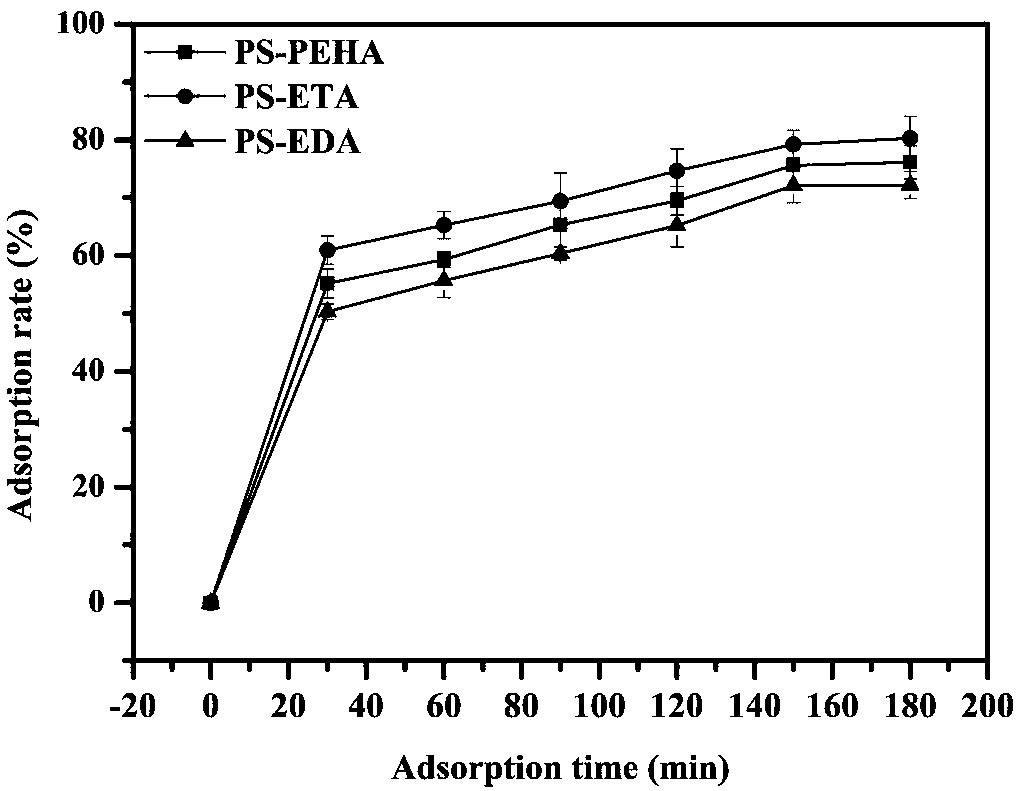
Examples
Embodiment 1
[0026] (1) Preparation of carrier microspheres
[0027]15.4g styrene and 84.6g divinylbenzene were added to a 1000mL beaker, then 327.3g toluene, 109.1g ethyl acetate, 43.6g gasoline and 6.96g benzoyl peroxide were added, stirred to dissolve, and After the dissolution is complete, mix thoroughly to obtain an organic phase. At normal temperature, 11.02g of polyvinyl alcohol and 580mL of deionized water were added to a 2000mL three-neck flask to form an aqueous solution of 1.9% (mass fraction) of polyvinyl alcohol, and heated and stirred to 45°C to fully dissolve the polyvinyl alcohol to obtain Water phase, stop stirring, add the obtained uniformly mixed organic phase into the water phase, start the stirrer, adjust the stirring rate, so that the droplets are evenly distributed, after the temperature is raised to 50°C, the temperature is raised to 80°C at 5°C / 10min , to make the liquid titrate, keep it at this temperature for 3 hours after being finalized, then slowly raise the ...
Embodiment 2
[0033] (1) Preparation of carrier microspheres
[0034] Add 30g of styrene and 120g of divinylbenzene into a 1000mL beaker, then add 189.5g of toluene, 63.2g of ethyl acetate, 47.3g of gasoline and 4.5g of benzoyl peroxide, stir to dissolve, and wait until it is completely dissolved Afterwards, fully mix to obtain the organic phase. At room temperature, add 9g of polyvinyl alcohol and 900mL of deionized water into a 2000mL three-necked flask to form a 1% (mass fraction) aqueous solution of polyvinyl alcohol, and heat and stir to 45°C to fully dissolve the polyvinyl alcohol to obtain water Phase, stop stirring, add the obtained uniformly mixed organic phase into the water phase, start the stirrer, adjust the stirring rate, so that the droplets are evenly distributed, after the temperature is raised to 46°C, the temperature is raised to 75°C at 4°C / 10min, Make the solution titrate, keep it at this temperature for 4 hours after being finalized, then slowly raise the temperature ...
Embodiment 3
[0040] (1) Preparation of carrier microspheres
[0041] Add 28.6g of styrene and 71.4g of divinylbenzene into a 1000mL beaker, then add 120g of toluene, 30g of ethyl acetate, 30g of gasoline and 2g of benzoyl peroxide, and stir to dissolve it. After the dissolution is complete, Mix well to obtain an organic phase. At normal temperature, 7.5g of polyvinyl alcohol and 450mL of deionized water were added to a 2000mL three-necked flask to form an aqueous solution of 1.5% (mass fraction) of polyvinyl alcohol, and heated and stirred to 45°C to fully dissolve the polyvinyl alcohol to obtain Water phase, stop stirring, add the obtained uniformly mixed organic phase into the water phase, start the stirrer, adjust the stirring rate, so that the droplets are evenly distributed, after the temperature is raised to 42 ° C, the temperature is raised to 70 ° C at 3 ° C / 10 min , to make the liquid titrate, keep it at this temperature for 3.5 hours after being finalized, then slowly raise th...
PUM
| Property | Measurement | Unit |
|---|---|---|
| Granularity | aaaaa | aaaaa |
| Granularity | aaaaa | aaaaa |
| Specific surface area | aaaaa | aaaaa |
Abstract
Description
Claims
Application Information
 Login to View More