Check patentability & draft patents in minutes with Patsnap Eureka AI!

A preparation method for regulating the molecular weight and distribution of poly(dimethylsiloxane-co-methylvinylsiloxane)

A technology of methyl vinyl siloxane and dimethyl siloxane, which is applied in the field of preparation of polymolecular weight regulation and control, can solve the problems of difficult control of molecular weight and wide molecular weight distribution, and achieves easy control of molecular weight and distribution, and preparation process. Simple, high product yield effect

Active Publication Date: 2021-07-23
国科广化(南雄)新材料研究院有限公司 +2
View PDF5 Cites 0 Cited by
  • Summary
  • Abstract
  • Description
  • Claims
  • Application Information

AI Technical Summary

Problems solved by technology

[0005] At present, poly(dimethylsiloxane-co-methylvinylsiloxane) is usually synthesized by the "one-pot cooking" method, and the obtained molecular weight distribution is relatively wide, and the molecular weight is not easy to control

Method used

the structure of the environmentally friendly knitted fabric provided by the present invention; figure 2 Flow chart of the yarn wrapping machine for environmentally friendly knitted fabrics and storage devices; image 3 Is the parameter map of the yarn covering machine
View more

Image

Smart Image Click on the blue labels to locate them in the text.
Viewing Examples
Smart Image
  • A preparation method for regulating the molecular weight and distribution of poly(dimethylsiloxane-co-methylvinylsiloxane)
  • A preparation method for regulating the molecular weight and distribution of poly(dimethylsiloxane-co-methylvinylsiloxane)

Examples

Experimental program
Comparison scheme
Effect test

Embodiment 1

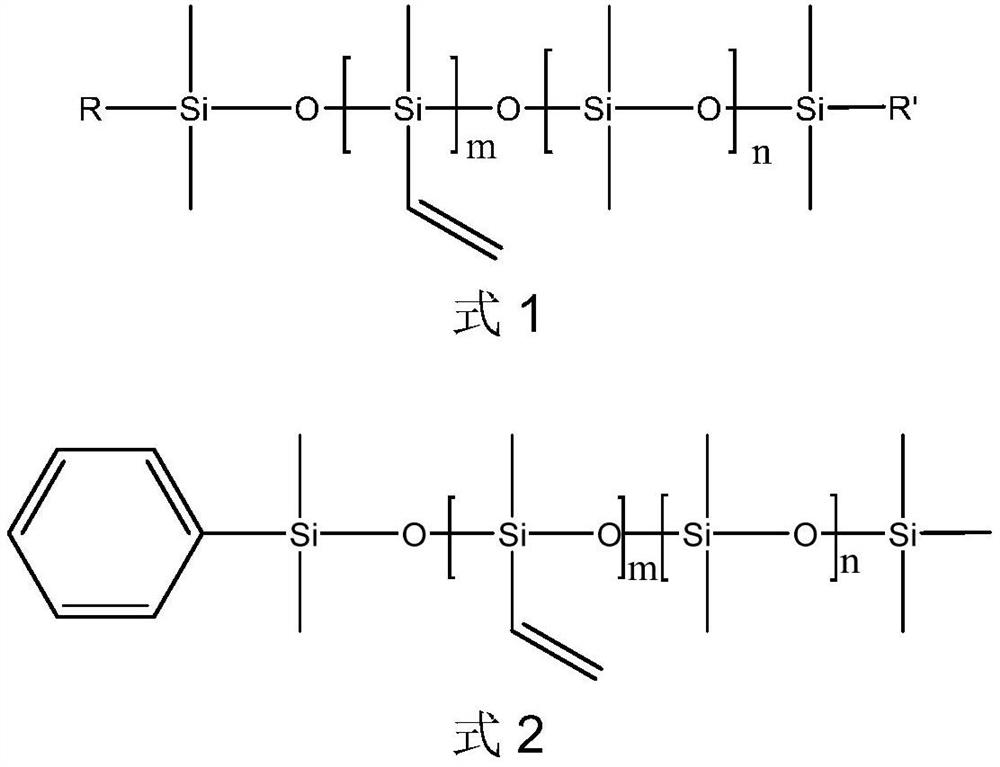
[0031] First, the two ring monomers, the base catalyst and the end-capping agent are purified. 5g (16.9mmol) octamethylcyclotetrasiloxane (D 4 ), 0.024g (0.187mmol) of potassium silanolate were placed in a four-necked flask equipped with a condenser, a stirrer, and a thermometer, and nitrogen gas was passed for 0.5h, and the temperature rose to 110°C for 2h of reaction, and then 5.8g (16.9mmol) Tetramethyltetravinylcyclotetrasiloxane (D 4 Vi ) and 0.368g (2.27mmol) hexamethyldisiloxane were added to the above reaction system, and the reaction was continued for 2h. The obtained crude product was purified in methanol, then centrifuged, and the methanol was removed by rotary evaporation, and finally a colorless and transparent viscous liquid was obtained, and the product was shown in Formula 1. Tested by GPC: Mn=7859; Mw / Mn=1.46. (Mw / Mn means molecular weight distribution)

Embodiment 2

[0033] First, the two ring monomers, catalysts and end-capping agents are purified. 3.76g (16.9mmol) hexamethylcyclotrisiloxane (D 3 ), 0.024g (0.187mmol) of potassium silanolate was put into a four-necked flask equipped with a condenser, a stirrer, and a thermometer, and nitrogen gas was passed for 0.5h, and the temperature rose to 110°C. After 2h of reaction, 5.8g (16.9mmol) of tetra Methyltetravinylcyclotetrasiloxane (D 4 Vi) and 0.368g (2.27mmol) of hexamethyldisiloxane were added to the above reaction system, and the reaction was continued for 2h. The obtained crude product was purified in methanol, then centrifuged, and the methanol was removed by rotary evaporation, and finally a colorless and transparent viscous liquid was obtained. Tested by GPC: Mn=6989; Mw / Mn=1.62.

Embodiment 3

[0035] First, the two ring monomers, catalysts and end-capping agents are purified. 5g (16.9mmol) octamethylcyclotetrasiloxane (D 4 ), 0.024g (0.187mmol) of potassium silanolate was placed in a four-necked flask equipped with a condenser, a stirrer, and a thermometer, and nitrogen gas was passed for 0.5h, and the temperature rose to 90°C. After 4h of reaction, 5.8g (16.9mmol) of four Methyltetravinylcyclotetrasiloxane (D 4 Vi ) into the above reaction system, reacted for 3h, then added 0.368g (2.27mmol) hexamethyldisiloxane, reacted for 2h, and stopped the reaction. The obtained crude product was purified in methanol, then centrifuged, and the methanol was removed by rotary evaporation, and finally a colorless and transparent viscous liquid was obtained. Tested by GPC: Mn=8288; Mw / Mn=1.55.

the structure of the environmentally friendly knitted fabric provided by the present invention; figure 2 Flow chart of the yarn wrapping machine for environmentally friendly knitted fabrics and storage devices; image 3 Is the parameter map of the yarn covering machine
Login to View More

PUM

PropertyMeasurementUnit
degree of polymerizationaaaaaaaaaa
Login to View More

Abstract

The invention discloses a preparation method for regulating the molecular weight and distribution of poly(dimethylsiloxane-co-methylvinylsiloxane), which comprises mixing dimethylcyclosiloxane and an alkali catalyst and passing nitrogen 0.5~1.5h; heat up to 90~130°C, polymerize for 2~6h to obtain a reaction liquid; (2) add methyl vinyl cyclosiloxane and end-capping agent to the reaction liquid, and continue the polymerization for 2~6h, The crude product was obtained; the crude product was post-treated, precipitated step by step with methanol, centrifuged, and finally rotary evaporated to obtain poly(dimethylsiloxane-co-methylvinylsiloxane). The preparation process of the present invention is simple, the post-processing is convenient, the product yield is high, the molecular weight and its distribution are easy to control, and can be widely used in the reinforcement and modification of silicone rubber and silicone resin, and in the modification of magnetic nanoparticles and drug release. At the same time, it can be used to improve the performance of release agents, mold release agents, and personal skin care products.

Description

technical field [0001] The invention relates to the field of materials, in particular to a preparation method for regulating the molecular weight of poly(dimethylsiloxane-co-methylvinylsiloxane). Background technique [0002] Siloxane polymer is a kind of organic-inorganic hybrid material with Si-O-Si chain as the main chain and organic groups (methyl, phenyl, vinyl, etc.) as side chains. This structure gives it excellent Excellent physical and chemical properties, high and low temperature resistance, flexibility, good dielectric properties, weather resistance, lubricity and low surface tension, etc., are widely used in waterproof materials, self-cleaning materials, seawater antifouling materials, silicone rubber And the application modification of silicone resin. [0003] Silicone rubber is generally based on vinyl-containing polysiloxane, which is vulcanized into an elastomer under the action of a crosslinking agent and a catalyst. The molecular weight of the polysiloxan...

Claims

the structure of the environmentally friendly knitted fabric provided by the present invention; figure 2 Flow chart of the yarn wrapping machine for environmentally friendly knitted fabrics and storage devices; image 3 Is the parameter map of the yarn covering machine
Login to View More

Application Information

Patent Timeline
no application Login to View More
Patent Type & Authority Patents(China)
IPC IPC(8): C08G77/20C08G77/08
Inventor 胡继文尚颖超涂园园林树东魏彦龙黄振祝
Owner 国科广化(南雄)新材料研究院有限公司
Features
  • R&D
  • Intellectual Property
  • Life Sciences
  • Materials
  • Tech Scout
Why Patsnap Eureka
  • Unparalleled Data Quality
  • Higher Quality Content
  • 60% Fewer Hallucinations
Social media
Patsnap Eureka Blog
Learn More