Non-fullerene acceptor compound containing benzoselenadiazole and organic optoelectronic element comprising the same

A non-fullerene acceptor, benzoselenodiazole technology, applied in the field of compounds, can solve the problems of difficult development of non-fullerene acceptor compounds, difficult control of compound types, low power conversion efficiency, etc.

CN113135941APending Publication Date: 2021-07-20RAYNERGY TEK INC
4 Cites 1 Cited by

Patent Information

Authority / Receiving Office
CN · China
Patent Type
Applications(China)
Current Assignee / Owner
Publication Date
2021-07-20

Smart Images

  • Figure 1
    Figure 1
  • Figure 2
    Figure 2
  • Figure 3
    Figure 3
Patent Text Reader

Abstract

The present invention relates to a non-fullerene acceptor compound containing benzoselenadiazole and an organic photoelectric element comprising the same. The non-fullerene acceptor compound containing benzoselenadiazole has a structure as shown in the following formula shown in the description, wherein Ar1 is a penta-heterocycles; Ar2 is a monocyclic or polycyclic aromatic heterocyclic derivative of C5-C20; pi is a C5-C20 monocyclic or polycyclic aromatic heterocyclic derivative, and m is equal to 0-5; and EG is a monocyclic or polycyclic derivative containing ketones and electron withdrawing groups. The organic photoelectric element, such as OPD or OPV, containing the benzoselenadiazole-containing non-fullerene acceptor compound can provide better light absorption wavelength range and photoelectric conversion efficiency during use.
Need to check novelty before this filing date? Find Prior Art

Description

technical field

[0001] The invention relates to a compound, especially a non-fullerene acceptor compound containing benzoselenadiazole, and an organic photoelectric element containing it. Background technique

[0002] In recent years, in order to manufacture more versatile and lower-cost electronic components, the demand for Organic Semiconductor Compounds (OSC) has increased. This phenomenon is due to the fact that compared with traditional semiconductor materials, organic semiconductor compounds have a wider range of light absorption, The light absorption coefficient is large and has an adjustable structure. Its light absorption range, energy level and solubility can be adjusted according to the target requirements. In addition, organic materials have low cost, flexibility, low toxicity and large-scale production in terms of component production. The advantages of organic photoelectric materials have good competitiveness in various fields. Such compounds have a wide range...

Examples

Embodiment 1

[0068] Embodiment 1: the preparation of compound N1, N2

[0069]

[0070] Compounds M1 to M7 were synthesized as described below

[0071] a. Synthesis of M1

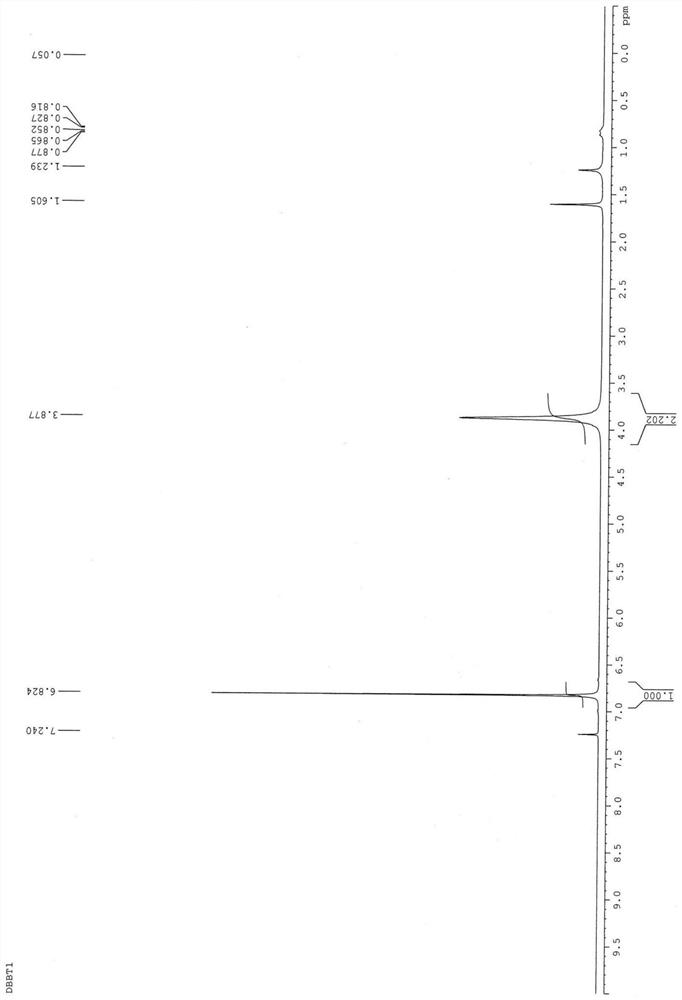
[0072] Weigh DBBT (8g, 27.2mmol) into a 500ml three-neck flask, add ethanol (120mL) and tetrahydrofuran (200mL), stir in an ice bath with a magnet until completely dissolved, and slowly add NaBH 4 (21g, 544mmol), stirred in an ice bath for 30 minutes, removed the ice bath and returned to room temperature for 1 hour, acidified the crude product, extracted three times with ethyl acetate / water, collected the organic layer and added magnesium sulfate to remove water, And the solvent was removed to obtain the product M1 as a white solid (6.5 g, 90%). The white solid M1 uses 1 HNMR (500MHz, CDCl 3 ) identification results are: δ6.82(s, 2H), 3.88(s, 4H), see figure 1 .

[0073] b. Synthesis of M2

[0074] Weigh M1 (7g, 26.3mmol) and selenium oxide (3.5g, 31.6mmol) into a 500ml three-neck flask, add ethanol (210mL) and...

Embodiment 2

[0091] Embodiment 2: the preparation of compound N3, N4

[0092]

Embodiment 3

[0093] Embodiment 3: the preparation of compound N5, N6

[0094]