Casting method of 12-cubic-meter slag ladle

A slag bag and casting technology, applied in the casting field of 12 cubic meters of slag bag, can solve the problems of easy falling off of the bag ears, large sand intake in the sand box, hidden safety hazards, etc., to optimize the heat treatment process, achieve significant economic benefits, and improve production. The effect of efficiency

CN113305268AActive Publication Date: 2021-08-27烟台恒邦合金材料有限公司
9 Cites 2 Cited by

Patent Information

Authority / Receiving Office
CN · China
Patent Type
Applications(China)
Current Assignee / Owner
Publication Date
2021-08-27

Smart Images

  • Figure 1
    Figure 1
  • Figure 2
    Figure 2
  • Figure 3
    Figure 3
Patent Text Reader

Abstract

The invention provides a casting method of a 12-cubic-meter slag ladle. The method comprises the following steps that (1) process design is performed, specifically, a casting scheme that a slag ladle opening faces downwards is adopted, a pouring system is a three-layer ceramic tube pouring gate, a main riser is arranged at the right bottom of the slag ladle, a branch riser is arranged on each of six ground feet, and pouring is simulated to determine each process parameter; (2) alkali phenolic resin sand is adopted for molding, a sand mold adopts split molding, and a sand box is a random tower type box; (3) an imbedding technology is adopted, and anti-falling and anti-rotating wrapping lugs are designed; (4) a bottom box is emptied, and an induced draft fan is adopted for exhausting during pouring; (5) molten steel is smelted in two furnaces, and ladles are closed for pouring; and (6) cooling and post-processing are performed. According to the 12-cubic-meter slag ladle cast through the method, the hardness requirement of equipment tools is lowered, meanwhile, internal defects of products can be reduced, the product quality can be improved, the use requirement can be met, the rate of finished products is up to 99%, the use amount of resin sand is greatly reduced, the production cost is saved, and economic benefits are remarkable.
Need to check novelty before this filing date? Find Prior Art

Description

technical field

[0001] The invention belongs to casting technology, in particular to a casting method of 12 cubic meters of slag ladle. Background technique

[0002] The slag bag is a necessary container for non-ferrous smelting enterprises to hold and transfer smelting slag, copper glaze, and slow cooling crystallization. The maximum temperature of the contents is 1300°C. The slag bag must be filled with slag and then transported to the slow cooling field for slow cooling at about 900°C. technical conditions, that is, the slag ladle must have high thermal fatigue resistance and meet the hot and cold working conditions, and the inner surface of the slag ladle should be flat and smooth, and the outer wall should be free from shrinkage, slag inclusions, sand inclusions, cracks, cold Casting defects such as partitions and pores, slag bag pressure test, no leakage, sweating, and a service life of ≥6 years. The current production status is that the single weight of 12 cubic mete...

Examples

Embodiment Construction

[0028] In order to better understand and implement, the following example illustrates a casting method of a 12 cubic meter slag bag, and the specific steps include:

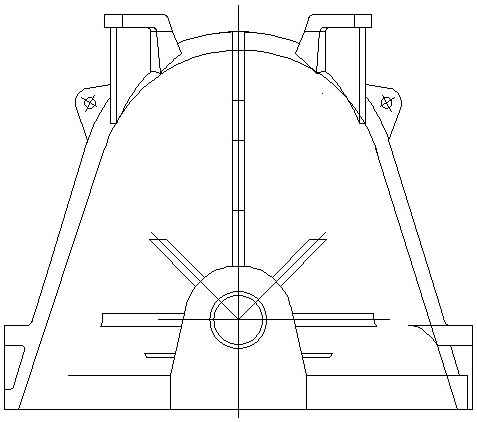
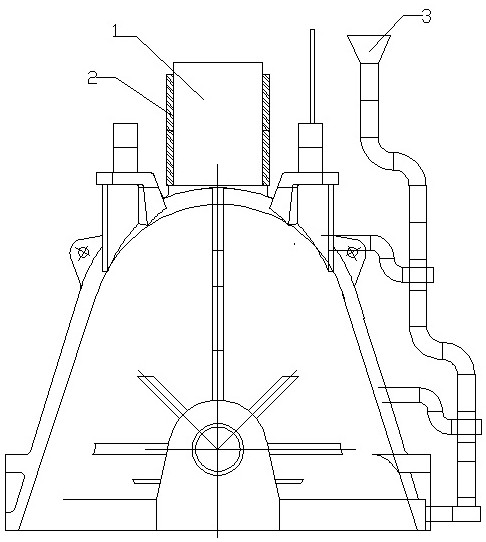
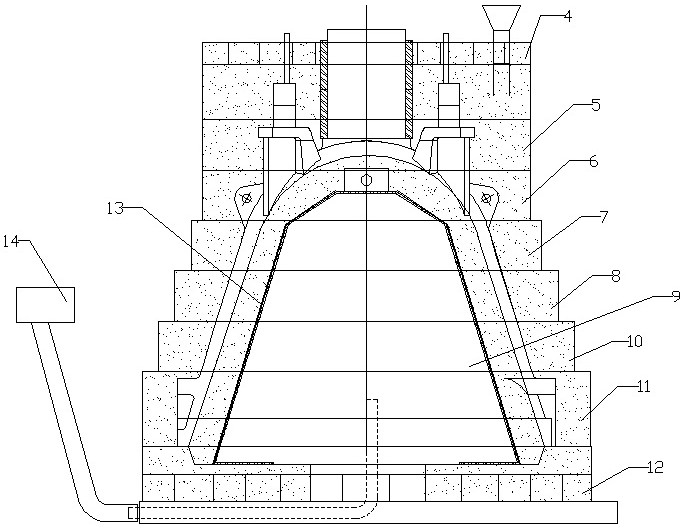
[0029] 1. Design and production:

[0030] (1) The casting size is large, Φ3240mm*2910mm (see figure 1 ), the design gating system uses three-layer runners to inject molten steel stably, the vertical main runner is a φ120 ceramic tube, the horizontal runner is a φ100 ceramic tube, and elbows are added to both the straight and runners to ensure smooth flushing of molten steel; The bottom of the slag bag is equipped with a main riser 1 of φ720mm and a height of 1000mm, wrapped with a 60mm thick thermal insulation and heating plate 2 with a height of two floors, and each of the six feet of the slag bag is equipped with 2 φ200mm and a height of 200mm (superimposed) thermal insulation and heating risers, through The magma simulation software conducts repeated analysis, simulation, and correction to finally determine t...