
Epoxy crosslinking agent and its prepn and application in preparing biodegradable material
A technology of biodegradable materials and cross-linking agents, applied in the preparation of biodegradable materials, the field of preparation of epoxy-based cross-linking agents, can solve the problem of cell toxicity, matching degradation rate, poor cell affinity, etc. problems, to achieve the effect of broadening the range of selection, enhancing mechanical properties, and having no toxic and side effects
- Summary
- Abstract
- Description
- Claims
- Application Information
AI Technical Summary
Problems solved by technology
Method used
Image

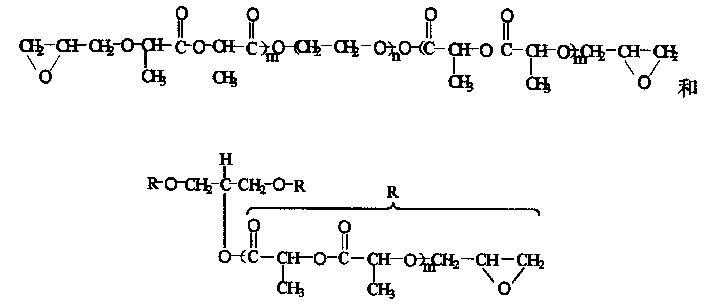
Examples
Embodiment 1
[0028] 13.5g of lactide, 6g of PEG400 and 0.17g of stannous octoate were mixed and stirred, blown with nitrogen, heated to 130°C, and reacted for 6 hours. The crude product was dissolved in chloroform, filtered and dissolved in n-hexane, separated into layers, filtered again, and repeated several times until the liquid was completely transparent, and then dried under vacuum at 55°C for one day. Take 5g of the product, 7.5g of epichlorohydrin and 0.15g of benzyltriethylammonium chloride, add 4g of 50% sodium hydroxide dropwise for 30min under stirring at room temperature, then stir and react at 60°C for 1h; cool, filter with suction, and separate the liquids The organic layer was separated, washed three times with 60 ml of saturated brine, dried over anhydrous magnesium sulfate, and distilled under reduced pressure to obtain a light yellow transparent liquid.
Embodiment 2
[0030] 15g of lactide, 2g of glycerin and 0.15g of stannous octoate were mixed and stirred, nitrogen was blown, the temperature was raised to 130°C, and the reaction was carried out for 6 hours. The crude product was dissolved in chloroform, filtered and dissolved in n-hexane, separated into layers, filtered again, and repeated several times until the liquid was completely transparent, and then dried under vacuum at 55°C for one day. Take 5g of the product, 5g of epichlorohydrin and 0.3g of benzyltriethylammonium chloride, add 3g of 50% sodium hydroxide dropwise for 30min under stirring at room temperature, then stir and react at 60°C for 1h; The organic layer was taken out, washed three times with 60 ml of saturated brine, dried over anhydrous magnesium sulfate, and distilled under reduced pressure to obtain a light yellow transparent liquid.
Embodiment 3
[0032] Mix and stir 12g of lactide, 6g of PEG800 and 0.15g of stannous octoate, blow nitrogen, raise the temperature to 130°C, and react for 6 hours. The crude product was dissolved in chloroform, filtered and dissolved in n-hexane, separated into layers, filtered again, and repeated several times until the liquid was completely transparent, and then dried under vacuum at 55°C for one day. Take 5g of the product, 5g of epichlorohydrin and 0.15g of benzyltriethylammonium chloride, add 4g of 50% sodium hydroxide dropwise for 30min under stirring at room temperature, then stir and react at 60°C for 1h; The organic layer was taken out, washed three times with 60 ml of saturated brine, dried over anhydrous magnesium sulfate, and distilled under reduced pressure to obtain a light yellow transparent liquid.
PUM
| Property | Measurement | Unit |
|---|---|---|
| contact angle | aaaaa | aaaaa |
| epoxy value | aaaaa | aaaaa |
| water absorption | aaaaa | aaaaa |
Abstract
Description
Claims
Application Information
 Login to View More