Check patentability & draft patents in minutes with Patsnap Eureka AI!

Catalytic systems for the polymerization and copolymerization of alpha-olefins

Inactive Publication Date: 2003-10-09
REPSOL QUIMICA
View PDF6 Cites 15 Cited by
  • Summary
  • Abstract
  • Description
  • Claims
  • Application Information

AI Technical Summary

Benefits of technology

[0007] Thanks to the methods described in the present invention, heterogeneous catalysts can be obtained; they allow to effectively control the morphology and the distribution of particle sizes, with a regular growth of the polymer around the catalyst particles and without reactor fouling.

Problems solved by technology

It is very well known that homogeneous catalytic systems present a disadvantage: when they are used in suspension polymerization processes, a part of the produced polymer adheres to the reactor walls; this effect is technically called "reactor fouling".
Besides, in most cases, the particle size of the obtained polymer is very small and the bulk density is low, thus the industrial production is reduced.

Method used

the structure of the environmentally friendly knitted fabric provided by the present invention; figure 2 Flow chart of the yarn wrapping machine for environmentally friendly knitted fabrics and storage devices; image 3 Is the parameter map of the yarn covering machine
View more

Image

Smart Image Click on the blue labels to locate them in the text.
Viewing Examples
Smart Image
  • Catalytic systems for the polymerization and copolymerization of alpha-olefins
  • Catalytic systems for the polymerization and copolymerization of alpha-olefins
  • Catalytic systems for the polymerization and copolymerization of alpha-olefins

Examples

Experimental program
Comparison scheme
Effect test

example 1

Preparation of [(3-trimethylsiloxypropyl)methylsilylen] bis indenyl zirconium dichloride

[0759] Preparation of (3-trimethylsiloxypropyl)methyldichlorosilane

[0760] A 500 ml Schlenk flask equipped with a stir-bar, a reflux condenser and a rubber septum was charged under nitrogen with 103.3 g of HSiMe.sub.2Cl and 5 drops of a 0.1M solution of the platinum Pt(0) 2,4,6,8-tetramethyl -2,4,6,8-tetravinylcyclotetrasiloxane complex (a product sold by Aldrich Chemical Co) at room temperature. To this solution 100 g of Me.sub.3SiO--CH.sub.2--CH.dbd.CH.sub.2 was added during 30 minutes. After the addition was completed, the reaction mixture was gradually heated at 40.degree. C. and maintained at this temperature under stirring for 2 hours, and finally heated at 60.degree. C. for another 5 hours. The desired product can be isolated by distillation under vacuum (10 mbar) at 75.degree. C. Yield 84% .sup.1H NMR (CDCl.sub.3): 0.120 (s, 9H, Si(Me).sub.3), 0.810 (s, 6H, SiMe), 1.120-1.190 (m,CH.sub.2),...

example 2

Preparation of [(1,1-dimethyl-1-sila-4-trimetylsiloxybutyl) cyclopentadienyl]cyclopentadienyl zirconium dichloride

[0767] Preparation of (3-trimethylsiloxypropyl)dimethylchlorosilane

[0768] A 500 ml Schlenk flask equipped with a stir-bar, a reflux condenser and a rubber septum was charged under nitrogen with 94.6 g of HSiMe.sub.2CI and 5 drops of a 0.1 M solution of the platinum complex Pt(0) 2,4,6,8-tetramethyl -2,4,6,8-tetravinylcyclotetrasiloxane complex (a product sold by Aldrich Chemical Co) at room temperature. To this solution 131 g of Me.sub.3SiO--CH.sub.2--CH.dbd.CH.sub.2 was added during 30 minutes. After the addition the reaction mixture was gradually heated at 40.degree. C. and mantained at this temperature under stirring for 2 hours, and finally heated at 60.degree. C. for another 5 hours. The desired product can be isolated by distillation under vacuum (25 mbar) at 84.degree. C. Yield 80%. .sup.1H NMR (CDCl.sub.3): 0.125 (s, 9H, SiMe.sub.3), 0.413 (s, 6H, SiMe.sub.2), 0....

example 3

Preparation of [1-(3-trimethylsiloxypropyl)indenyl] cyclopentadienyl zirconium dichloride

[0773] Preparation of [3-(3 trimethylsiloxypropyl)indene]

[0774] A solution of 25.3 g (230 mmol) of LiInd in 250 ml of THF was slowly added to a solution of 48.5 g (230 mmol) of 3-bromo-1-trimethylsiloxypropane, prepared according to EP 0 839 836, in 250 ml of THF at room temperature. A red solution was immediately formed. The mixture was stirred at room temperature for 12 h and then the solvent was removed under vacuum, the residue was treated with hexane and the supernatant solution was filtered. The removal of the hexane led to a green oil. This oil was distilled in order to obtain a pale yellow oil. (T.sub.b: 89-91.degree. C., 1 mm Hg). (21.5 g, 87.4 mmol, yield: 38%). .sup.1H-NMR (CDCl.sub.3): 7.52 (m, 1H); 7.45 (m, 1H); 7.36 (m, 1H); 7.24 (m, 1H); 6.28 (m, 1H); 3.74 (m, 2H); 3.39 (m, 2H); 2.65 (m, 2H); 1.99 (m, 2H); 0.20 (s, 9H).

[0775] Preparation of lithium [1-(3-trimethylsiloxypropyl)inde...

the structure of the environmentally friendly knitted fabric provided by the present invention; figure 2 Flow chart of the yarn wrapping machine for environmentally friendly knitted fabrics and storage devices; image 3 Is the parameter map of the yarn covering machine
Login to View More

PUM

PropertyMeasurementUnit
Percent by massaaaaaaaaaa
Login to View More

Abstract

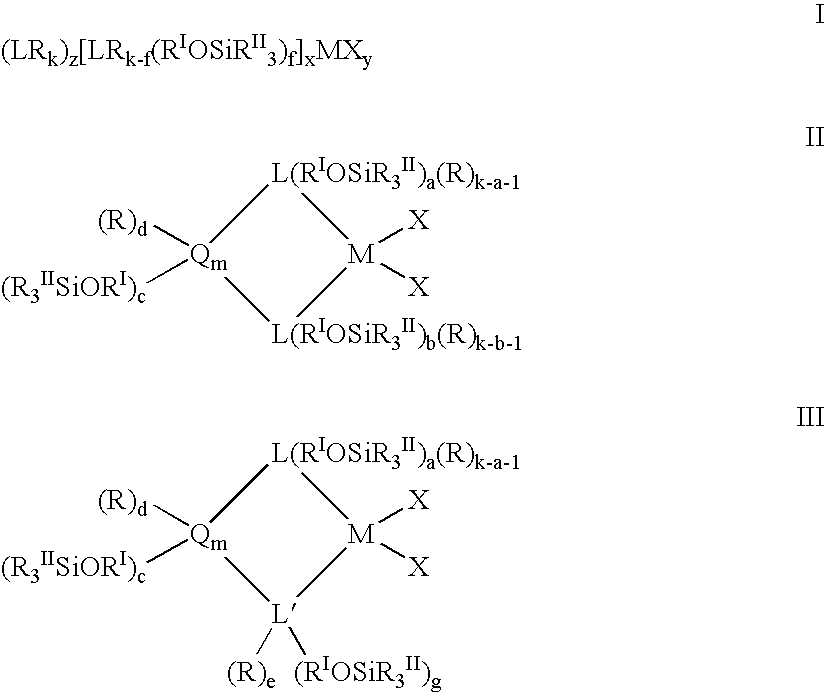
The invention relates to heterogeneous catalytic systems obtainable by reacting a porous inorganic support with an alumoxane and subsequently supporting at least one metallocene compound thereon, characterized in that the metallocene compound is defined by the following general formulas: wherein: L, equal to or different from each other, is selected from the group comprising: cyclopentadienyl, indenyl, tetrahydroindenyl, fluorenyl, octahydrofluorenyl or benzoindenyl; each R is independently selected from hydrogen, C1-C20 alkyl, C3-C20 cycloalkyl, C6-C20 aryl, C3-C20 alkenyl, C7-C20 arylalkyl, C7-C20 alkylaryl, C8-C20 arylalkenyl, linear or branched, optionally substituted by 1 to 10 halogen atoms, or a group SiR<II>3; each R, equal to or different from each other, is a divalent aliphatic or aromatic hydrocarbon group containing from 1 to 20 carbon atoms, optionally containing from 1 to 5 heteroatoms of groups 14 to 16 of the periodic table of the elements and boron ; preferably it is: C1-C20 alkylene, C3-C20cycloalkylene, C6-C20 arylene, C7-C20 alkenyl, C7-C20 arylalkylene, or alkylarylene, linear or branched, or a group SiR<II>2; each R<II >is independently selected from C1-C20 alkyl , C3-C20 cycloalkyl, C6-C20 aryl, C3-C20 alkenyl, C7-C20 arylalkyl, C8-C20 arylalkenyl or C7-C20 alkylaryl, linear or branched; preferably R<II >is methyl, ethyl, isopropyl; each Q is independently selected from B, C, Si, Ge, Sn; M is a metal of group 3, 4 or 10 of the Periodic Table, Lanthanide or Actinide; preferably it is titanium, zirconium or hafnium; each X is independently selected from: hydrogen, chlorine, bromine, OR<II>, NR<II>2, C1-C20 alkyl or C6-C20 aryl; L&p

Description

[0001] The present invention relates to a heterogeneous catalytic system and its use in olefin polymerization.STATE OF THE ART[0002] It is very well known that homogeneous catalytic systems present a disadvantage: when they are used in suspension polymerization processes, a part of the produced polymer adheres to the reactor walls; this effect is technically called "reactor fouling". Besides, in most cases, the particle size of the obtained polymer is very small and the bulk density is low, thus the industrial production is reduced. In order to prevent the reactor from fouling and to control the size and the morphology of the polymer particles which are formed, the homogeneous system can be supported on an inorganic oxide.[0003] In the last years different preparatory strategies have been used in order to reach this aim. EPA-206794 (Exxon) discloses a catalyst which comprises a carrier, a metallocene, and an alumoxane. The carrier is first treated with alumoxane and then the metallo...

Claims

the structure of the environmentally friendly knitted fabric provided by the present invention; figure 2 Flow chart of the yarn wrapping machine for environmentally friendly knitted fabrics and storage devices; image 3 Is the parameter map of the yarn covering machine
Login to View More

Application Information

Patent Timeline
no application Login to View More
IPC IPC(8): C08F4/619C08F4/6192C08F4/642C08F4/659C08F4/6592C08F10/00C08F110/02C08F210/16
CPCC08F4/61912C08F4/61922C08F10/00C08F110/02C08F210/16Y10S526/943C08F4/61916C08F2500/03C08F2500/18C08F210/14
Inventor MUNOZ-ESCALONA LAFUENTE, ANTONIOCANAS, PILAR LAFUENTEROYO, JOSE SANCHOGARCIA, BEGONA PENAMARCOS, CARLOS MARTIN
Owner REPSOL QUIMICA
Features
  • R&D
  • Intellectual Property
  • Life Sciences
  • Materials
  • Tech Scout
Why Patsnap Eureka
  • Unparalleled Data Quality
  • Higher Quality Content
  • 60% Fewer Hallucinations
Social media
Patsnap Eureka Blog
Learn More