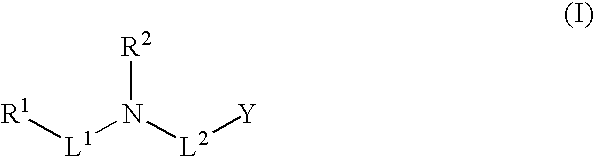
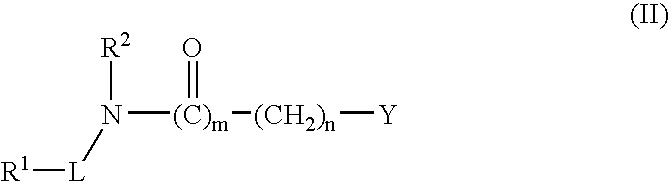
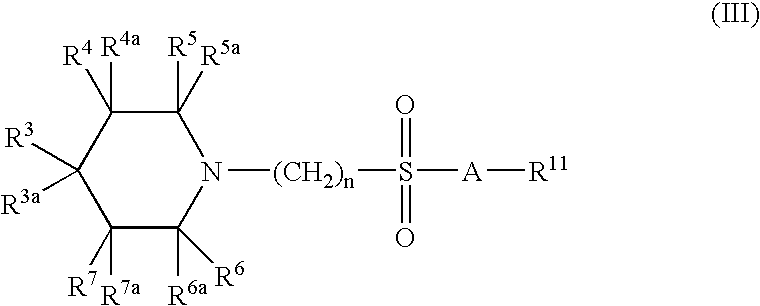
The present invention relates to the use of certain compounds in the treatment of amyloid-related diseases. In particular, the invention relates to a method of treating or preventing an amyloid-related disease in a subject comprising administering to the subject a therapeutic amount of a compound of the invention. The invention also pertains to each of the novel compounds of the invention as described herein. Among the compounds for use in the invention are those according to the following Formulae, such that, when administered,
amyloid fibril formation,
organ specific dysfunction (e.g.,
neurodegeneration), or cellular
toxicity is reduced or inhibited.
In one embodiment, the compounds disclosed herein prevent or inhibit amyloid
protein assembly into insoluble fibrils which,
in vivo, are deposited in various organs, or it favors clearance of pre-formed deposits or slows deposition in patients already having deposits. In another embodiment, the compound may also prevent the amyloid
protein, in its soluble, oligomeric form or in its fibrillar form, from binding or adhering to a
cell surface and causing
cell damage or
toxicity. In yet another embodiment, the compound may block amyloid-induced cellular
toxicity or macrophage activation. In another embodiment, the compound may block amyloid-induced
neurotoxicity or microglial activation. In another embodiment, the compound protects cells from amyloid induced
cytotoxicity of B-
islet cells. In another embodiment, the compound may enhance clearance from a specific organ, e.g., the brain or it decreases concentration of the amyloid
protein in such a way that
amyloid fibril formation is prevented in the targeted organ.
The compounds of the invention may be administered therapeutically or prophylactically to treat diseases associated with
amyloid fibril formation, aggregation or deposition. The compounds of the invention may act to ameliorate the course of an amyloid related disease using any of the following mechanisms (this
list is meant to be illustrative and not limiting): slowing the rate of amyloid
fibril formation or deposition; lessening the degree of
amyloid deposition; inhibiting, reducing, or preventing amyloid
fibril formation; inhibiting
neurodegeneration or cellular toxicity induced by amyloid; inhibiting amyloid induced
inflammation; enhancing the clearance of amyloid; or favoring the degradation of amyloid protein prior to its organization in fibrils.
The compounds of the invention may be administered therapeutically or prophylactically to treat diseases associated with amyloid-β
fibril formation, aggregation or deposition. The compounds of the invention may act to ameliorate the course of an amyloid-β related disease using any of the following mechanisms (this
list is meant to be illustrative and not limiting): slowing the rate of amyloid-β
fibril formation or deposition; lessening the degree of amyloid-β deposition; inhibiting, reducing, or preventing amyloid-β
fibril formation; inhibiting
neurodegeneration or cellular toxicity induced by amyloid-β; inhibiting amyloid-β induced
inflammation; enhancing the clearance of amyloid-β from the brain; or favoring the degradation of amyloid-β protein prior to its organization in fibrils.
Therapeutic compounds of the invention may be effective in controlling amyloid-β deposition either following their entry into the brain (following penetration of the
blood brain barrier) or from the periphery. When acting from the periphery, a compound may alter the equilibrium of Aβ between the brain and the
plasma so as to favor the exit of Aβ from the brain. It may also increase the
catabolism of neuronal Aβ and change the rate of exit from the brain. An increase in the exit of Aβ from the brain would result in a decrease in Aβ brain and
cerebrospinal fluid (CSF) concentration and therefore favor a decrease in Aβ deposition. Alternatively, compounds that penetrate the brain could control deposition by acting directly on brain Aβ e.g., by maintaining it in a non-fibrillar form, favoring its clearance from the brain, or by slowing down APP
processing. These compounds could also prevent Aβ in the brain from interacting with the
cell surface and therefore prevent
neurotoxicity, neurodegeneration or
inflammation. They may also decrease Aβ production by activated
microglia. The compounds may also increase degradation by macrophages or neuronal cells.


 Login to View More