
Utilization of phosphorus pentasulfide in thionylations using phase transfer catalysis
a technology of phosphorus pentasulfide and thionylation, which is applied in the field of improved utilization of phosphorus pentasulfide in thionylation using phase transfer catalysis, can solve the problems of failure to work for 2-benzo[b]thiophenecarboxylic acid, and achieve excellent yield and quality
- Summary
- Abstract
- Description
- Claims
- Application Information
AI Technical Summary
Benefits of technology
Problems solved by technology
Method used
Image

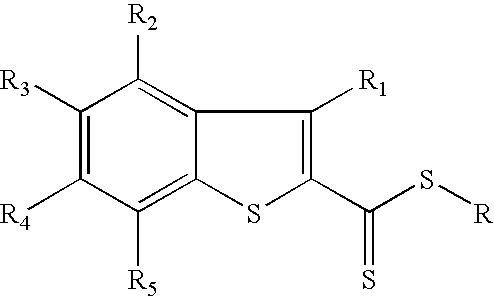
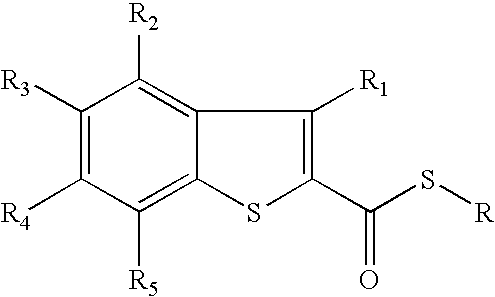
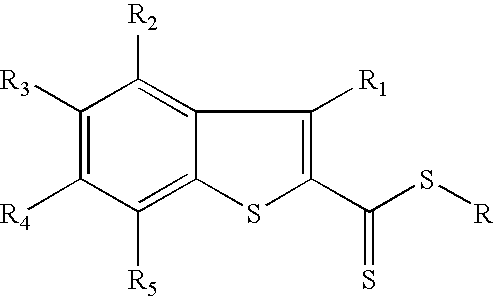
Examples
example 1
Preparation of Ethyl 2-benzo[b]thiophenecarbodithioate
Under nitrogen, a mixture of phosphorus pentasulfide (2.22 grams, 0.01 mol) and potassium carbonate (2.76 grams) in toluene (40 mL) was stirred and refluxed for one hour. After cooling to 70° C., S-ethyl 2-benzo[b]thiophenecarbothioate, (EBCT), (6.11 grams, 0.0275 mol), benzyltriethylammonium chloride, (TEBA), (0.165 gram, 7.2×10⁻⁴ mol) and water (90 μL) were added and gradually heated to 105° C. An exotherm was observed at around 90-100° C. and the reaction temperature was controlled and finally maintained at 105° C. and held for 2 hours. Periodically, the reaction was monitored by thin layer chromatography (TLC) using CH2Cl2:hexane, 40:60 for vanishing EBCT substrate. The reaction was complete after a further one hour. The reaction mixture was cooled to ambient temperature, spent P2S5 was removed by filtration, the filtrate was washed with toluene, and the combined toluene solutions were washed with aqueous sodium bicarbonate...
example 2
Under nitrogen, a mixture of potassium carbonate (14.60 grams) and P2S5 (11.80 grams, 0.053 mol) was stirred and brought to gentle reflux and maintained as such for one hour. The reaction mixture was cooled to 62.1° C. and charged with a mixture of 33.37% EBCT toluene solution (97.30 grams, 89.2%, 0.13 mol), water (0.38 gram) and TEBA (0.80 gram, 3.5 mmol). With stirring, the reaction mixture was gradually heated to reflux. At 98.5° C. a slight exotherm was noted and the reaction was allowed to remain at reflux. TLC (CH2Cl2:hexane, 40:60) showed that after a post reaction time of 2 hours and 50 minutes the reaction was almost complete. After cooling to ambient temperature, the reaction mixture was filtered, the filtrate was washed with toluene (55 mL) and the combined toluene solutions were washed with 7% aqueous sodium bicarbonate solution (1×25.4 gram and 1×11.3 gram). Removal of the toluene left technical EBCT, 33.34 grams, HPLC analysis gave EBCT, 2% and EBCD, 92.43%.
example 3
Example 2 was repeated except that water was omitted from the reaction. After a post reaction time of four hours, TLC indicated the reaction was only about 60% complete. The reaction was stopped and the product isolated as in Example 2. HPLC analysis gave EBCT, 28.3% and EBCD, 62.2%.
PUM
| Property | Measurement | Unit |
|---|---|---|
| boiling | aaaaa | aaaaa |
Abstract
Description
Claims
Application Information
 Login to View More