
Microfluidic apparatus and method for synthesis of molecular imaging probes
a molecular imaging and microfluidic technology, applied in the field of microfluidic devices and methods for chemical synthesis, to achieve the effect of promoting faster synthesis times and higher synthesis yields
- Summary
- Abstract
- Description
- Claims
- Application Information
AI Technical Summary
Benefits of technology
Problems solved by technology
Method used
Image

Examples
example 1
Radiochemical Synthesis of [18F]fluoroethyl tosylate
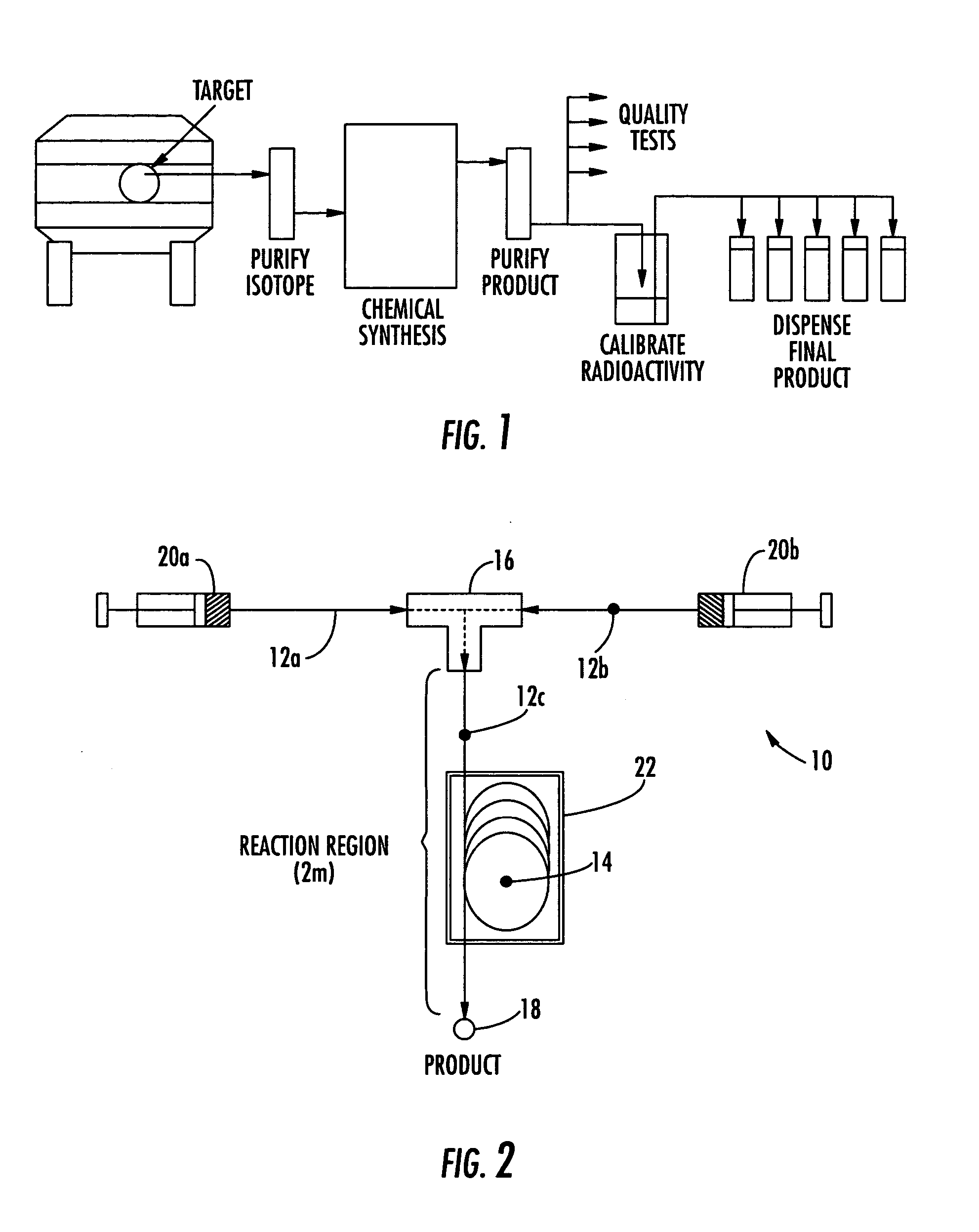
[0123] An embodiment of the micro reactor of the invention, which is shown in FIG. 2, was constructed using fused silica capillary tubing (360 μm OD×100 μm ID) and Microtight® fittings (Upchurch Scientific). Two pieces of capillary tubing exactly 25 cm long were attached to the opposite sides of a MicroTee (Part No. P-775, Upchurch Scientific, 150 μm thru-holes, 29 nL swept volume) and a third piece of capillary tubing 2 m long was attached to the remaining orthogonal position on the MicroTee. The chemical and radiochemical reagents were introduced into and moved through the reactor using a syringe pump (Harvard PHD 2000) and two 1 mL polypropylene syringes. A central 125 cm portion of the 2 m reaction channel was formed into four 10 cm diameter loops that were secured together. This section of four loops was placed in a water bath that was heated to 65-70° C. The output end of the reaction channel was placed into a small test tub...
example 2
Radiochemical synthesis of 2-deoxy-2-[18F]fluoro-1,3,4,6-tetra-O-acetyl-β-D-glucose
[0126] Using the same micro reactor apparatus described in Example 1 above, a solution of mannose triflate (4.4 mg, 9.2 μmol)) in acetonitrile (140 μL) was loaded into a 1 μL syringe. An anhydrous solution of [18F] fluoride ion (210 mCi) in 140 μL of acetonitrile (prepared as described in Example 1 above) was transferred to a second 1 μL syringe. Once the two syringes were loaded with equal volumes of reagent solution, the syringe pump was started at a flow rate of 4 μL / min. After 1 minute the flow rate was changed to 1.0 μL / min. The two solutions were pumped through the 2 m reaction channel that included the 125 cm portion heated to 65-70° C. over a period of 100 minutes. After about 100 minutes, the collected product solution was analyzed by radioTLC (silica gel, ether). In addition to unreacted [18F] fluoride ion at Rf=0.0, the desired radiofluorinated product was detected at Rf=0.65.
example 3
Radiochemical synthesis of 2-deoxy-2-[18F]fluoro-1,3,4,6-tetra-O-acetyl-β-D-glucose
[0127] [18F] fluoride ion in acetonitrile was prepared by the following method: [18O] water was irradiated with 11 MeV protons. At the end of bombardment the [18O] water was transferred through a Waters QMA Light anion exchange cartridge to trap the [18F] fluoride ion. The [18F] fluoride ion was then released from the resin column using 1.0 mL of potassium carbonate (5.5 mg) in a solution of 97.5% acetonitrile / 2.5% water by weight. This mixture was delivered in to a 20 mL glass vial where an additional 9 mL of dry acetonitrile was added. This resulted in a [18F] fluoride solution containing 0.25% water in acetonitrile by weight.
[0128] A micro reactor system was constructed using a microchip having a T-shaped microchannel with two inlet ports and an outlet port. Using a Hamilton Company, having an address of 4970 Energy Way, Reno, Nev. 89502, syringe system comprising SGE gas tight syringe needles, a...
PUM
| Property | Measurement | Unit |
|---|---|---|
| Temperature | aaaaa | aaaaa |
| Fraction | aaaaa | aaaaa |
| Capacitance | aaaaa | aaaaa |
Abstract
Description
Claims
Application Information
 Login to View More