As stated previously, the brain's
neurotransmission system is quite complex, featuring large numbers of interrelationships of neurotransmitters, pro-neurotransmitters, amino-acids, minerals, vitamins, and metabolites of these, all acting simultaneously on various different areas of the brain.
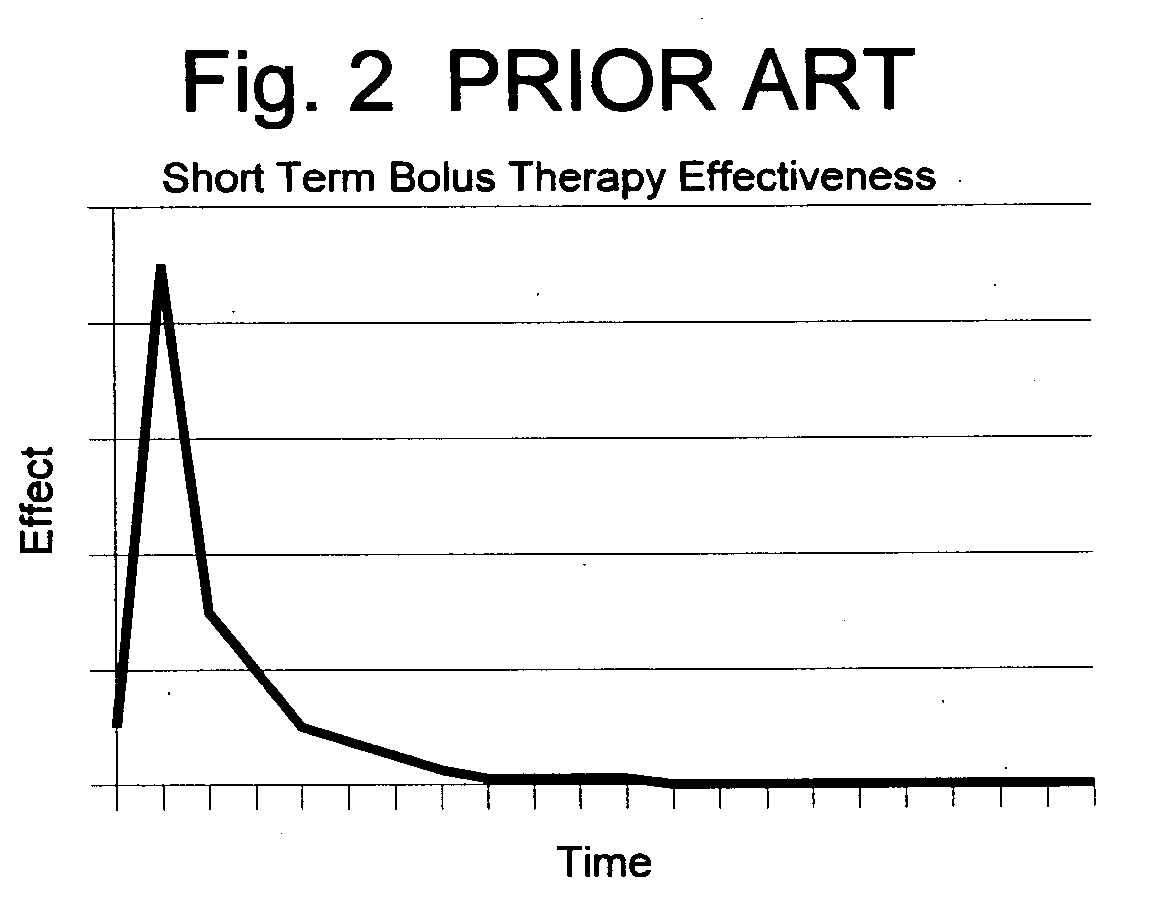
While the net effect is a theoretical improvement of the area under the chart (instantaneous effectiveness as function of instantaneous concentration, integrated over time), the presence of the spikes makes the likelihood of systemic overload more likely.
The
poor nutrition of substance abusers is believed to negatively
impact the ability of active agents to cross the blood / brain barrier.
Tryptophan, for example, has a
lower affinity than other amino-acids for the
protein which carries the amino-acids across the blood / brain barrier, and furthermore the
poor nutrition of many substance abusers tends to result in a comparatively low concentration of
tryptophan in the blood in any case.
One final barrier to effective use of anti-craving medications is not premised upon the state of the patient's health but rather upon the practicality of administration of the medication.
When providing multiple medical agents to patients, the greater the number of components to be administered, more difficulty in administration, the greater the resistance of the patient to the therapy, and the greater the commitment of health-care professional time necessary to begin the administration of them.
When the number of solutions rises to a dozen or more, the result can be forcing the patient to endure an extended span of time hooked to an IV tube and bag just to receive a regular
dose of medication.
Different active ingredients may react with each other in unpredictable ways inside the vials of medication during storage.
A sister problem with multiple agent formulas is
chelation, that is, metallization of another product such as a carbon-based molecule.
The resulting precipitated or combined or
metal-organic chemical or salt usually no longer has the desired medicinal properties, may no longer be suitable (small enough) to pass through the cannula of the IV needle, and may even be dangerous to the patient if administered.
For these reasons, it is a further challenge in this area to select and group active agents which can be safely combined and conveniently stored with a minimized risk of
chelation or other undesirable reactions.
Glucose and
fructose solutions are not feasible for use in administering via IV drip multiple amino-acid medicines.
Second,
fructose and glucose act much like
calcium does, driving amino-acids into the
muscle tissues rather than across the blood / brain barrier, and furthermore this undesirable activity is promoted by the presence of
chromium and
niacin, which are important agents for other reasons.
Thus a
saline solution is preferred, which in turn means that osmolarity of the IV solution becomes an issue as a result of the desire for a minimal number of components, at one component per
vial, necessary for the administration.
Unfortunately, due to the fact that many substance abusers self-administer numerous injections, resulting in a potential difficulty in location of a suitable
peripheral vein, it is entirely conceivable that in the clinical setting a
central venous catheter may nonetheless be required.
A further important issue which arises form the improved selection process for the agents in anti-craving medications is the criteria for exclusion of potentially beneficial agents by reason of the negative effects on the
efficacy of the overall medication.
Of course, the original limitation remains in place: the ingredients selected must provide an effective anti-craving medication when they finally reach the brain.
Racemic
phenylalanine may exhibit unpredictable and undesirable properties, such as covalent bonding, at the same concentrations.
Excess amounts may even suppress enzymatic functions rather than promote them.



 Login to View More