Check patentability & draft patents in minutes with Patsnap Eureka AI!

Glycan analysis using deuterated glucose

Inactive Publication Date: 2006-06-08
TARGET DISCOVERY
View PDF17 Cites 62 Cited by
  • Summary
  • Abstract
  • Description
  • Claims
  • Application Information

AI Technical Summary

Benefits of technology

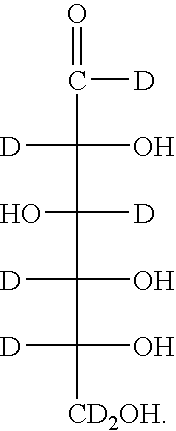
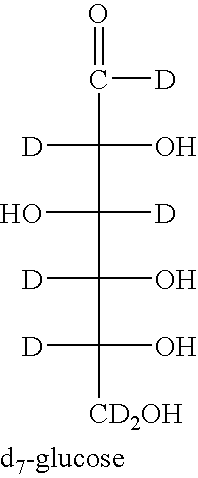
[0009] In some embodiments, the method involves administering a substrate (e.g. a D7-glucose D7-glucose/H7-glucose mixture, or composition including a D7-glucose/H7-glucose mixture) to a subject, where the relative ratio of D7-glucose to H7-glucose is known prior to administration. The subject is then allowed sufficient time to at least partially metabolize the substrate to form one or more target metabolites. The abundance

Problems solved by technology

Quality control of glycosylation patterns of recombinant drugs is a critical issue because of the potential for pyrophoric reactions and inactivity of the resultant drug product.
However, many biomarker assays are not specific for a given disease or progression of that disease without the aid of additional confirmatory methods, such as invasive biopsy, expensive imaging (MRI), or the requirement of a more time-consuming battery of diagnostic tests.
One of the issues that contributes to this lack of specificity and accuracy for any given assay is the fact that glycoforms of a biomarker may exist that are functionally- or clinically-relevant but are not identified by the methodology used to interrogate the biomarker status.
Current glycomic methods suitable for both sequence and structure determination are very laborious, time and sample consuming.
Structural analysis has been performed by mass spectrometric fragmentation analysis, but no method has yet been reported that can determine all of the linkages and branching patterns of a complex branched oligosaccharide.

Method used

the structure of the environmentally friendly knitted fabric provided by the present invention; figure 2 Flow chart of the yarn wrapping machine for environmentally friendly knitted fabrics and storage devices; image 3 Is the parameter map of the yarn covering machine
View more

Image

Smart Image Click on the blue labels to locate them in the text.
Viewing Examples
Smart Image
  • Glycan analysis using deuterated glucose
  • Glycan analysis using deuterated glucose
  • Glycan analysis using deuterated glucose

Examples

Experimental program
Comparison scheme
Effect test

example 1

[0213] The yeast (ATCC Saccharomyces cerevisiae wild type) were grown in Yeast Nitrogen Base (Sigma-Aldrich) spiked with either D7-D-glucose (Isotec) or normal D-glucose to a final concentration of 0.1 g / mL. The cultures were incubated at 30° C. to confluence and harvested by centrifugation. Exoglucanase is secreted into the growth media was recovered from the supernatant after trichloroacetic acid precipitation, resuspended, and purified from the other exoglucanase isoforms by established HPLC methods. See Larriba et al., Biomol. Eng. 18:132-42 (2001).

[0214] Carboxypeptidase Y was recovered in the cell pellet, which was lysed using the Y-PER™ Yeast Protein Extraction Reagent (Pierce). Carboxypeptidase Y was affinity purified from the Y-PER lysate using the commercially-available mAb attached to an AminoLink column (Pierce) following the manufacturer's protocols.

[0215] The glycans from each of these glycopeptides were recovered from the purified model proteins by cleavage with PNG...

example 2

[0216] An optimal mass defect tag is formulated for sequencing and characterization of complex oligosaccharides using in-source fragmentation in an ESI-TOF mass spectrometer. The linkage chemistry is designed for efficient attachment to the reducing end of the oligosaccharide (i.e., the free aldehyde). A mass defect label for conjugation to the reducing end of an oligosaccharide is designed with consideration of four general attributes: an element from the periodic table with a significant mass defect, a basic site for protonation for positive-ion mode mass spectral ionization, stability to MS fragmentation (i.e., the label withstands the energy needed to fragment the glycosidic bonds), and an appropriate linking moiety to the reducing end aldehyde.

example 2.1

[0217] Mass defect tags having an aromatic bromides are advantageous due to a natural 50:50 isotope pair (79Br and 81Br), which provides redundancy in the mass spectrum and improves the ability to resolve the mass defect spectrum because of peak pairing.

TABLE 3Mass Defect Tags with Aromatic BromidesCompoundReactivityAlready SynthesizedIAmineIIIIISulfhydrylVI

[0218] A primary amino group is included into the tag for conjugation to the reducing end aldehyde by reductive amination. Incorporation has been demonstrated for numerous UV-absorbent tags such as 2-aminobenzamide and 4-aminobenzoic acid methyl ester into mono- and oligo-saccharides by reductive amination. See Harvey, J. Am. Soc. Mass Spectrom., 11:900-915 (2000). The resulting linkage (a secondary amine) is very stable to mass spectrometric fragmentation conditions, and it provides a basic site for protonation in positive-ion mode ESI mass spectrometry.

[0219] Table 4 shows some initial targets for a mass tag. Compound V is c...

the structure of the environmentally friendly knitted fabric provided by the present invention; figure 2 Flow chart of the yarn wrapping machine for environmentally friendly knitted fabrics and storage devices; image 3 Is the parameter map of the yarn covering machine
Login to View More

PUM

PropertyMeasurementUnit
Massaaaaaaaaaa
Atomic numberaaaaaaaaaa
Defectsaaaaaaaaaa
Login to View More

Abstract

Novel methods and apparatuses are provided for use in identifying glucose metabolic products and determining metabolic flux by administering D7-glucose to a subject.

Description

CROSS-REFERENCES TO RELATED APPLICATIONS [0001] This application claims the benefit of U.S. Provisional Patent Application No. 60 / 623,521, filed Oct. 29, 2004, which is incorporated herein by reference in its entirety for all purposes.BACKGROUND OF THE INVENTION [0002] Glycosylation patterns (including sequence and branching structure) are important for many biological reasons. The sialic acid content of glycosylated plasma proteins is a biological indicator for clearance. See Chitlaru, et al., Biochem. J., 336:647-658 (1998); Millar, Atherosclerosis, 154:1-13 (2001). Glycosylation differences of red blood cell surface proteins is critical for triggering the immune response to different blood types. Glycoproteins are also being pursued as drug products (e.g., full-length glycosylated recombinant thrombopoietins). See Haznedaroglu, et al., Clin. Appl. Thromb. Hemost., 8:193-212 (2002). Glycosylation of cell surface proteins have a predominant role in cell-cell and cell-substratum rec...

Claims

the structure of the environmentally friendly knitted fabric provided by the present invention; figure 2 Flow chart of the yarn wrapping machine for environmentally friendly knitted fabrics and storage devices; image 3 Is the parameter map of the yarn covering machine
Login to View More

Application Information

Patent Timeline
no application Login to View More
IPC IPC(8): A61K49/00G01N33/00
CPCA61K49/0004A61K51/0491G01N33/574G01N33/58G01N33/6848G01N2400/00
Inventor SCHNEIDER, LUKE V.HALL, MICHAEL P.
Owner TARGET DISCOVERY
Features
  • R&D
  • Intellectual Property
  • Life Sciences
  • Materials
  • Tech Scout
Why Patsnap Eureka
  • Unparalleled Data Quality
  • Higher Quality Content
  • 60% Fewer Hallucinations
Social media
Patsnap Eureka Blog
Learn More