
Antibodies recognizing methyllysine, process for producing the same and utilization thereof
a technology of methyllysine and antibody, applied in the field of antibodies, can solve the problems of poor ability to recognize methylated proteins other than histones, antibody can only recognize dimethyllysine, and no great advance in the study of questions
- Summary
- Abstract
- Description
- Claims
- Application Information
AI Technical Summary
Benefits of technology
Problems solved by technology
Method used
Image

Examples
example 1
Preparation of Anti-Methyllysine Mouse Monoclonal Antibody-Producing Hybridomas
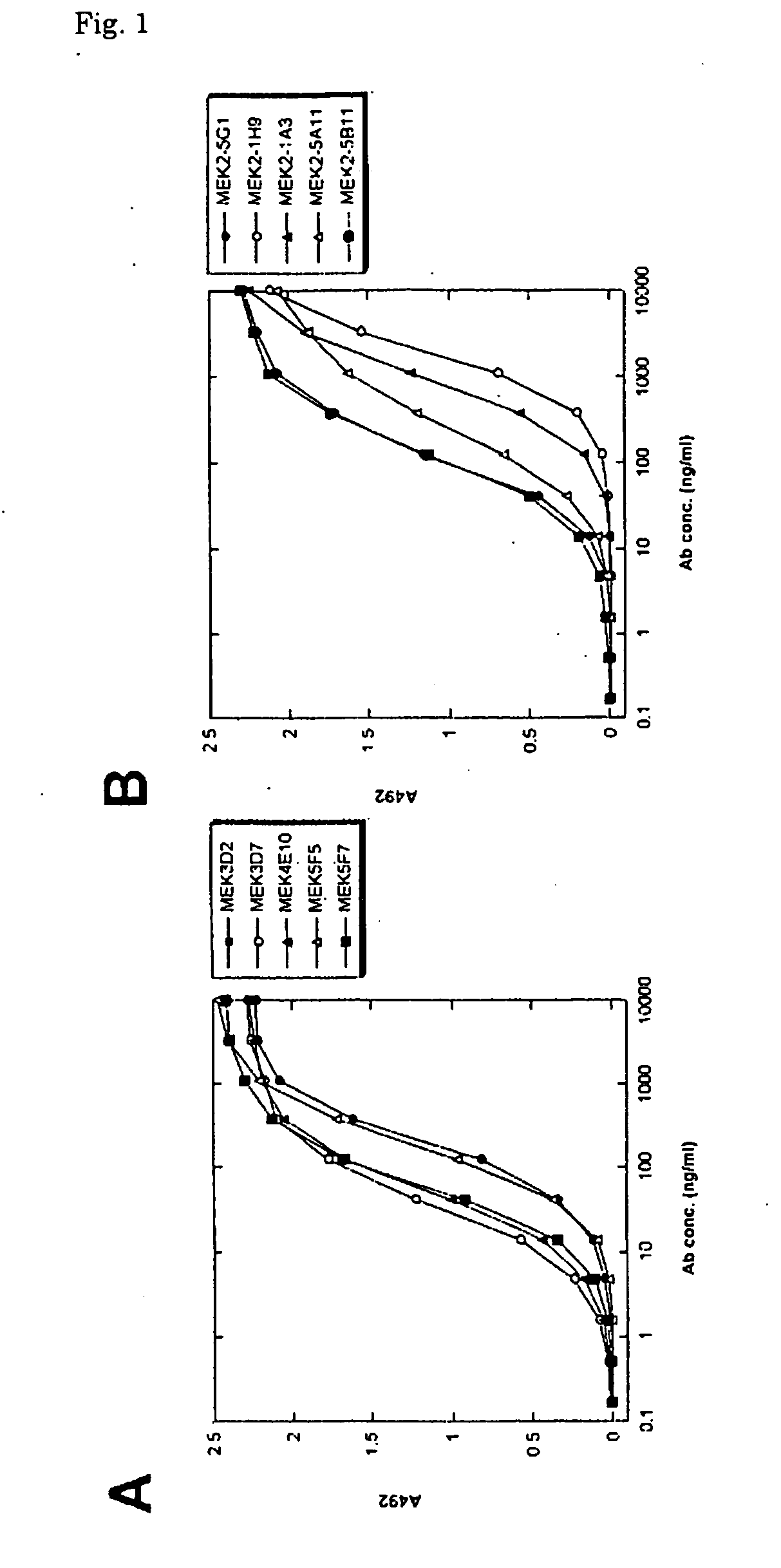
[0034] Anti-methyllysine mouse monoclonal antibody-producing hybridomas exemplified by MEK3D7, MEK4E10, MEK5F7, MEK2-5A11 and MEK2-5B11 were prepared by the following method.
[0035] These hybridomas have been deposited with International Patent Organisms Depository, National Institute of Advanced Industrial Science and Technology, Japan under Accession Nos. FERM P-19595, FERM P-19596, FERM P-19597, FERM P-19593 and FERM P-19594 respectively since Nov. 21, 2003, then applied for transfer to international deposition and has been deposited under FERM ABP-10168, FERM ABP-10169, FERM ABP-10170, FERM ABP-10166 and FERM ABP-10167 respectively since Dec. 1, 2004.
[0036] Mouse immunization was carried out in the following manner. A methylated KLH solution and TiterMax Gold (CytRx Ltd.) were mixed at a ratio of 1:1 and then formed into an emulsion by passing the mixture repeatedly through an interchange joint for...
example 2
Preparation of Anti-Methyllysine Rabbit Polyclonal Antibodies
[0041] The anti-methyllysine rabbit polyclonal antibodies were prepared in the following procedure. Two rabbits (Japanese female white species) were immunized with the methylated KLH in a dose of 0.15 mg / rabbit in first immunization and in a dose of 0.3 mg / rabbit in second to fifth immunization. The back of the rabbit was administered subcutaneously with the methylated KLH as an emulsion with Freund complete adjuvant in the first immunization and as an emulsion with Freund incomplete adjuvant in the second and subsequent immunization. The immunization was conducted at 2-week intervals, and 1 week after the final immunization, whole blood was collected to prepare antiserum. 118 ml antiserum was obtained in total from the two rabbits.
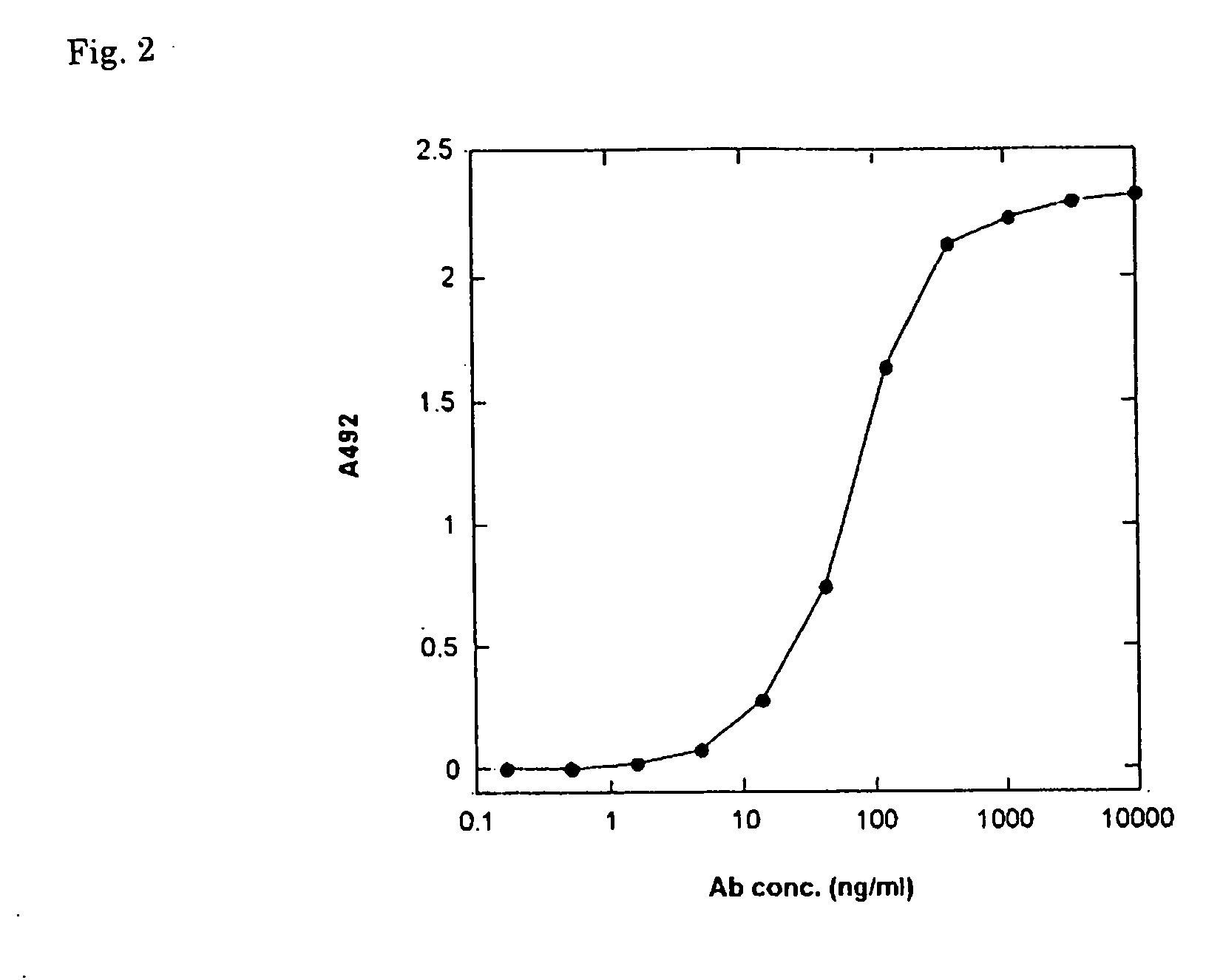
[0042]FIG. 2 shows the results of the reactivity, determined by ELISA, of the purified anti-methyllysine rabbit polyclonal antibodies to the immobilized methylated BSA. The antibodies certain...
example 3
Purification of the Anti-Methyllysine Antibodies by an Affinity Column
[0043] The polyclonal antibody-containing antiserum was purified by an affinity column having a methylated protein immobilized thereon.
[0044] The affinity column having a methylated protein immobilized thereon was prepared by the following method. First, a carrier having BSA immobilized thereon was prepared in a first step. For immobilization, an Aminolink Immobilization kit available from Pierce was used. 2 ml agarose carrier activated with aldehyde was equilibrated with 5 ml coupling buffer, and then 10 mg BSA dissolved in 2 ml coupling buffer was added. 200 μl reductant solution was added and the BSA was bound to the carrier at room temperature for 6 hours. The carrier was washed with 5 ml coupling buffer, then 5 ml of 1 M ethanolamine was added thereto, and after 200 μl reductant solution was added, the mixture was reacted at room temperature for 30 minutes. After the reaction was finished, the carrier was ...
PUM
| Property | Measurement | Unit |
|---|---|---|
| Reactivity | aaaaa | aaaaa |
| Affinity | aaaaa | aaaaa |
Abstract
Description
Claims
Application Information
 Login to View More