Plasma reactor with wide process window employing plural vhf sources
What is AI technical title?
AI technical title is built by PatSnap AI team. It summarizes the technical point description of the patent document.
a plasma reactor and process window technology, applied in the direction of electric discharge tubes, chemical vapor deposition coatings, coatings, etc., can solve the problems of radial transmission line effects and loading of the ceiling electrode, process non-uniformities at the wafer surface, and worsening the non-uniformity of the rf field, etc., to achieve the effect of sufficient capacity
Inactive Publication Date: 2008-07-31
APPLIED MATERIALS INC
View PDF12 Cites 34 Cited by
Summary
Abstract
Description
Claims
Application Information
AI Technical Summary
This helps you quickly interpret patents by identifying the three key elements:
Problems solved by technology
Method used
Benefits of technology
Benefits of technology
[0003]Various approaches are employed to reduce such undesirable effects. In one approach, magnetic steering may be employed to alter the plasma ion distribution, e.g., to reduce its center-high non-uniformity to produce a somewhat flatter distribution. One problem with this approach is that a center-high non-uniformity of the source may be beyond the corrective capability of magnetic steering. Another problem with this approach can be electrical charging damage of the workpiece if the magnetic flux density is too high. In another approach, the plasma sheath (or bias) voltage is increased by applying more plasma RF bias power to the wafer. This has the effect of increasing the plasma sheath thickness which in turn typically decreases the capacitance across the ceiling-plasma sheath as well as the capacitance across the wafer-plasma sheath, thereby forming three capacitors in series, including the ceiling sheath capacitance, the plasma capacitance and the wafer sheath capacitance. The net effect is to reduce the effect of the dielectric constant of the plasma, thereby reducing the non-uniformity of the RF field. The high bias voltage required in some oxide etch plasma process recipes is compatible with this latter approach. However, a high plasma bias voltage is not desirable in some other types of plasma processes. The worst non-uniformities appear in processes employing the lowest plasma bias voltage.
Problems solved by technology
One problem inherent in such a plasma source is that the ceiling electrode exhibits radial transmission line effects and loading due to the effective dielectric constant of the plasma.
Therefore, the RF field varies significantly across the surface of the ceiling electrode, giving rise to process non-uniformities at the wafer surface.
For a plasma with an effective dielectric constant greater than 1, the effective wavelength is reduced to less than the ceiling electrode diameter, worsening the non-uniformity of the RF field, making processing non-uniformities across the wafer surface worse.
For an etch process, this may produce a non-uniform edge low etch rate distribution across the wafer surface.
One problem with this approach is that a center-high non-uniformity of the source may be beyond the corrective capability of magnetic steering.
Another problem with this approach can be electrical charging damage of the workpiece if the magnetic flux density is too high.
The net effect is to reduce the effect of the dielectric constant of the plasma, thereby reducing the non-uniformity of the RF field.
However, a high plasma bias voltage is not desirable in some other types of plasma processes.
The worst non-uniformities appear in processes employing the lowest plasma bias voltage.
Such approaches are complicated by the fact that other process conditions dictated by the process recipe have as great an effect upon plasma distribution as either magnetic steering or bias (sheath) voltage.
Method used
the structure of the environmentally friendly knitted fabric provided by the present invention; figure 2 Flow chart of the yarn wrapping machine for environmentally friendly knitted fabrics and storage devices; image 3 Is the parameter map of the yarn covering machine
View more
Image
Smart Image Click on the blue labels to locate them in the text.
Viewing Examples
Smart Image
Click on the blue label to locate the original text in one second.
Reading with bidirectional positioning of images and text.
Smart Image
Examples
Experimental program
Comparison scheme
Effect test
Embodiment Construction
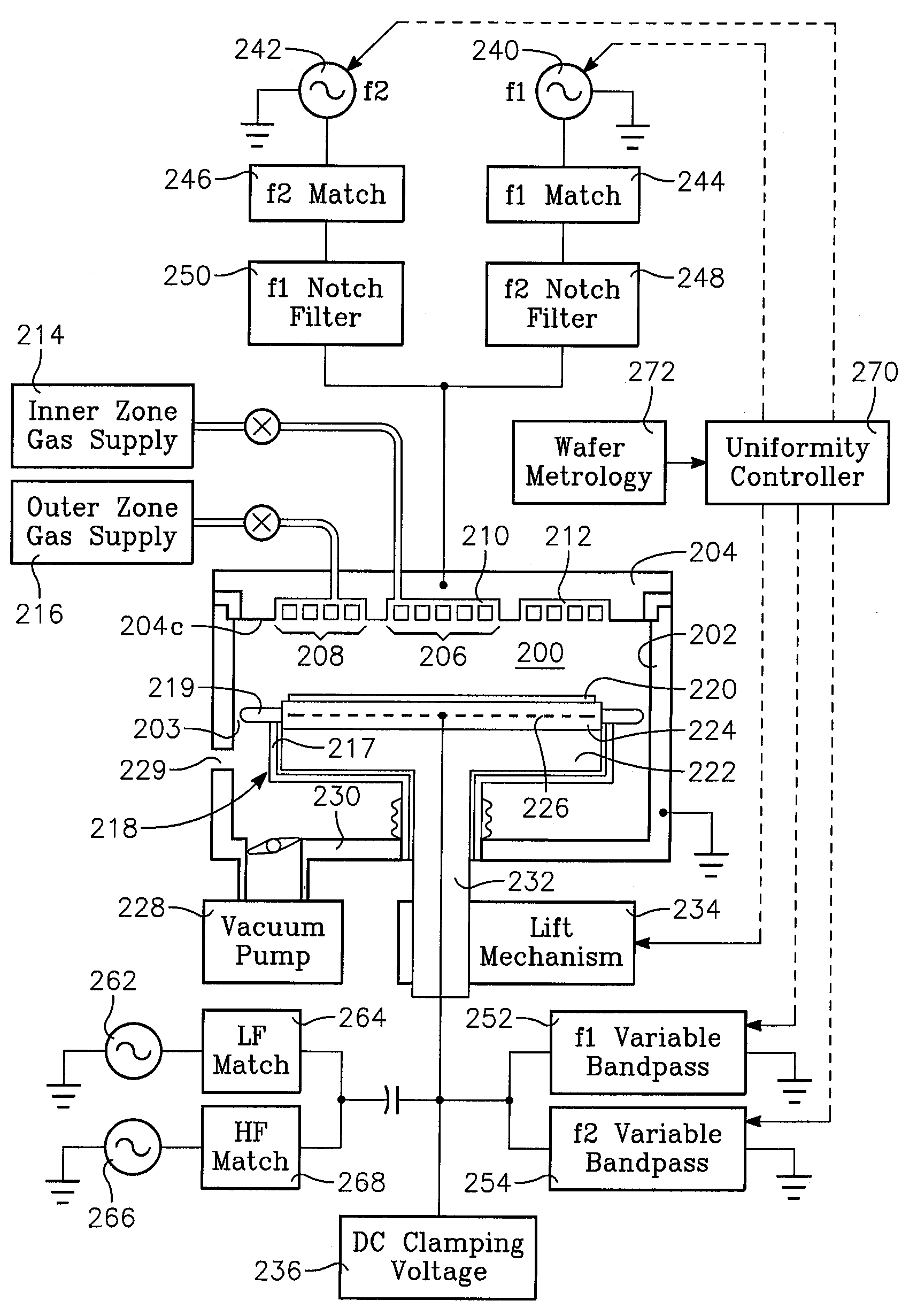
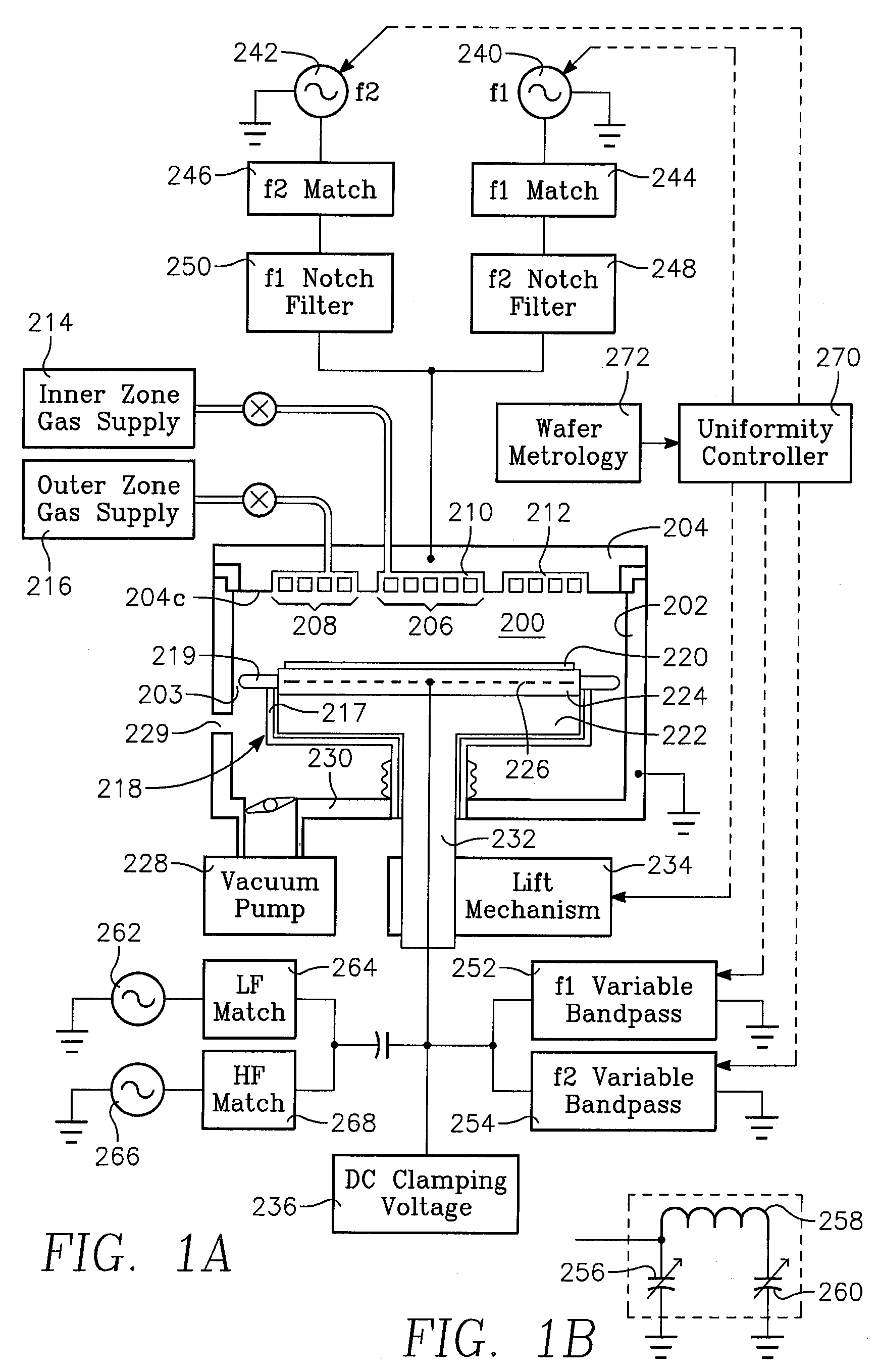
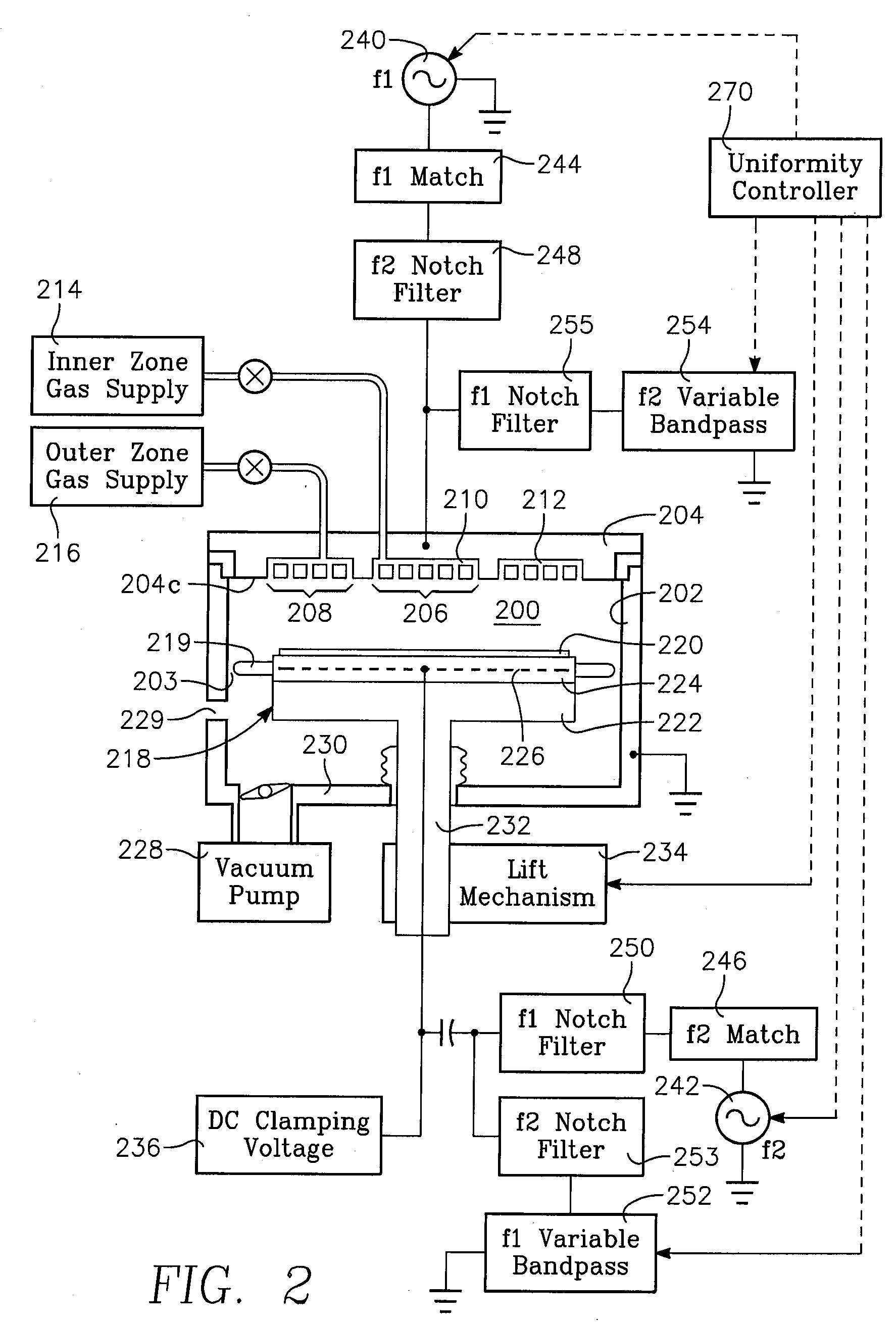
[0023]FIG. 1A is a simplified schematic diagram of a plasma reactor capable of controlling radial distribution of plasma ion density by apportioning capacitively coupled plasma source power among different source power frequencies. The reactor has a vacuum chamber 200 enclosed by a cylindrical side wall 202 and a disk-shaped ceiling 204. The ceiling 204 is both a conductive ceiling electrode as well as a gas distribution showerhead or plate, and will be referred to herein as the ceiling electrode 204. The ceiling electrode may optionally be covered with a conducting, semiconducting or insulating material. The ceiling electrode 204 includes inner and outer zones 206, 208 of gas injection orifices on its bottom surface 204c coupled to respective inner and outer internal gas manifolds 210, 212. Inner and outer zone process gas supplies 214, 216 furnish process gases to the inner and outer manifolds 210, 212. A wafer support pedestal 218 can support a workpiece such as a semiconductor w...
the structure of the environmentally friendly knitted fabric provided by the present invention; figure 2 Flow chart of the yarn wrapping machine for environmentally friendly knitted fabrics and storage devices; image 3 Is the parameter map of the yarn covering machine
Login to View More
PUM
Property
Measurement
Unit
Pressure
aaaaa
aaaaa
Power
aaaaa
aaaaa
Electrical conductor
aaaaa
aaaaa
Login to View More
Abstract
A plasma reactor includes an electrostatic chuck in the chamber for supporting the workpiece, a ceiling electrode facing the electrostatic chuck and an ESC electrode in the electrostatic chuck with an electrostatic clamping voltage supply coupled to the ESC electrode. The reactor further includes at least a first RF bias source of an LF or HF frequency coupled to the pedestal electrode, and first and second VHF power sources of different frequencies coupled to the same or to different ones of the electrodes. The first and second VHF power sources are of sufficiently high and sufficiently low frequencies, respectively, to produce center-high and center-low plasma distribution non-uniformities, respectively, in the chamber.
the structure of the environmentally friendly knitted fabric provided by the present invention; figure 2 Flow chart of the yarn wrapping machine for environmentally friendly knitted fabrics and storage devices; image 3 Is the parameter map of the yarn covering machine
Login to View More
Application Information
Patent Timeline
Application Date:The date an application was filed.
Publication Date:The date a patent or application was officially published.
First Publication Date:The earliest publication date of a patent with the same application number.
Issue Date:Publication date of the patent grant document.
PCT Entry Date:The Entry date of PCT National Phase.
Estimated Expiry Date:The statutory expiry date of a patent right according to the Patent Law, and it is the longest term of protection that the patent right can achieve without the termination of the patent right due to other reasons(Term extension factor has been taken into account ).
Invalid Date:Actual expiry date is based on effective date or publication date of legal transaction data of invalid patent.
InventorCOLLINS, KENNETH S.HANAWA, HIROJIRAMASWAMY, KARTIKBUCHBERGER, DOUGLAS A.RAUF, SHAHIDBERA, KALLOLWONG, LAWRENCEMERRY, WALTER R.MILLER, MATTHEW L.SHANNON, STEVEN C.NGUYEN, ANDREWCRUSE, JAMES P.CARDUCCI, JAMESDETRICK, TROY S.DESHMUKH, SUBHASHSUN, JENNIFER Y.



 Login to View More