
Pyrazoles Useful in the Treatment of Inflammation
a technology of pyrazoles and pyrazoles, which is applied in the field of compounds, can solve the problems of no perceived utility ascribed, no disclosure or suggestion in any of these documents of n-unsubstituted 3-amidopyrazoles, etc., and achieves the effects of less toxic, longer acting, and more efficacy
- Summary
- Abstract
- Description
- Claims
- Application Information
AI Technical Summary
Benefits of technology
Problems solved by technology
Method used
Image

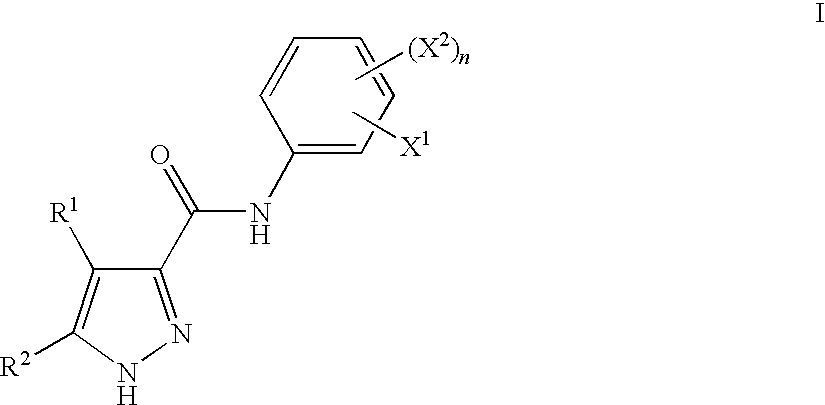
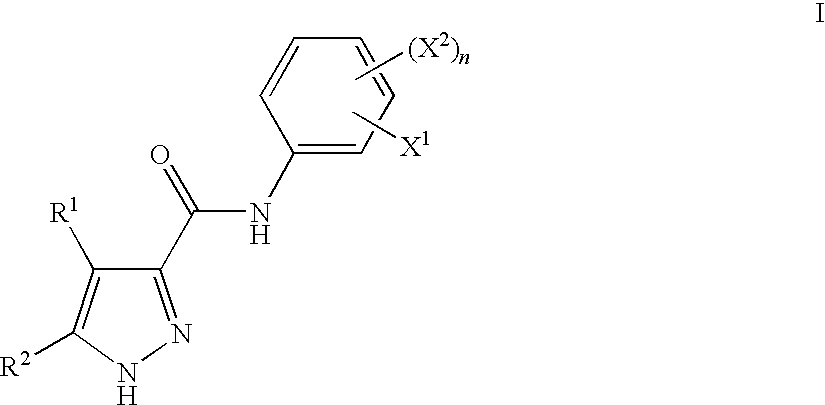
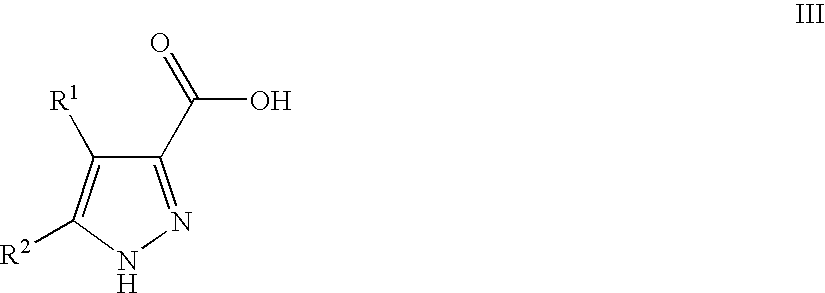
Examples
example 1
4-Chloro-N-(2-chloro-4-fluorophenyl)pyrazole-3-carboxamide
(a) 4-Chloro-3-methylpyrazole Hydrochloride
[0207]A stirred solution of 3-methylpyrazole (50 mmol, 4.10 g) in carbon tetrachloride (50 mL) was saturated with chlorine gas at −78° C. The temperature was allowed to rise to rt and the mixture was stirred overnight. The slurry was diluted with pentane (50 mL) and stirred for an additional 30 min. The white crystalline solid was filtered off, washed with pentane (2×50 mL) and dried to provide the sub-title compound (Yield 7.50 g (98%)).
[0208]MS (M++H) m / z=117.
[0209]1H NMR (DMSO-d6, 400 MHz) δ 13.38 (s, 2H), 7.68 (s, 1H), 2.16 (s, 3H).
[0210]13C NMR (DMSO-d6, 100 MHz) δ 139.1, 132.2, 106.8, 9.3.
(b) 4-Chloropyrazole-3-carboxylic acid
[0211]A well-stirred mixture of 4-chloro-3-methylpyrazole hydrochloride (20 mmol, 3.06 g; see step (a)) and potassium permanganate (50 mmol, 11.4 g) in water (500 mL) was stirred for 3 days at rt and then for 5 h at 70° C. The mixture was filtered and conc...
example 2
5-Chloro-N-(2-chloro-4-fluorophenyl)pyrazole-3-carboxamide
(a) 5-Chloro-3-methylpyrazole
[0217]A mixture of 5-chloro-1,3-dimethylpyrazole (2.6 mmol) and pyridine hydro-chloride (13.1 mmol) in a sealed 5 mL process vial was heated using microwave irradiation for 2 h at 200° C. After cooling to rt, EtOAc (15 mL) was added and the mixture was washed with HCl (aq., 2M; 10 mL), NaCl (sat, aq.), dried (MgSO4) and concentrated to afford the sub-title compound as a white solid (Yield: 210 mg (67%)).
[0218]MS (M++H) m / z=117.
[0219]1H-NMR (DMSO-d6, 400 MHz), δ 12.66 (br s, 1H), 6.03 (m, 1H), 2.19 (s, 3H).
(b) 5-Chloropyrazole-3-carboxylic Acid
[0220]A mixture of 5-chloro-3-methylpyrazole (3.6 mmol; see step (a) above), water (6 mL) and tert-butanol (1.2 mL) was heated to 75° C., after which KMnO4 (1.42 g, 9 mmol) was added. The mixture was stirred at 75° C. overnight and filtered hot. The solids were washed with boiling water. The combined cooled filtrates were extracted with EtOAc, and the combine...
example 3
5-Chloro-N-(2,4-dichlorophenyl)pyrazole-3-carboxamide
[0225]BuLi (1.6M, 0.116 mL, 0.19 mmol) was added under argon to a solution of 1-benzenesulfonyl-3-chloropyrazole (30 mg, 0.12 mmol; see Intermediate (VI) above) in THF (2 mL) at −78° C. The mixture was allowed to stir for 30 min before 2,4-dichlorophenylisocyanate (46 mg, 0.25 mmol) was added. The mixture was stirred at −78° C. for a further 18 h, after which NH4Cl (aq, sat; 2 mL) and EtOAc (20 mL) was added. The layers were separated and the aqueous phase extracted with EtOAc (10 mL). The combined organic phases were dried (Na2SO4) and concentrated. Purification by chromatography (1:4 EtOAc / heptane) gave a white solid residue which was dissolved in MeOH (10 mL). Sodium methoxide (30% in MeOH, 0.024 mL, 0.1 mmol) was added and the mixture was stirred at rt for 3 days, after which NH4Cl (sat., aq.; 20 mL) was added. The mixture was diluted with water (30 mL) and the EtOH removed in vacuo. The aqueous residue was extracted with EtOA...
PUM
| Property | Measurement | Unit |
|---|---|---|
| bone mineral density | aaaaa | aaaaa |
| voltage | aaaaa | aaaaa |
| optical | aaaaa | aaaaa |
Abstract
Description
Claims
Application Information
 Login to View More