Method of making a semiconductor chip assembly with a post/base/cap heat spreader

a technology of semiconductor chips and heat spreaders, which is applied in the manufacture of printed circuits, printed circuit aspects, basic electric elements, etc., can solve the problems of short life span and immediate failure of semiconductor devices at high operating temperatures, heat not only degrades the chip, and the device is susceptible to performance degradation. , to achieve the effect of excellent heat spreading and heat dissipation, low cost and low thermal conductivity

US20100075448A1Inactive Publication Date: 2010-03-25BRIDGE SEMICON
73 Cites 2 Cited by

Patent Information

Authority / Receiving Office
US · United States
Patent Type
Applications(United States)
Current Assignee / Owner
Publication Date
2010-03-25
Estimated Expiration
Not applicable · inactive patent

Smart Images

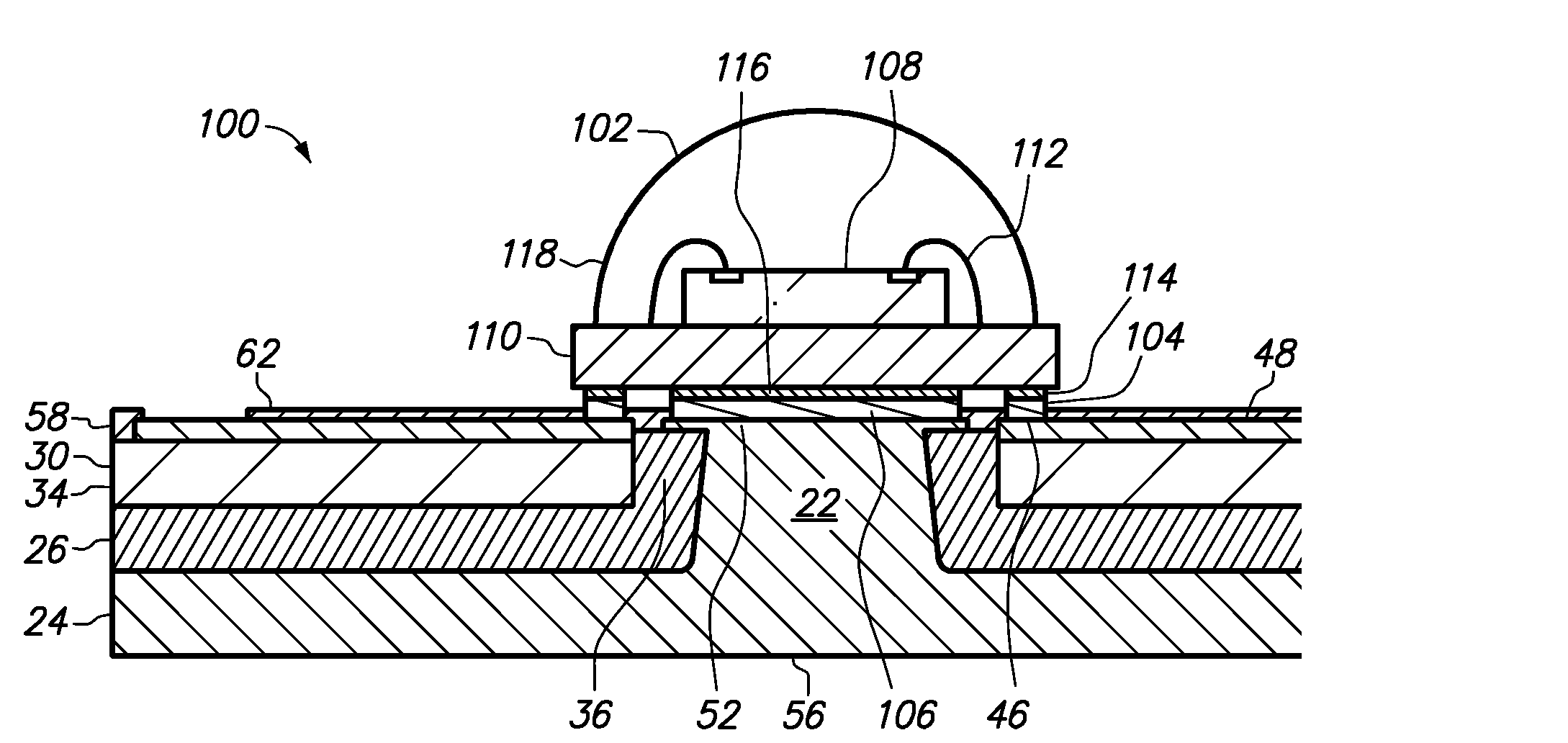
  • Figure 1
    Figure 1
  • Figure 2
    Figure 2
  • Figure 3
    Figure 3
Patent Text Reader

Abstract

A method of making a semiconductor chip assembly includes providing a post and a base, mounting an adhesive on the base including inserting the post into an opening in the adhesive, mounting a conductive layer on the adhesive including aligning the post with an aperture in the conductive layer, then flowing the adhesive into and upward in a gap located in the aperture between the post and the conductive layer, solidifying the adhesive, then providing a conductive trace that includes a pad, a terminal and a selected portion of the conductive layer, providing a cap on the post, mounting a semiconductor device on a heat spreader that includes the post, the base and the cap, electrically connecting the semiconductor device to the conductive trace and thermally connecting the semiconductor device to the heat spreader.
Need to check novelty before this filing date? Find Prior Art

Description

CROSS-REFERENCE TO RELATED APPLICATIONS

[0001] This application is a continuation-in-part of U.S. application Ser. No. 12 / 616,773 filed Nov. 11, 2009, which is incorporated by reference. This application is also a continuation-in-part of U.S. application Ser. No. 12 / 616,775 filed Nov. 11, 2009, which is incorporated by reference.

[0002] U.S. application Ser. No. 12 / 616,773 filed Nov. 11, 2009 and U.S. application Ser. No. 12 / 616,775 filed Nov. 11, 2009 are each a continuation-in-part of U.S. application Ser. No. 12 / 557,540 filed Sep. 11, 2009 and a continuation-in-part of U.S. application Ser. No. 12 / 557,541 filed Sep. 11, 2009.

[0003] U.S. application Ser. No. 12 / 557,540 filed Sep. 11, 2009 and U.S. application Ser. No. 12 / 557,541 filed Sep. 11, 2009 are each a continuation-in-part of U.S. application Ser. No. 12 / 406,510 filed Mar. 18, 2009, which claims the benefit of U.S. Provisional Application Ser. No. 61 / 071,589 filed May 7, 2008, U.S. Provisional Application Ser. No. 61 / 071,588 fil...

Examples

Embodiment Construction

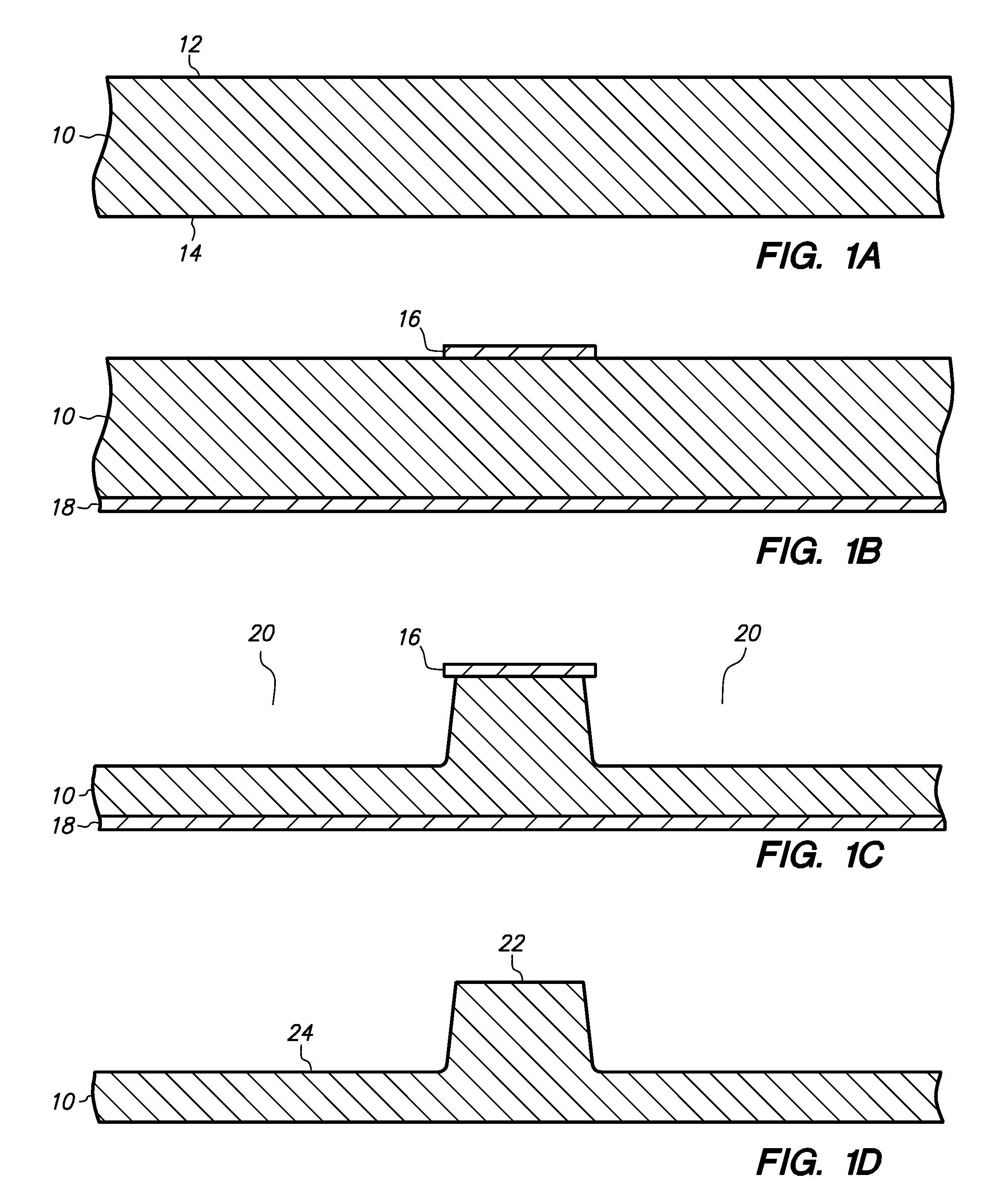
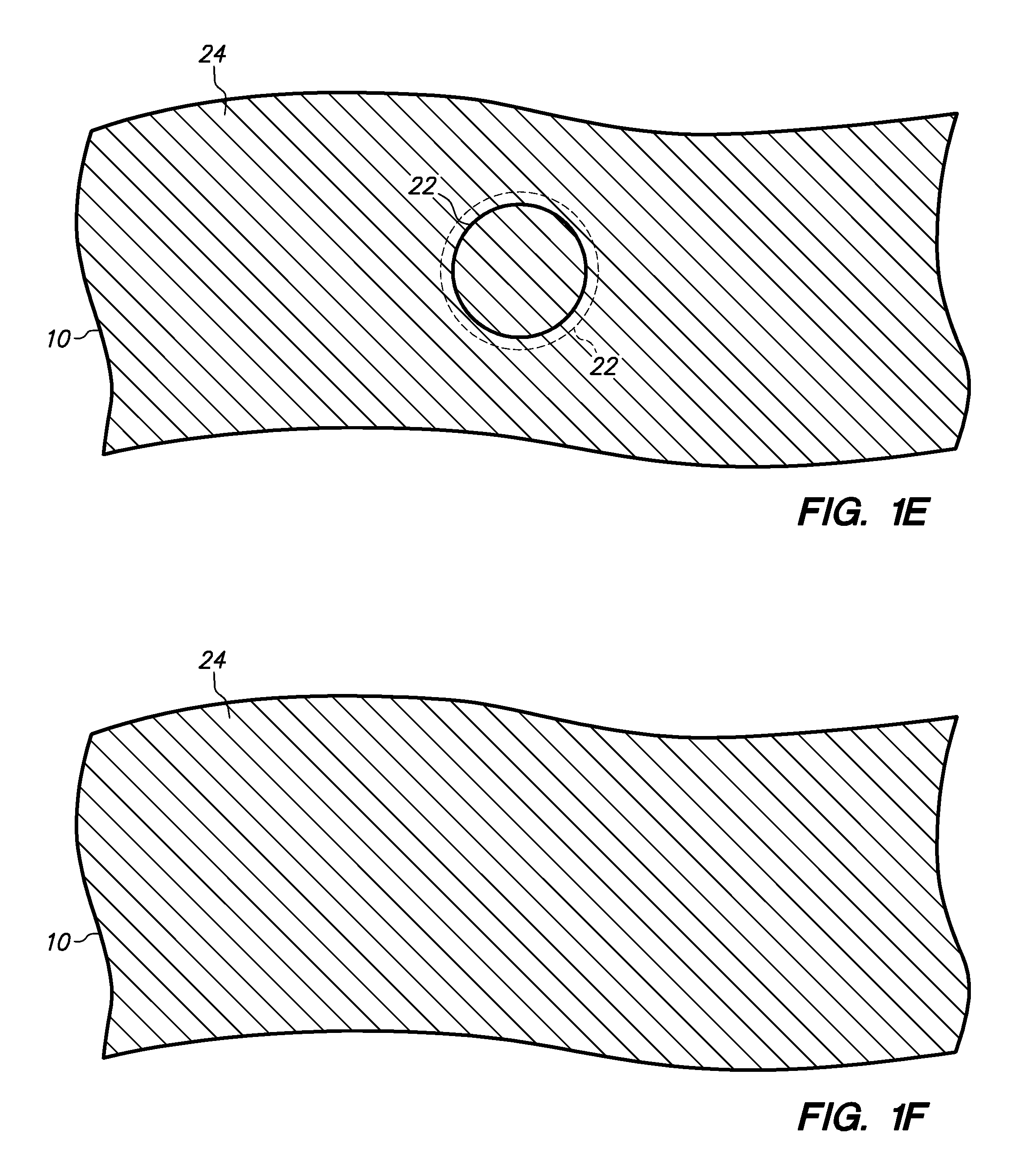
[0082]FIGS. 1A-1D are cross-sectional views showing a method of making a post and a base in accordance with an embodiment of the present invention, and FIGS. 1E and 1F are top and bottom views, respectively, corresponding to FIG. 1D.

[0083]FIG. 1A. is a cross-sectional view of metal plate 10 which includes opposing major surfaces 12 and 14. Metal plate 10 is illustrated as a copper plate with a thickness of 500 microns. Copper has high thermal conductivity, good bondability and low cost. Metal plate 10 can be various metals such as copper, aluminum, alloy 42, iron, nickel, silver, gold, combinations thereof, and alloys thereof.

[0084]FIG. 1B is a cross-sectional view of etch mask 16 and cover mask 18 formed on metal plate 10. Etch mask 16 and cover mask 18 are illustrated as photoresist layers which are deposited on metal plate 10 using dry film lamination in which hot rolls simultaneously press photoresist layers 16 and 18 onto surfaces 12 and 14, respectively. Wet spin coating and c...