
Oral pharmaceutical formulations for antidiabetic compounds
a technology of antidiabetic compounds and oral preparations, which is applied in the direction of biocide, drug compositions, metabolic disorders, etc., can solve the problems of limiting the effective concentration of antidiabetic compounds in pharmaceutical preparations, reducing bioavailability upon administration, etc., and achieves surprising physical and chemical stability, no loss of potency, and good solubility
- Summary
- Abstract
- Description
- Claims
- Application Information
AI Technical Summary
Benefits of technology
Problems solved by technology
Method used
Image

Examples
example 1
5.1 Example 1
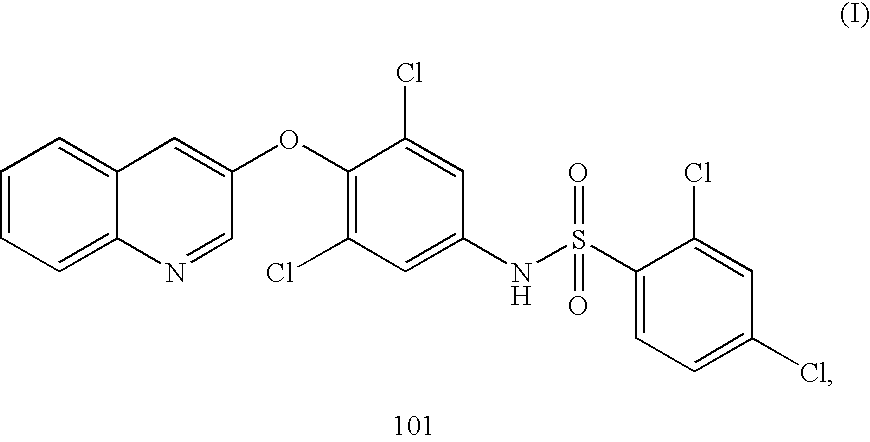
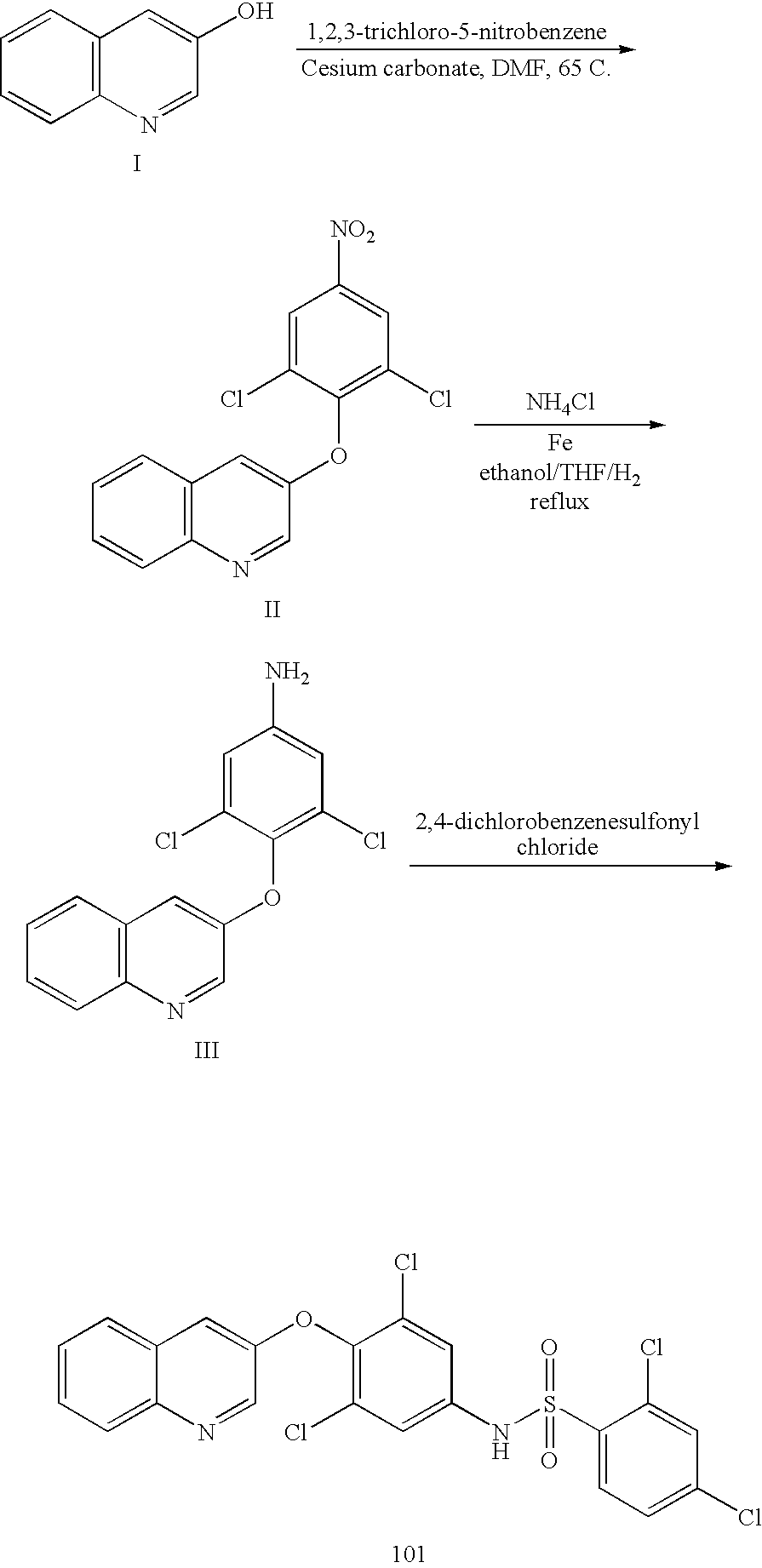
Synthesis of Compound 101
[0164]This example provides an exemplary synthesis of compound 101. Alternate methods of synthesizing compound 101, including methods of synthesizing acid addition salts of compound 101 are described below; still other alternate synthetic methods will be apparent to those of skill in the art.
3-(2,6-Dichloro-4-nitro-phenoxy)-3,4-dihydro-quinoline (II)
[0165]3-Hydroxyquinoline (I) (prepared according to the procedure of Naumann et. al., Synthesis 4:279-281 (1990)) (3 g) and 1,2,3-trichloro-5-nitrobenzene (4.7 g) were dissolved in DMF (80 mL) and heated with cesium carbonate (7.4 g) for 2 h at 60° C. The reaction was poured into ice / water (500 mL). The resulting off-white precipitate was collected by filtration and rinsed with hexane to afford compound II as a solid (6.9 g) suitable for use in the next reaction.
[0166]1H NMR in CDCl3 d 8.863 (d, J=2.2 Hz, 1H), 8.360 (s, 2H), 8.106 (d, J=8.6 Hz, 1H), 7.646 (m, 2H), 7.529 (d, J=8.6 Hz, 1H), 7.160 (d, J...
example 2
5.2 Example 2
PPARγ Ligand Binding
[0171]Using methods similar to Lehmann et al., J. Biol. Chem. 270:12953-12956 (1995), compound 101, prepared according to Example 1, exhibited an IC50 of less than 1 μM in a PPARγ ligand binding assay utilizing [3H]-BRL 49653 as the radioligand.
example 3
5.3 Example 3
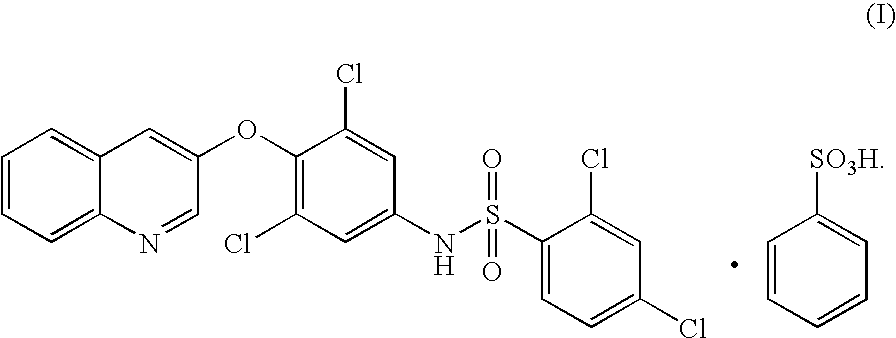
Large Scale Synthesis of the Besylate Salt of Compound 101
[0172]This example provides an exemplary synthesis of the besylate salt of compound 101 from precursors to compound 101. Alternate methods of synthesizing the besylate salt of compound 101 from such precursors will be apparent to those of skill in the art.
Synthesis of Salts of Compound 101 According to Examples 3 and 4
3-hydroxyquinoline (3)
[0173]3-aminoquinoline (2), via the diazonium salt, was converted to 3-hydroxyquinoline (3) in 96% yield.
3-(2,6-Dichloro-4-nitro-phenoxy)-quinoline (4)
[0174]3-Hydroxyquinoline (3) and 1,2,3-trichloro-5-nitrobenzene were dissolved in DMF and heated with calcium carbonate to give, after titration with isopropanol, 3-(2,6-dichloro-4-nitro-phenoxy)-quinoline (4) in 93% yield.
3,5-dichloro-4-(quinolin-3-yloxy)-phenylamine (5)
[0175]The nitro functionality of 3-(2,6-dichloro-4-nitro-phenoxy)-quinoline (4) was catalytically reduced under hydrogen with 5% weight / weight (catalyst / compound...
PUM
| Property | Measurement | Unit |
|---|---|---|
| Force | aaaaa | aaaaa |
| Force | aaaaa | aaaaa |
| Mass | aaaaa | aaaaa |
Abstract
Description
Claims
Application Information
 Login to View More