Zwitterionic stationary phase as well as method for using and producing said phase
- Summary
- Abstract
- Description
- Claims
- Application Information
AI Technical Summary
Benefits of technology
Problems solved by technology
Method used
Image

Examples
example 1
Synthesis and Characterization of the Zwitterionic Stationary Phase KS-polyMPC
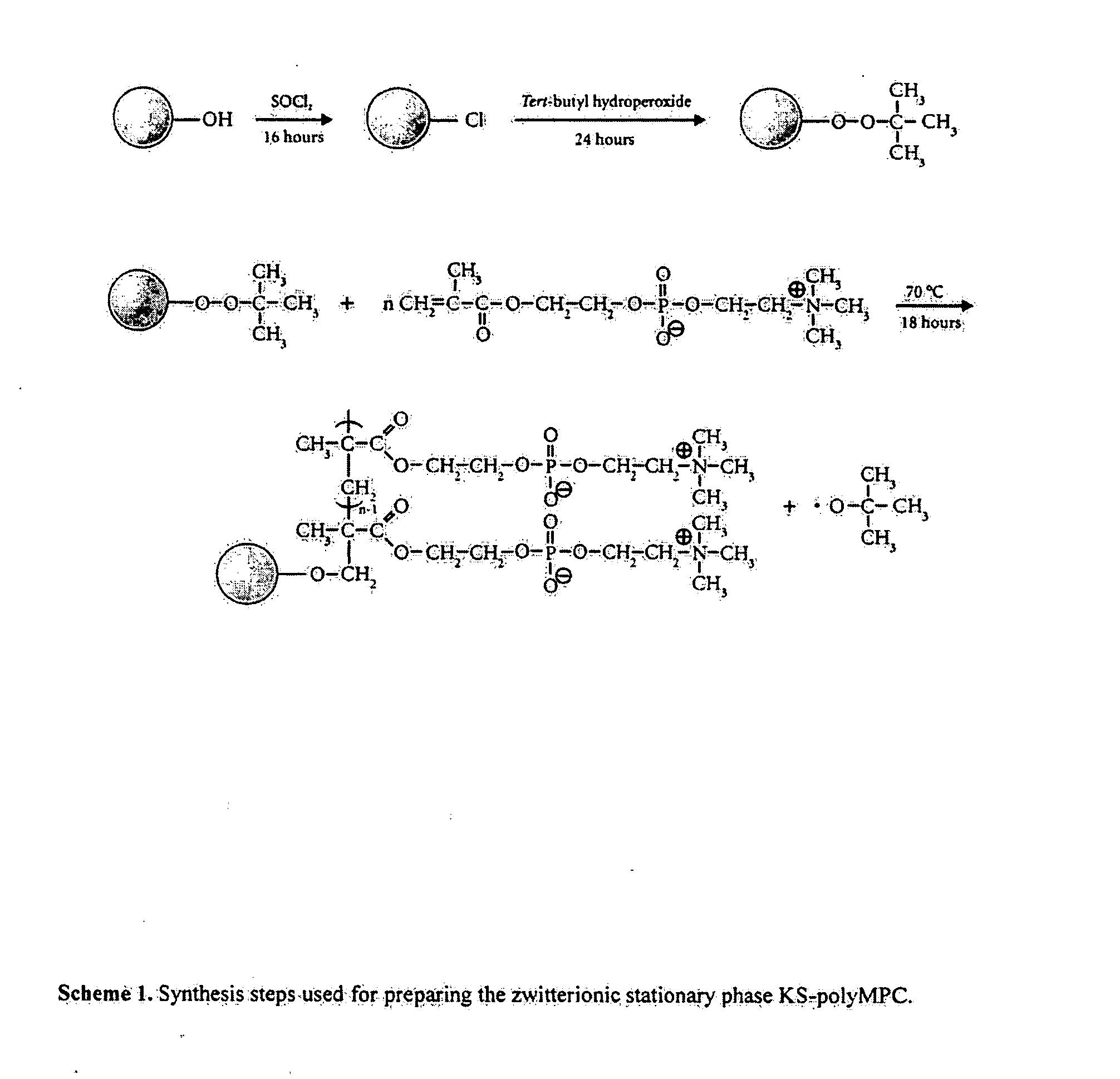
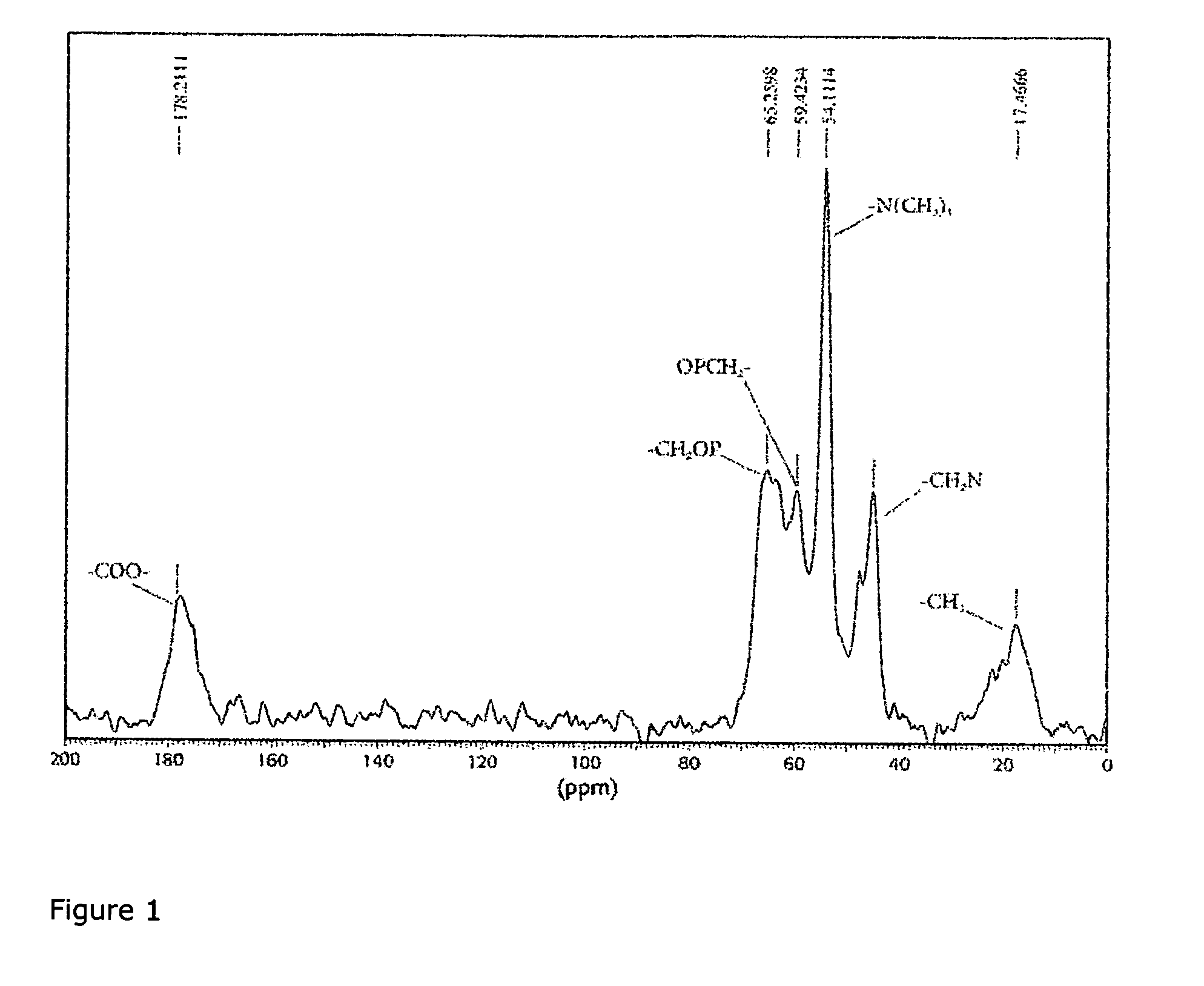
[0034]Scheme 1 shows the schematic procedures used in the synthesis of the KS-polyMPC zwitterionic separation material. As was discussed previously (Jiang, W.; Irgum, K. Anal. Chem. 2002, 74, 4682-4687), porous silica particles were activated to achieve peroxide groups on the material surface, used as intiator sites for subsequent graft polymerization of zwitterionic monomer. This method was chosen because it ascertains that the graft polymerization starts form the particle surface, as opposed to homogeneous intiation, where polymers initiated in solution loop past vinylic groups on the surface. The nitrogen and phosphorus contents were analyzed by elemental analysis. The phosphorus to nitrogen molar ratio was found to be between 1.00 and 1.12. This means the grafted MPC zwitterionic material had a charge balance close to unity. The materials were also analyzed by FT-IR, but the area of most important info...
example 2
Separation of Peptides by HILIC
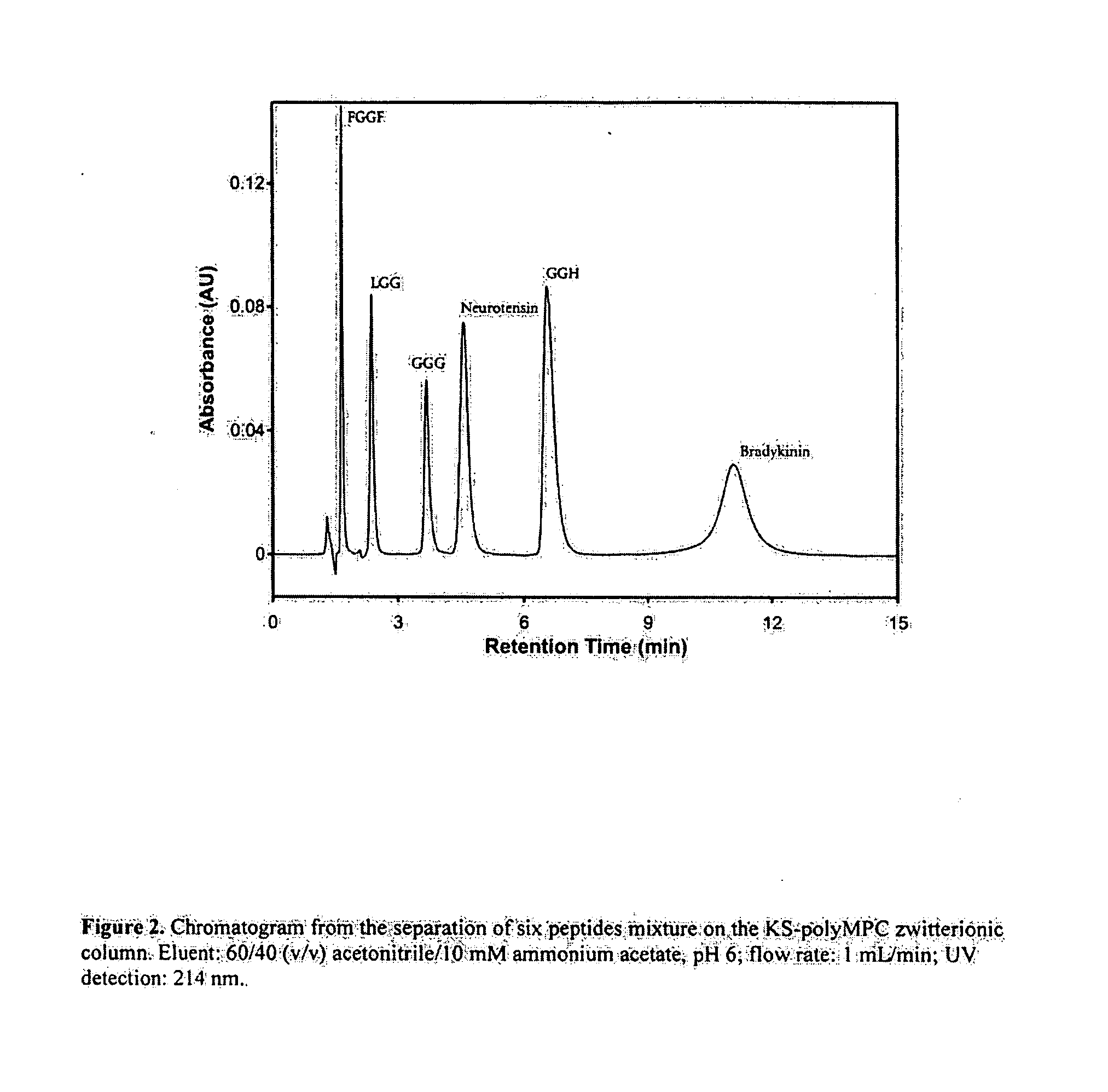
[0038]Six peptides were chosen as test probes for studies of the hydrophilic interaction chromatographic properties of KS-polyMPC column. Of these peptides, four had two glycines in peptide chain (FGGF, LGG, GGG, and GGH). FGGF has two hydrophobic phenylalanine residues in each terminal, making it most hydrophobic among these four peptides. GGH has a histidine group in the carboxyl terminal and is the most hydrophilic member of the test set. Neurotensin and bradykinin are both hydrophilic peptides with 13 and 9 residues, respectively. Table 2 lists the pI values, hydropathicity scale (GRAVY score) and estimated hydrophilic retention coefficients of the peptides used in this study.
TABLE 2pI, hydrophobic scale and hydrophilicity retention coefficients of peptides used as test probes.HydrophilicityRetentionHILIC ModePeptideSequencepIa)GRAVYb)Coefficientc)Retentiond)Phe-Gly-Gly-FGGF5.701.2006.70 0.38PheLeu-Gly-GlyLGG5.701.00010.27 0.90Gly-Gly-GlyGGG5.70−0....
example 3
Effect of Buffer pH
[0043]Peptides are amphoteric molecules whose charges change with pH of the surrounding medium. Their net charge is zero at pH=pI and increases with decreasing pH of buffer solution and vice versa, owing to protonation and dissociation of weakly basic and acidic side chains of the peptide, and of the amino and carboxy terminals. The retention factors (k) on both KS-polyMPC and on native Kromasil silica are shown in FIG. 4 as a function of the pH of the buffers used for mixing the eluents, maintaining the acetonitrile admixture and buffer concentration constant. These retention data can then be correlated with the estimated pH-dependent charge of the peptides shown in FIG. 3. As can be seen in FIG. 4A, the retention factors of the small peptides with identical pI (due to the terminals only), FGGF, LGG, and GGG, decreased slightly when pH was increased from 3 to 7 on the KS-polyMPC column. We attribute this to an increased positive charge accompanied by an increase ...
PUM
| Property | Measurement | Unit |
|---|---|---|
| Length | aaaaa | aaaaa |
| Size | aaaaa | aaaaa |
| Retention factor | aaaaa | aaaaa |
Abstract
Description
Claims
Application Information
 Login to View More
 - R&D
- Intellectual Property
- Life Sciences
- Materials
- Tech Scout
- Unparalleled Data Quality
- Higher Quality Content
- 60% Fewer Hallucinations
Browse by: Latest US Patents, China's latest patents, Technical Efficacy Thesaurus, Application Domain, Technology Topic, Popular Technical Reports.
© 2025 PatSnap. All rights reserved.Legal|Privacy policy|Modern Slavery Act Transparency Statement|Sitemap|About US| Contact US: help@patsnap.com