
Systems and Methods for Pharmacogenomic Decision Support in Psychiatry
a pharmacogenomics and decision support technology, applied in the field of clinical decision support, can solve the problems of confusion, lack of algorithmic solutions for processing both unstructured and structured data, and almost no compelling results
- Summary
- Abstract
- Description
- Claims
- Application Information
AI Technical Summary
Benefits of technology
Problems solved by technology
Method used
Image

Examples
example 1
[0110]The following hypothetic example shows how the systems and methods of the present invention are used in clinical decision support for a patient (Jane Doe, whom, e.g., has been diagnosed with PTSD).
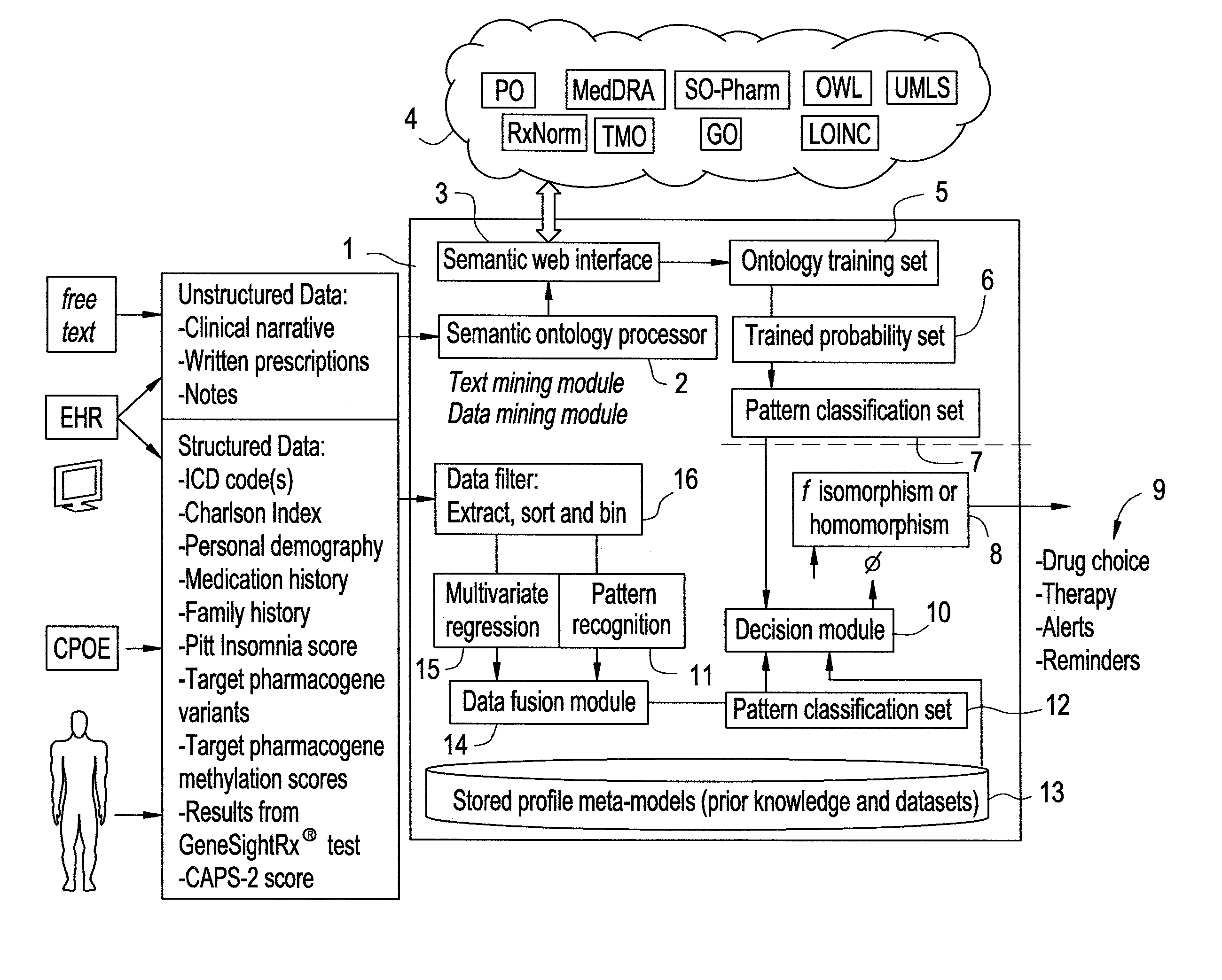
[0111]First, the system computes the best three dimensional isograph for the patient's genomic data by matching that data against one of a set of pre-defined phenotype models in the form of three dimensional isographs. The following steps are included in this process:[0112]1. Extract all clinical text from all electronic health record data and other clinical notes, using the system shown in FIG. 6. All data are converted into the three dimensional vector space of the tri-graph generator.[0113]2. From biobanked samples, or as collected from a bodily fluid such as blood cells, preferably peripheral blood monocytes (PBMCs), determine genomic variants and epigenomic variants that are described in Tables 5 and 6. All data are already in a form that fits the three dimensional vector space ...
PUM
 Login to View More
 Abstract
Description
Claims
Application Information
 Login to View More