
Antifouling coating composition, antifouling coating film and antifouling substrate, and method for producing antifouling substrate
- Summary
- Abstract
- Description
- Claims
- Application Information
AI Technical Summary
Benefits of technology
Problems solved by technology
Method used
Image


Examples
examples
[0128]Hereinafter, with reference to Examples, the present invention is further specifically described, but the present invention is limited in no way with these Examples. In the section of “Example”, “%” denotes “% by weight” unless otherwise noted.
production example a1
[0129]A reaction vessel equipped with a stirring device, a reflux condenser, a thermometer, a nitrogen-introducing tube and a dropping funnel was charged with xylene in an amount of 53 parts. Under nitrogen atmosphere, while xylene was stirred with the stirring device, under an atmospheric pressure, the reaction vessel was heated until the temperature of xylene in the reaction vessel reached 85° C. While keeping the temperature of xylene in the reaction vessel at 85° C., a monomer mixture composed of 75 parts by weight of TIPSMA (triisopropylsilyl methacrylate), 5 parts by weight of TIPSA (triisopropylsilyl acrylate), 10 parts by weight of EA (ethyl acrylate), 10 parts by weight of MMA (methyl methacrylate) and 1 part by weight of AMBN (2,2′-azobis(2-methylbutyronitrile)) was added into the reaction vessel with the dropping funnel over a period of 2 hours.
[0130]Subsequently, 0.5 parts by weight of t-butylperoxyoctoate was further added to the reaction vessel. Under atmospheric press...
production examples a2
to A16 and Production Examples B1 to B7
[0132]The same procedure as in Production Example A1 was performed except that a monomer mixture having a formulation shown in Table 1 or Table 2 was used instead of the monomer mixture used in Production Example A1. Thereby, a silyl(meth)acrylate (co)polymer solution (A1) containing a silyl(meth)acrylate copolymer (polymer (A)) was prepared, and its heat residue was calculated, and the weight average molecular weight (Mw) of the (co)polymer was measured.
[0133]In Tables 1 to 4, (co)polymer solutions A2 to A16 and (co)polymer solutions B1 to B7 refer to solutions containing (co)polymers obtained in Production Examples A2 to A16 and Production Examples B1 to B7, respectively.
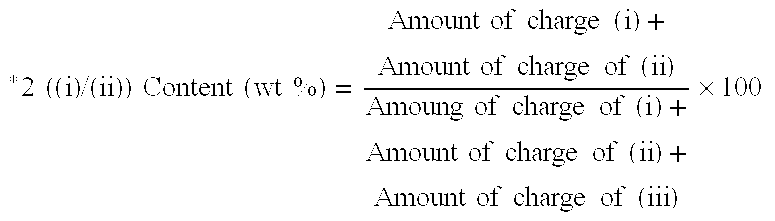
TABLE 2Resin Production ExampleB1B2B3B4B5B6B7Polymer SolutionB1B2B3B4B5B6B7Monomer(i)TIPSMA(part by weight)703520102030mixture(ii)TIPSA(part by weight)703550604050(iii)EA(part by weight)10101010101010MMA(part by weight)20202020203010BA(part by weight)ReactionAMBN(part by weig...
PUM
 Login to View More
 Abstract
Description
Claims
Application Information
 Login to View More