

Production system for vapor-grown carbon nanofibers
a carbon nanofiber and production system technology, applied in the direction of nano-carbon, chemical/physical/physicochemical processes, chemistry apparatuses and processes, etc., can solve the problems of unfavorable electrical and heat conduction performance of conventional vgcf, unfavorable vgcf performance, and inability to increase the performance of electrical and heat conduction. achieve the effect of high fiber purity and high graphitization degr
- Summary
- Abstract
- Description
- Claims
- Application Information
AI Technical Summary
Benefits of technology
Problems solved by technology
Method used
Image


Examples
application example 1
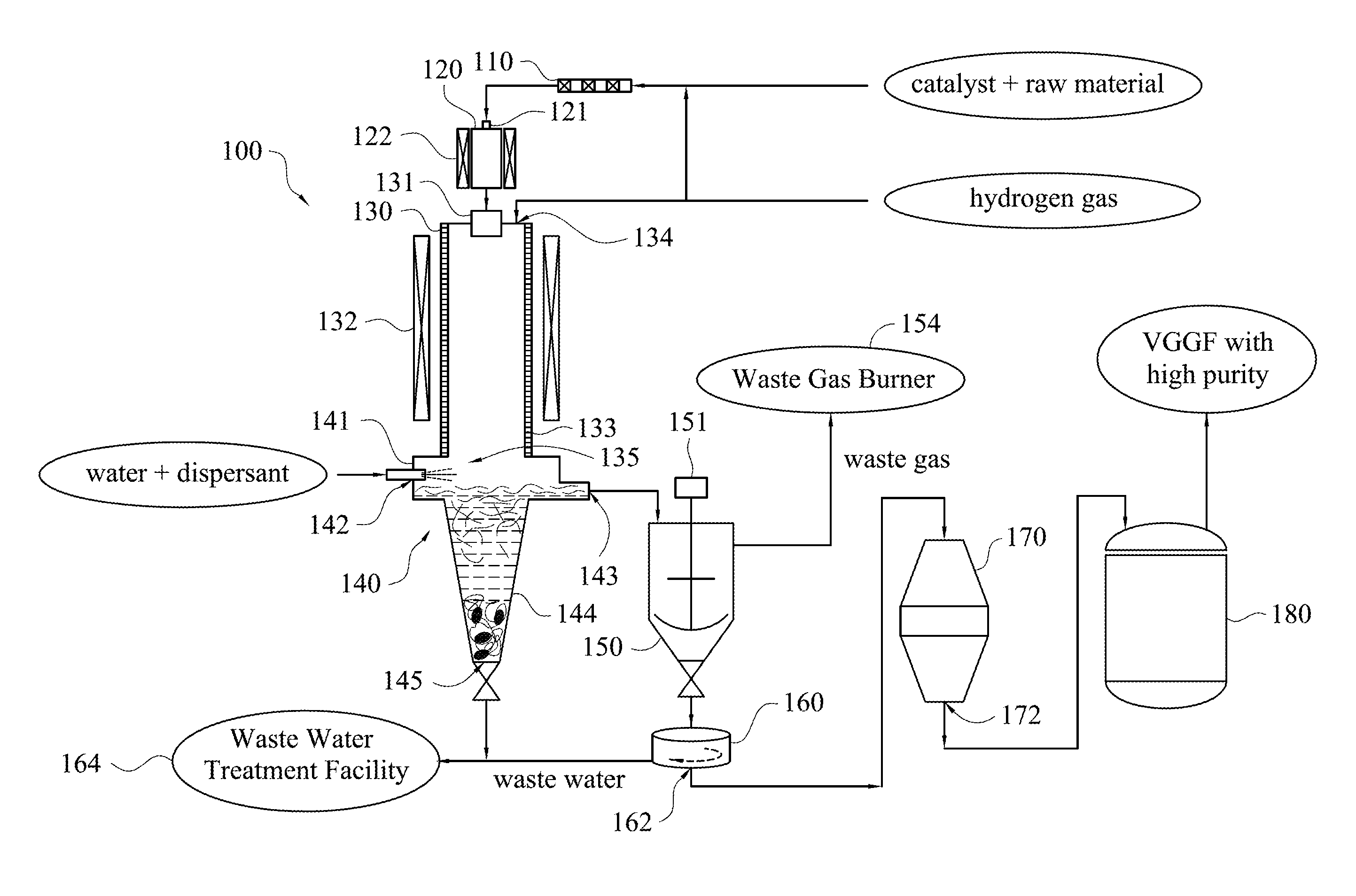
[0028]At first, a transition metal compound catalyst is dissolved in a liquid hydrocarbon compound to form a first mixture, and the first mixture is delivered to an input pipeline and mixed with hydrogen gas. The first mixture and the hydrogen gas enter the static mixer 110 and are blended to form a second mixture. The second mixture is injected into the preheating room 120 via the micro mist nozzle 121, and is heated and vaporized at the temperature of 300° C. to form reaction gas. Then, the reaction gas enters the vertical tubular reactor 130 of which an inner wall is covered by a boron nitride coating (the anti-adhering coating 133), and meanwhile the remaining hydrogen gas enters the vertical tubular reactor 130 via another pipeline on the top of the vertical tubular reactor 130. After the reaction gas is reacted in the vertical tubular reactor 130, the product produced therein enters the sedimentation device 140. Water containing a dispersant is injected into the sedimentation ...
application example 2
[0030]In this application example, the liquid raw material is formed from 96 wt % xylene, 2 wt % ferrocene and 2 wt % thiophene, and the anti-adhering coating 133 is an aluminum nitride. After reaction, the product is purified by sedimentation, dried and graphitized under the temperature 2900° C., and the other conditions are the same those of the application example 1. Other features of the VGGF composition obtained by this application example are shown in Table 1.
TABLE 1Application Example12reaction apparatusFIG. 1FIG. 1anti-adhering coatingBNAlNreaction temperature11501150hydrocarbonxylene9696compound (wt %)catalyst(wt %)ferrocene32co-catalyst(wt %)thiophene12graphitization temperature(° C.)30002900productcarbon (wt %)99.9999.93degree of graphitization (%)9183non-fibrous carbon / fibrous1.62.7carbon (A %)VGGF average outer115109diameter (nm)thermal decomposition733728onset temperature (° C.)iron content (ppm)2355
[0031]It can be known from the aforementioned embodiment that, the pro...
PUM
 Login to View More
 Abstract
Description
Claims
Application Information
 Login to View More