Ortho-substituted thermally activated delayed fluorescence material and organic light-emitting device comprising same
Pending Publication Date: 2018-05-03
SAMSUNG DISPLAY CO LTD
View PDF0 Cites 13 Cited by
Summary
Abstract
Description
Claims
Application Information
AI Technical Summary
This helps you quickly interpret patents by identifying the three key elements:
Problems solved by technology
Method used
Benefits of technology
Benefits of technology
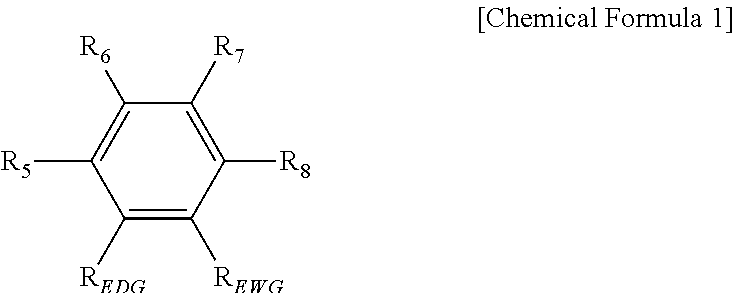
The present invention introduces a compound with an electron donating group and an electron withdrawing group at the ortho positions of the benzene ring. This compound has reduced energy difference between singlet and triplet excited states. As a result, the compound can easily undergo reverse intersystem crossing from triplet to singlet excited states through heat or device operating temperature, resulting in delayed fluorescence.
Problems solved by technology
However, these materials are expensive, and their applications are limited due to the instability of the blue light emitting material.
Method used
the structure of the environmentally friendly knitted fabric provided by the present invention; figure 2 Flow chart of the yarn wrapping machine for environmentally friendly knitted fabrics and storage devices; image 3 Is the parameter map of the yarn covering machine
View more
Image
Smart Image Click on the blue labels to locate them in the text.
Viewing Examples
Smart Image
Click on the blue label to locate the original text in one second.
Reading with bidirectional positioning of images and text.
[0094]9-(2-bromophenyl)carbazole (10 g, 31.03 mmol), 4,4,4′,4′,5,5,5′,5′-octamethyl-2,2′-bi(1,3,2-dioxaborane) (11.82 g, 46.55 mmol), potassium acetate (9.14 g, 93.11 mmol), and 1,1′-bis(diphenylphosphino) ferrocene-palladium (II) (0.76 g, 0.93 mmol) were dissolved in 1,4-dioxane (180 ml), and then oxygen in the solution was rem...
synthesis example 2
nd 2
[0099]Compound 2 was obtained in a yield of 83% using the same method as in Synthesis Example 1 except that 3,6-dimethylcarbazole was used instead of carbazole in Step 1 of Synthesis Example 1.
[0100]Compound 2:
[0101]Mass Spec (FAB) m / z 502 [(M+H)+]. Elemental analysis theoretical value C35H26N4: C (83.64%) H (5.21%) N (11.15%) Measured: C, 83.69%; H, 5.26%; N, 11.09%. 1H NMR (500 MHz, CDCl3): 8.50 (d, 1H), 8.00 (d, 4H), 7.78 (t, 3H), 7.73 (t, 1H), 7.67 (d, 1H), 7.47 (t, 2H), 7.31 (t, 4H), 7.11 (d, 2H), 7.06 (d, 2H), 2.49 (s, 6H).
synthesis example 3
nd 3
[0102]Compound 3 was obtained in a yield of 81% using the same method as in Synthesis Example 1 except that 3,6-di-t-butylcarbazole was used instead of carbazole in Step 1 of Synthesis Example 1.
[0103]Compound 3:
[0104]Mass Spec (EI) m / z 586 [(M+H)+]. Elemental analysis theoretical value C41H38N4: C (83.92%) H (6.53%) N (9.55%) Measured: C, 83.85%; H, 6.61%; N, 9.53%. 1H NMR (500 MHz, CDCl3): 8.56 (d, 1H), 8.09 (d, 4H), 8.02 (d, 2H), 7.81 (t, 1H), 7.74 (t, 1H), 7.68 (d, 1H), 7.49 (t, 2H), 7.34 (t, 6H), 7.11 (d, 2H), 1.42 (s, 18H).
the structure of the environmentally friendly knitted fabric provided by the present invention; figure 2 Flow chart of the yarn wrapping machine for environmentally friendly knitted fabrics and storage devices; image 3 Is the parameter map of the yarn covering machine
Login to View More
PUM
Login to View More
Abstract
A thermally activated delayed fluorescent (TADF) material is provided. The TADF material has a form in which an electron donating group and an electron withdrawing group are connected to benzene and the electron withdrawing group is position in an ortho position to the electron donating group.
the structure of the environmentally friendly knitted fabric provided by the present invention; figure 2 Flow chart of the yarn wrapping machine for environmentally friendly knitted fabrics and storage devices; image 3 Is the parameter map of the yarn covering machine
Login to View More
Application Information
Patent Timeline
Application Date:The date an application was filed.
Publication Date:The date a patent or application was officially published.
First Publication Date:The earliest publication date of a patent with the same application number.
Issue Date:Publication date of the patent grant document.
PCT Entry Date:The Entry date of PCT National Phase.
Estimated Expiry Date:The statutory expiry date of a patent right according to the Patent Law, and it is the longest term of protection that the patent right can achieve without the termination of the patent right due to other reasons(Term extension factor has been taken into account ).
Invalid Date:Actual expiry date is based on effective date or publication date of legal transaction data of invalid patent.


 Login to View More
  Login to View More