Biofunctionalized nanoshell immobilized microarrays and applications thereof

a biofunctionalized, microarray technology, applied in the field of new microarrays, can solve the problems of insufficient functional integration of many membrane proteins, difficult to perform binding dependent assays, relative instability of membranes, etc., and achieve the effects of rapid multiplexing detection of membrane-binding analytes, and enhancing mechanical stability of microarrays

a biofunctionalized, microarray technology, applied in the field of new microarrays, can solve the problems of insufficient functional integration of many membrane proteins, difficult to perform binding dependent assays, relative instability of membranes, etc., and achieve the effects of rapid multiplexing detection of membrane-binding analytes, and enhancing mechanical stability of microarrays

US20180327833A1Inactive Publication Date: 2018-11-15THE ARIZONA BOARD OF REGENTS ON BEHALF OF THE UNIV OF ARIZONA

Image

Smart Image Click on the blue labels to locate them in the text.
Viewing Examples
Smart Image
  • Biofunctionalized nanoshell immobilized microarrays and applications thereof
  • Biofunctionalized nanoshell immobilized microarrays and applications thereof
  • Biofunctionalized nanoshell immobilized microarrays and applications thereof

Examples

Experimental program
Comparison scheme
Effect test

examples

[0079]The following is a non-limiting example of fabricating a microarray functionalized with stabilized phospholipid nanoshells and implementing said microarray in cholera toxin B detection. Equivalents or substitutes are within the scope of the present invention.

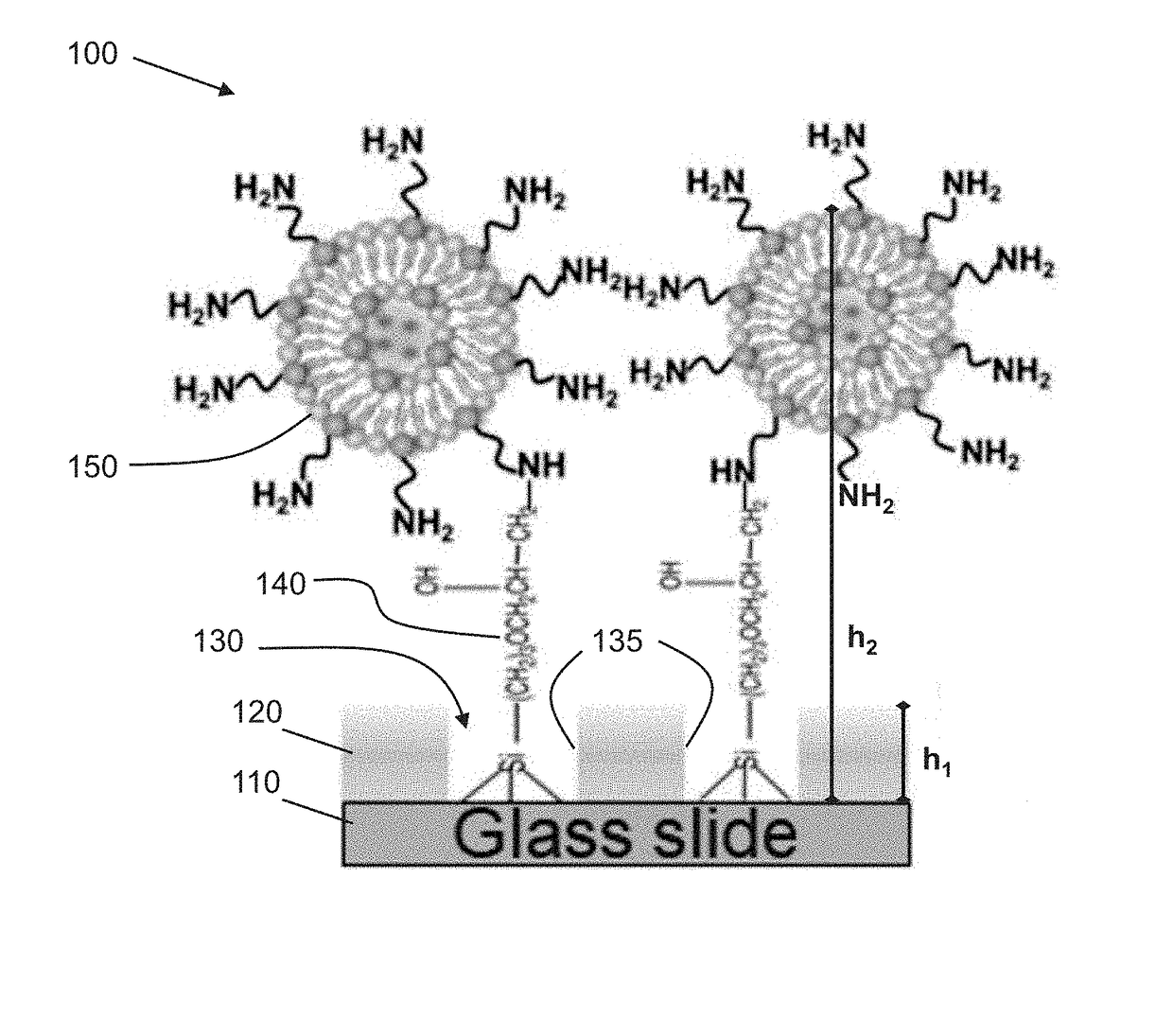
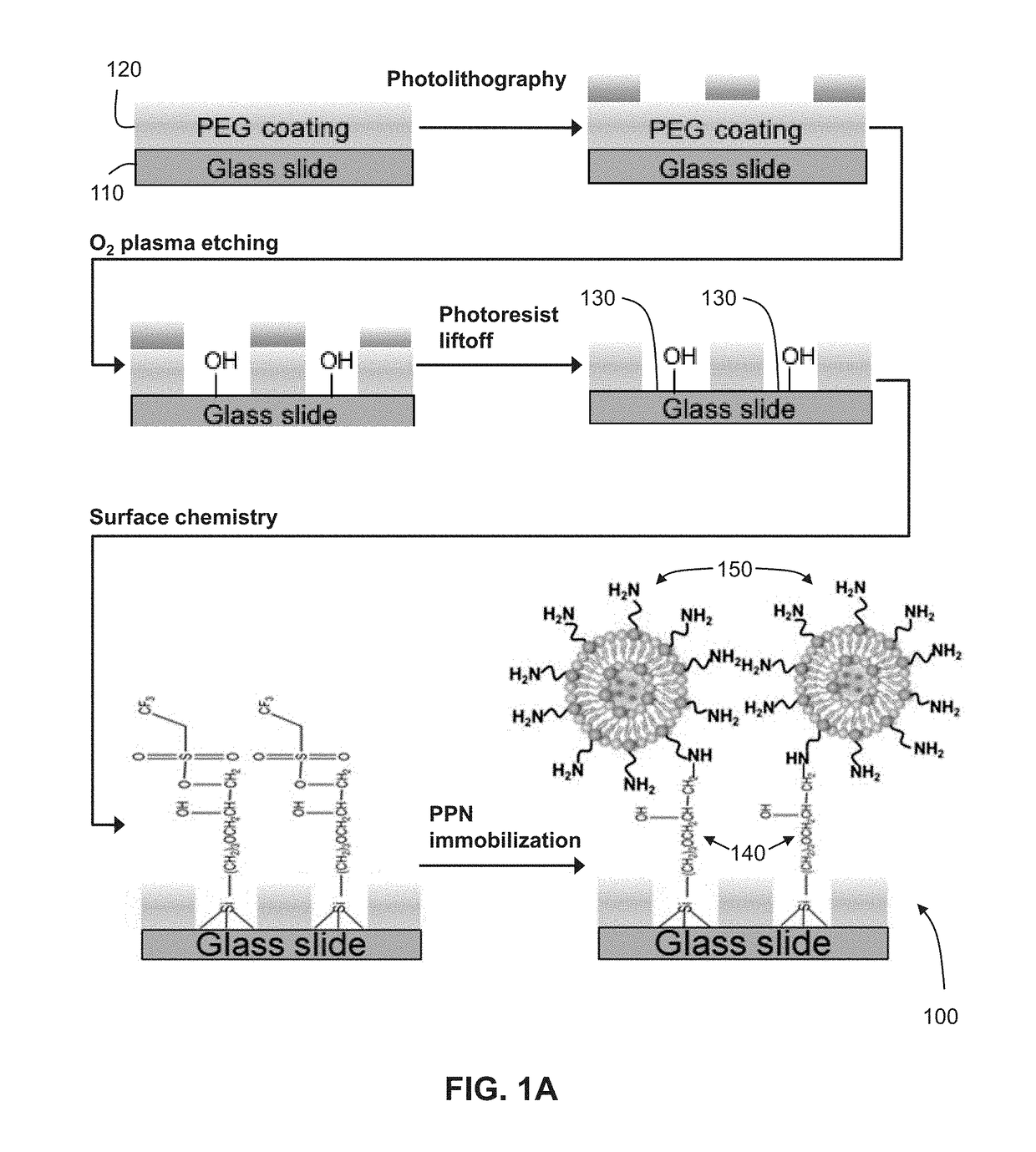
[0080]Referring to FIG. 1A, an exemplary method of fabricating a microarray from a PEG-based substrate is described as follows.

[0081]Preparation of PEGylated Glass Substrates

[0082]Glass cover slips (1.5 mm thickness) were first sonicated in methanol for 15 minutes, then were treated with a mixture of methanol (95%, w / v) and hydrochloric acid (37%) (1:1 v / v) for 30 minutes at room temperature. The samples were then thoroughly washed with water, blown dry with nitrogen gas and briefly heated at 60° C. for 10 minutes to dry out all of water residues. A solution comprised of 0.2% PEG silane in toluene (with 0.8 mL of HCl (37%) / L) was sonicated for 10 minutes prior to adding the glass cover slips. Samples were then shaken for 4...

the structure of the environmentally friendly knitted fabric provided by the present invention; figure 2 Flow chart of the yarn wrapping machine for environmentally friendly knitted fabrics and storage devices; image 3 Is the parameter map of the yarn covering machine
Login to View More

PUM

PropertyMeasurementUnit
Fractionaaaaaaaaaa
Structureaaaaaaaaaa
Heightaaaaaaaaaa
Login to View More

Abstract

Microarray platforms and methods of fabricating said microarrays without traditional high aspect ratio barriers used to define individual array elements are described herein. Self-assembled nanoshells were stabilized with a polymerized scaffold to enhance the stability in physiological conditions and serve as an optical transducer upon molecular recognition events. Soft photolithography combined with surface chemistry was developed for covalent immobilization of nanoshells onto the pre-patterned arrayed microspots for rapid multiplexed detection of membrane-binding analytes. This robust fabrication methodology is amenable for general lipid structures, and thus facilitates the integration of stable membrane architectures into diagnostic and prognostic platforms. In particular, the microarray platform may be used in diverse applications ranging from the detection of pathogens, such bacterial toxin in biological matrices, to cellular membrane studies.

Description

CROSS REFERENCE[0001]This application claims priority to U.S. Provisional Application No. 62 / 505,720 filed May 12, 2017, the specification(s) of which is / are incorporated herein in their entirety by reference.GOVERNMENT SUPPORT[0002]This invention was made with government support under Grant No. R01 GM116946, awarded by NIH. The government has certain rights in the invention.FIELD OF THE INVENTION[0003]The present invention relates to a novel microarray platform and fabrication process for multiplexed detection of a wide range of membrane-interacting particles.BACKGROUND OF THE INVENTION[0004]Cell membranes serve as transducers of the extracellular environment into intracellular signaling, a critical role in cell function. A wide range of binding interactions occur at the cell membrane via protein-ligand, protein-protein, and other interactions that are highly selective and highly specific. The capability to utilize these interactions for purification, preconcentration and quantific...

Claims

the structure of the environmentally friendly knitted fabric provided by the present invention; figure 2 Flow chart of the yarn wrapping machine for environmentally friendly knitted fabrics and storage devices; image 3 Is the parameter map of the yarn covering machine
Login to View More

Application Information

Patent Timeline
15 Nov 2018
Publication
US20180327833A1
IPC
C12Q1/6874; C12Q1/6809; C12Q1/6816; C12Q1/6832; C12Q1/6837
CPC
C12Q1/6874; C12Q1/6809; C12Q1/6816; C12Q1/6832; C12Q1/6837; B01J19/0046; C40B50/18; B01J2219/00527
Inventors
ASPINWALL, CRAIG A.; NGUYEN, PHUONG-DIEM