Battery energy storage control systems and methods
a control system and battery technology, applied in the direction of electric energy management, safety/protection circuits, arrangements for several simultaneous batteries, etc., to achieve the effects of reducing congestion, smooth power fluctuation, and enhancing power quality
- Summary
- Abstract
- Description
- Claims
- Application Information
AI Technical Summary
Benefits of technology
Problems solved by technology
Method used
Image

Examples
example 1
[0078]For power generation / demand shaping the real-time control algorithm is applied to solar power generation with many fluctuations.
[0079]Refer now to FIG. 5 and FIG. 6. FIG. 5 is a graph 500 of output power in W versus minutes that shows the shaping capability of software for smoothing solar power fluctuations on a typical day, using data obtained from solar panels. Here, the output power of the solar system 502 and the ones of the solar and battery system 504 are shown.
[0080]FIG. 6 is a graph 600 of battery power flux in W versus minutes. Here, the curve 602 shows the performance of battery storage system. The advantage of this method is that at the end of the day the state of charge of battery doesn't change.
[0081]From the FIG. 5, there can be seen some fluctuations in the output power, due to the computational and execution delays of the controller and devices, but the root-mean-square deviation (RMSD) or root-mean-square error (RMSE) show 86% improvement in smoothing the fluc...
example 2
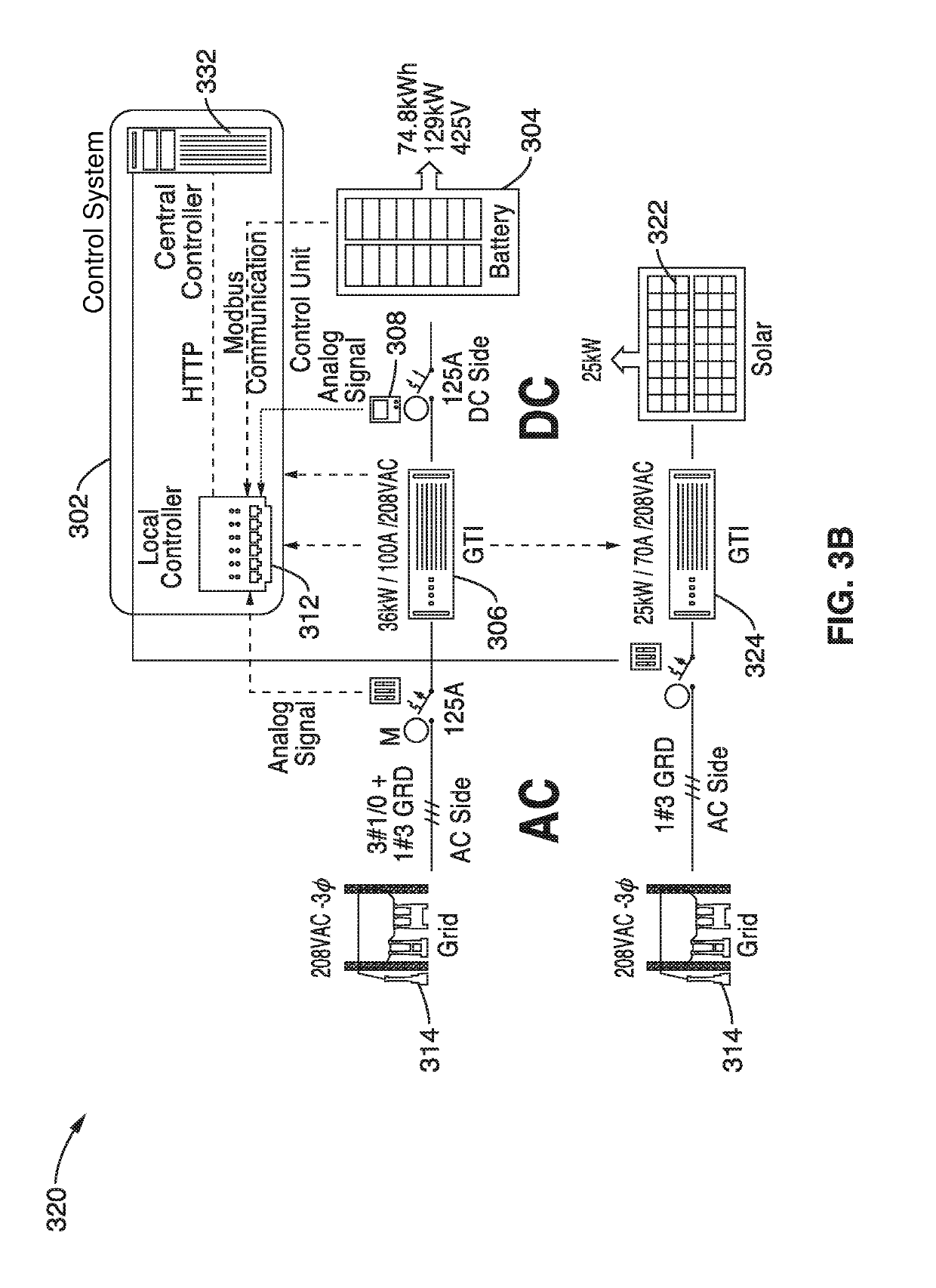
[0160]Refer now to FIG. 10, which is a graph 1000 of DC Fast Charging (DCFC) 1002 and power seen by the grid 1004 versus time. This would be roughly the system previously described in FIG. 3C. This second example application is power demand shifting, which is used to cut the peak demand of a level 3 DCFC charging station: one of the high demanding loads on the grid. The same technology developed in the last section is applied to this new application. FIG. 10 shows the result of this application under test.
[0161]Refer now to FIG. 11, which is a graph 1100 of battery power output 1102 versus time for the DCFC load test. During the test, the battery discharges for a short period to cut and compensate the level 3 charger station power demand and afterward continues charging. The battery power output 1102 curve shows the reaction of the battery.
[0162]Due to limitation of battery energy storage system (BESS) power capacity (36 kw) compared with the load (50 kw) the BESS is not able to com...
example 3
[0163]A third example application is controlling the active and reactive power for voltage regulation purpose in distribution system.
[0164]The intermittent nature of modern power generation and loads, for example renewable energy sources and EV loads, impacts the load profile of the low voltage distribution feeder. The wide penetration of these new loads and generation sources may cause challenges to grid distribution.
[0165]One of these challenges is overloading of transformers and high voltage drops at the end of a feeder, or over-generation and voltage increase at the point of the renewables connection.
[0166]When overloading occurs, transformers and power cables will need to be replaced. However, such equipment is extremely costly, and it is often a difficult task to replace them. On the other hand, the over-generation problem normally is solved by curtailment renewable energy generation, which essentially wastes free energy.
[0167]One practical and effective solution to achieve fl...
PUM
 Login to View More
 Abstract
Description
Claims
Application Information
 Login to View More
 - R&D
- Intellectual Property
- Life Sciences
- Materials
- Tech Scout
- Unparalleled Data Quality
- Higher Quality Content
- 60% Fewer Hallucinations
Browse by: Latest US Patents, China's latest patents, Technical Efficacy Thesaurus, Application Domain, Technology Topic, Popular Technical Reports.
© 2025 PatSnap. All rights reserved.Legal|Privacy policy|Modern Slavery Act Transparency Statement|Sitemap|About US| Contact US: help@patsnap.com