PRECURSOR AND METHOD FOR PREPARING Ni BASED CATHODE MATERIAL FOR RECHARGEABLE LITHIUM ION BATTERIES
- Summary
- Abstract
- Description
- Claims
- Application Information
AI Technical Summary
Benefits of technology
Problems solved by technology
Method used
Image



Examples
example 2 (
Manufacturing Example 2 (Counterexample)
[0045]This example provides a crystalline precursor (lithium deficient sintered precursor) to prepare high Ni-excess NMC on a large-scale by double sintering. The process includes among others two sintering steps:
1) 1st blending: to obtain a lithium deficient sintered precursor, Li2CO3 and the mixed transition metal source are homogenously blended for 30 minutes.
2) 1st sintering: the mixture from the 1st blending step is sintered at 900° C. for 10 hours under dry air atmosphere in a tray based furnace. The dry air is continuously pumped into the equipment at a flow rate of 40 L / h. After the 1st sintering, the sintered cake is crushed, classified, and sieved so as to ready it for the 2nd blending step. The product obtained from this step is a lithium deficient sintered precursor, meaning that the Li / M′ atomic ratio in LiM′O2 is less than 1. The composition of this intermediate product is verified by a standard ICP test.
3) 2nd blending: the lith...
manufacturing example 3 (
Example According to the Invention)
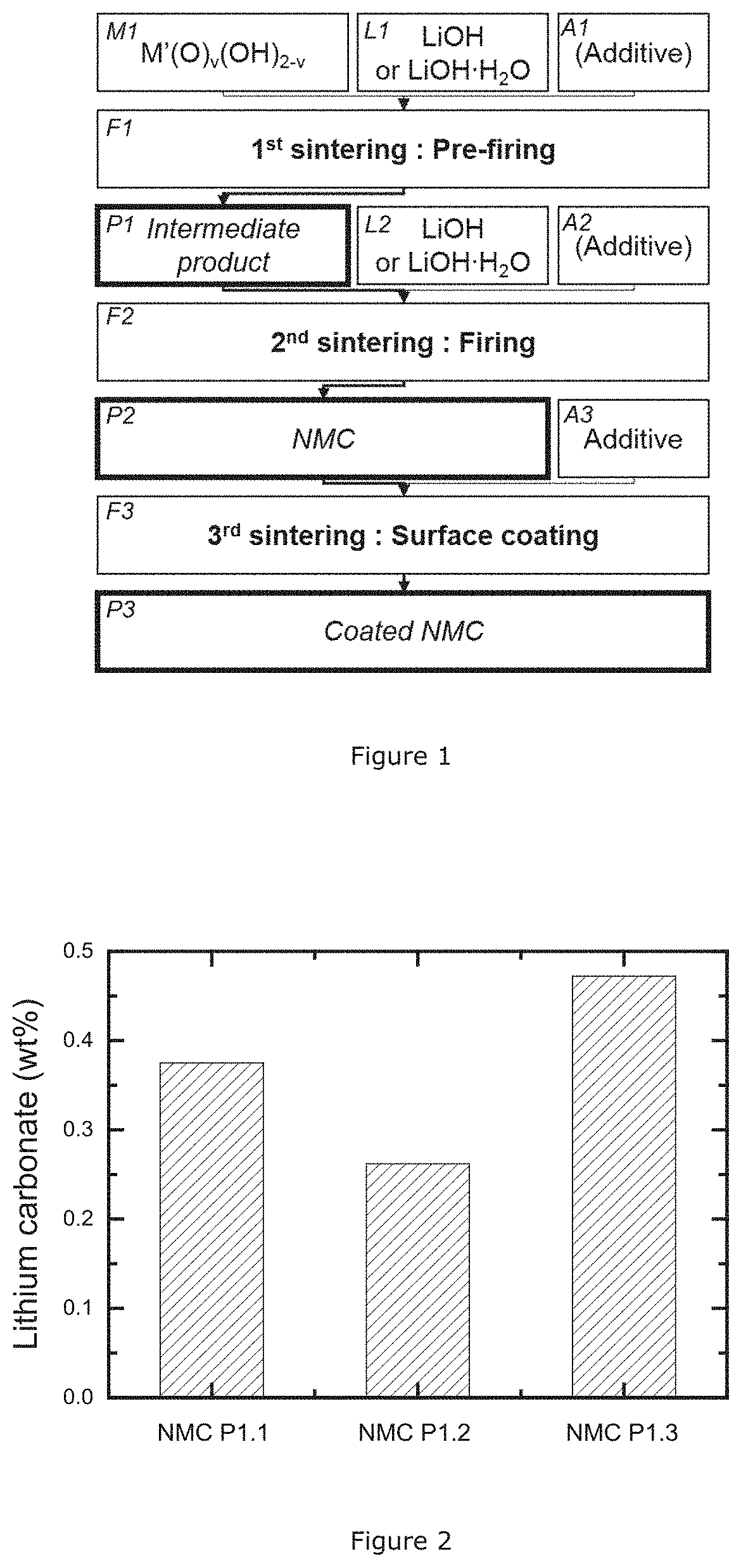
[0046]This invention discloses a process to obtain high Ni-excess NMC with a low soluble base content by a double firing method and is illustrated in FIG. 1. The double firing includes a 1st sintering (F1) which delivers an intermediate product (P1), and a second sintering delivering the final lithium metal oxide (P2). First, a transition metal precursor (M1) is mixed with a lithium source (L1). Transition metal precursors are selected from hydroxides, oxyhydroxides, carbonates, mixed oxide, etc. Preferable Ni, Mn, and Co are present and well mixed at atomic scale. The lithium source is selected from lithium hydroxide, lithium hydroxide hydrate, or lithium oxide. The lithium source is essentially free of Li2CO3. Additionally additives (A1) like Al2O3, MgO, etc. may be added for obtaining a doped final material. Additives can be oxides, hydroxides, carbonates, sulfates, etc. A 1st sintering step (F1)—which is the pre-firing—is applied and provides a...
example 2
Surface Coating Example 2
[0056]Referring back to FIG. 1, an aluminum and fluorine coated NMC is obtained by blending and subsequent sintering (F3) using an aluminum source (as described before) and a fluorine-containing polymer (A3). A typical example for such a polymer is a PVDF homopolymer or PVDF copolymer (such as HYLAR®) or SOLEF® PVDF, both from Solvay SA, Belgium). Another known PVDF based copolymer is for example a PVDF-HFP (hexa-fluoro propylene). Such polymers are often known under the name “Kynar®”. Teflon—or PTFE—could also be used as polymer. For the sintering step, the sintering temperature of the mixture is at least 250° C., preferably at least 350° C. The sintering time here is preferably at least 3 hours, more preferably at least 5 hours. In the sintering step, the crystalline structure of the fumed alumina is maintained during the coating process and is found in the coating layer surrounding the lithium metal oxide core. Also, the fluorine-containing polymer is com...
PUM
 Login to View More
 Abstract
Description
Claims
Application Information
 Login to View More