Check patentability & draft patents in minutes with Patsnap Eureka AI!

Water injection into a hydrocarbon reservoir

Pending Publication Date: 2020-12-24
CONOCOPHILLIPS CO
View PDF2 Cites 4 Cited by
  • Summary
  • Abstract
  • Description
  • Claims
  • Application Information

AI Technical Summary

Benefits of technology

The invention is about a method and apparatus for injecting water into a hydrocarbon reservoir. The method involves using a pressure-retarded osmotic membrane to draw water from two different salinities and pressures, and then using a booster pump to increase the pressure of the injection stream. The apparatus includes the membrane, pumps, and a pretreatment and post-treatment unit. The technical effects of the invention include a more efficient method for injecting water into a hydrocarbon reservoir, with lower salinity and pressure, and a reduced risk of contamination.

Problems solved by technology

The injection of water is associated with an energy cost; increasingly producers are seeking to lower the cost of production of hydrocarbons and there is an ongoing need to reduce the energy input and therefore the financial cost of waterflooding.
Depending on the composition of the two streams, commingling can result in undesirable precipitation of solids.
This precipitation is highly undesirable as it can lead to plugging of the reservoir with solids and reduce the effectiveness of waterflooding and / or add to the pumping energy needed.
If there is an incompatibility, undesirable solids can form due to chemical interactions between the PW / seawater and the connate water.
Regarding (a), produced water typically has a very high salinity which can reduce its effectiveness in waterflooding applications.
Also, depending on actual conditions, there may not be sufficient PW available so a second source of water may be needed.
Regarding (c), when seawater and PW are commingled, compatibility issues may arise and result in precipitation of inorganics, e.g. barium sulfate.
Also, seawater contains significant organics that can lead to biogrowth and / or reservoir souring.
Regarding (d), although seawater is readily available, there can be compatibility issues with the connate water that can ultimately lead to injectivity challenges.

Method used

the structure of the environmentally friendly knitted fabric provided by the present invention; figure 2 Flow chart of the yarn wrapping machine for environmentally friendly knitted fabrics and storage devices; image 3 Is the parameter map of the yarn covering machine
View more

Image

Smart Image Click on the blue labels to locate them in the text.
Viewing Examples
Smart Image
  • Water injection into a hydrocarbon reservoir
  • Water injection into a hydrocarbon reservoir
  • Water injection into a hydrocarbon reservoir

Examples

Experimental program
Comparison scheme
Effect test

examples 1-8

, Including Comparative Examples 1-5

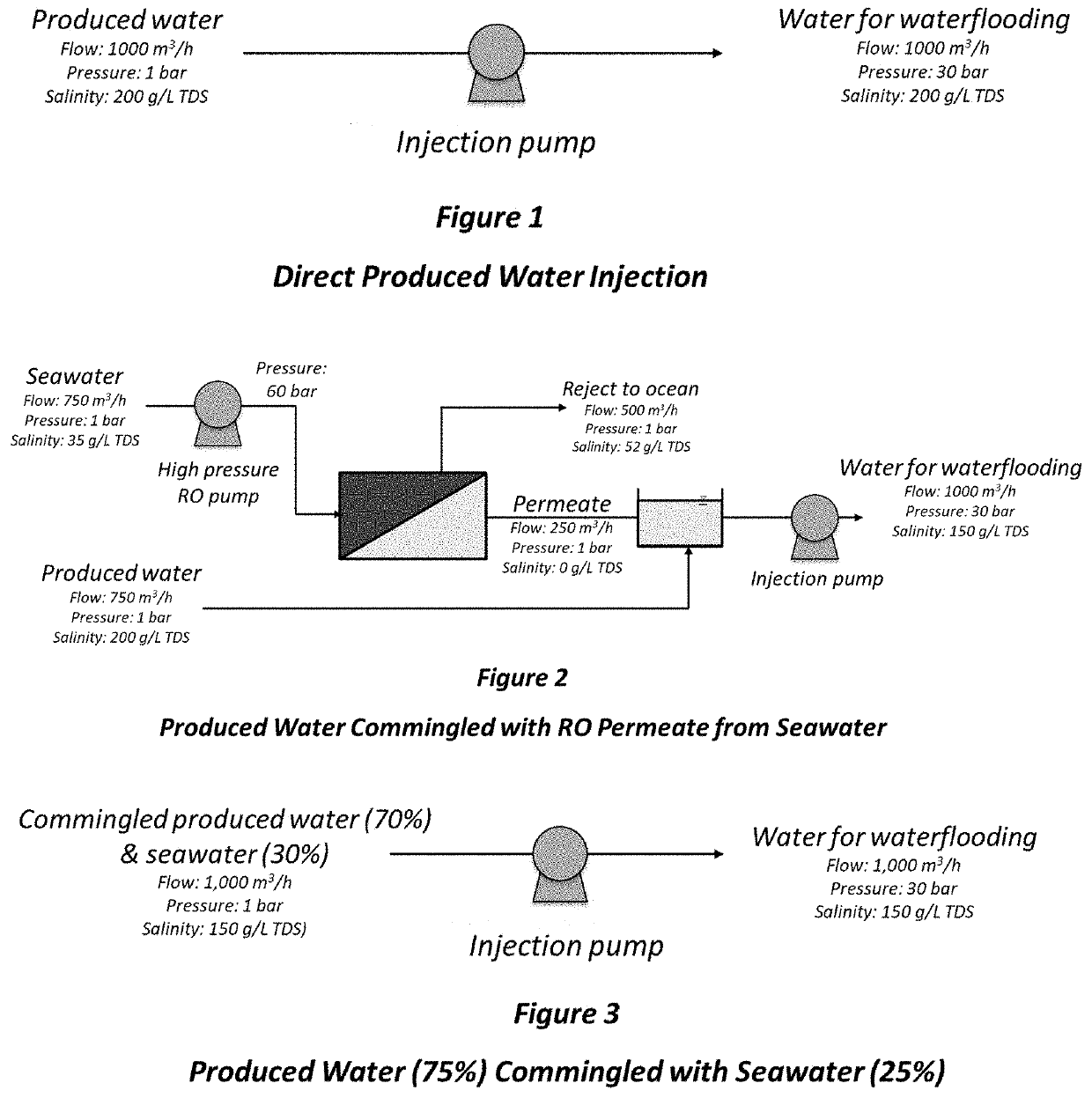
[0072]Each of these examples is a theoretical calculation of the power requirements for the individual pumps and the total power required (see Tables 1 and 2). The power requirements were calculated based on the following assumptions:

Waterflooding flow required: 1,000 m3 / h

Injection pressure needed: Examples 1-7: 30 bar (3 MPa); Example 8: 60 bar (6 MPa)

PRO pressure: Examples 6 & 8: 30 bar (3 MPa); Example 7: 3 bar (0.3 MPa)

PW salinity: 200 g / L (20%) total dissolved solids (TDS)

Seawater TDS: 35 g / L

[0073]Seawater RO operating pressure: 60 bar (6 MPa)

Seawater RO recovery: 33%

Nanofilter operating pressure: 20 bar (2 MPa)

Nanofilter recovery: 67%

Temperature: 25° C.

[0074]Pump efficiency: 75%

Produced water dilution by PRO permeate: 25%

[0075]For Example 8, the energy benefit is not directly comparable since the required injection pressure is assumed to be 60 bar (60 MPa).

[0076]The following pumping energy equation was used to derive these results:

Ph(kW)=qρ...

example 6

[0089]This Example (see FIG. 6) also assumes the same requirements as the comparative examples in terms of pressure and flow rate of injected water. A high pressure pump conveys PW with a salinity of 200 g / L TDS at 30 bar (3 MPa) and a flow rate of 750 m3 / h to a pressure retarded osmosis (PRO) unit as the “draw” stream. Another low pressure pump conveys seawater (salinity 35 g / l TDS) at 3 bar (0.3 MPa) and a flow rate of 750 m3 / h to the PRO unit as the “feed” stream.

[0090]Because the osmotic pressure differential exceeds the hydrostatic head differential, pure water is drawn across the PRO membrane against the static pressure head from the seawater stream to the PW stream. At the assumed permeate recovery rate of 33%, the permeate flow is 250 m3 / h. The permeate flow combined with the original PW flow is now 1000 m3 / h and the pressure remains at 30 bar (3 MPa). Through the addition of the permeate, the salinity of the PW has been reduced by 25% from 200 g / L to 150 g / L TDS. This flow ...

example 7

[0091]In the event that the required injection pressure is higher than the limit for commercially available PRO membranes, or simply because the existing equipment arrangement favours having the PRO unit upstream, it may be desirable to have the high-pressure pump located after the PRO unit. FIG. 7 shows an example of this arrangement. Low pressure pumps convey 750 m3 / h of both PW and seawater streams each at 3 bar (0.3 MPa) to the PRO unit. Although the term “pressure retarded osmosis” is used, in fact there is a negligible pressure increase across the membrane in this example and the process is more accurately referred to as “osmotic dilution” of the produced water. The 30 bar (3 MPa) injection pressure can be higher or lower but is used in this example to provide an effective method for comparing the various configurations. Although energy savings are not realized, the key benefits of i) more water available for waterflooding, ii) lower salinity and iii) less reservoir incompatib...

the structure of the environmentally friendly knitted fabric provided by the present invention; figure 2 Flow chart of the yarn wrapping machine for environmentally friendly knitted fabrics and storage devices; image 3 Is the parameter map of the yarn covering machine
Login to View More

PUM

No PUM Login to View More

Abstract

The invention relates to the production of hydrocarbons and in particular to waterflooding, or the injection of water into a hydrocarbon reservoir to assist recovery of the hydrocarbons. It is often desirable to use produced water (PW) for waterflooding, whereas seawater (which is often more convenient to use) can cause issues such as undesirable precipitation in the reservoir and associated pipelines and equipment. Often there is insufficient PW and the supply of PW needs to be supplemented. It is also often desirable to reduce the salinity of the PW. The invention contemplates an osmotic process in which the high salinity PW acts as a draw solution and lower salinity seawater is used as a feed. The PW supply may be pressurized in preparation for injecting it into the reservoir and then passed through an osmotic membrane element, whilst low pressure seawater is passed through the osmotic membrane element on the other side. The lower salinity of the seawater leads to an osmotic pressure difference across the membrane causing a pure water permeate to enter the PW stream, whilst maintaining the pressure of the PW stream. In this way, the volume of the PW injection stream is increased without reducing the pressure, the specific energy requirement for injecting water into the reservoir are reduced and undesirable components of the seawater are removed.

Description

CROSS-REFERENCE TO RELATED APPLICATIONS[0001]This application is a non-provisional application which claims benefit under 35 USC § 119(e) to U.S. Provisional Application Ser. No. 62 / 864,315 filed Jun. 20, 2019, entitled “WATER INJECTION INTO A HYDROCARBON RESERVOIR” which is incorporated herein in its entirety.STATEMENT REGARDING FEDERALLY SPONSORED RESEARCH OR DEVELOPMENT[0002]None.FIELD OF THE INVENTION[0003]This invention relates to the injection of water under pressure into a hydrocarbon reservoir to facilitate the recovery of hydrocarbons from the reservoir.BACKGROUND OF THE INVENTION[0004]The oil & gas industry continuously strives to increase the recovery of hydrocarbons from underground reservoirs. One widely used technique is called “waterflooding”: the injection of water into the reservoir to increase pressure and displace hydrocarbons from within the formation. This is considered “secondary recovery” and typically follows “primary recovery” wherein the natural pressure an...

Claims

the structure of the environmentally friendly knitted fabric provided by the present invention; figure 2 Flow chart of the yarn wrapping machine for environmentally friendly knitted fabrics and storage devices; image 3 Is the parameter map of the yarn covering machine
Login to View More

Application Information

Patent Timeline
no application Login to View More
IPC IPC(8): C02F1/44B01D61/00B01D61/02E21B43/20
CPCC02F1/44B01D61/002C02F2103/10C02F2103/08B01D61/025E21B43/20C02F1/445B01D61/0022
Inventor JANSON, ARNOLDADHAM, SAMERMINIER-MATAR, JOELDARDOR, DAREENSHARMA, RAMESHAL-MAAS, MASHAEL
Owner CONOCOPHILLIPS CO
Features
  • R&D
  • Intellectual Property
  • Life Sciences
  • Materials
  • Tech Scout
Why Patsnap Eureka
  • Unparalleled Data Quality
  • Higher Quality Content
  • 60% Fewer Hallucinations
Social media
Patsnap Eureka Blog
Learn More