Methods for manufacturing thermoplastic liquid crystal polymer film and circuit board
a liquid crystal polymer film and thermoplastic technology, applied in the direction of synthetic resin layered products, chemistry apparatus and processes, other domestic articles, etc., can solve the problems of the film that does not meet the above state cannot improve the adhesive property, so as to avoid local adhesion failure, improve the adhesion, and reduce the melting point
- Summary
- Abstract
- Description
- Claims
- Application Information
AI Technical Summary
Benefits of technology
Problems solved by technology
Method used
Image

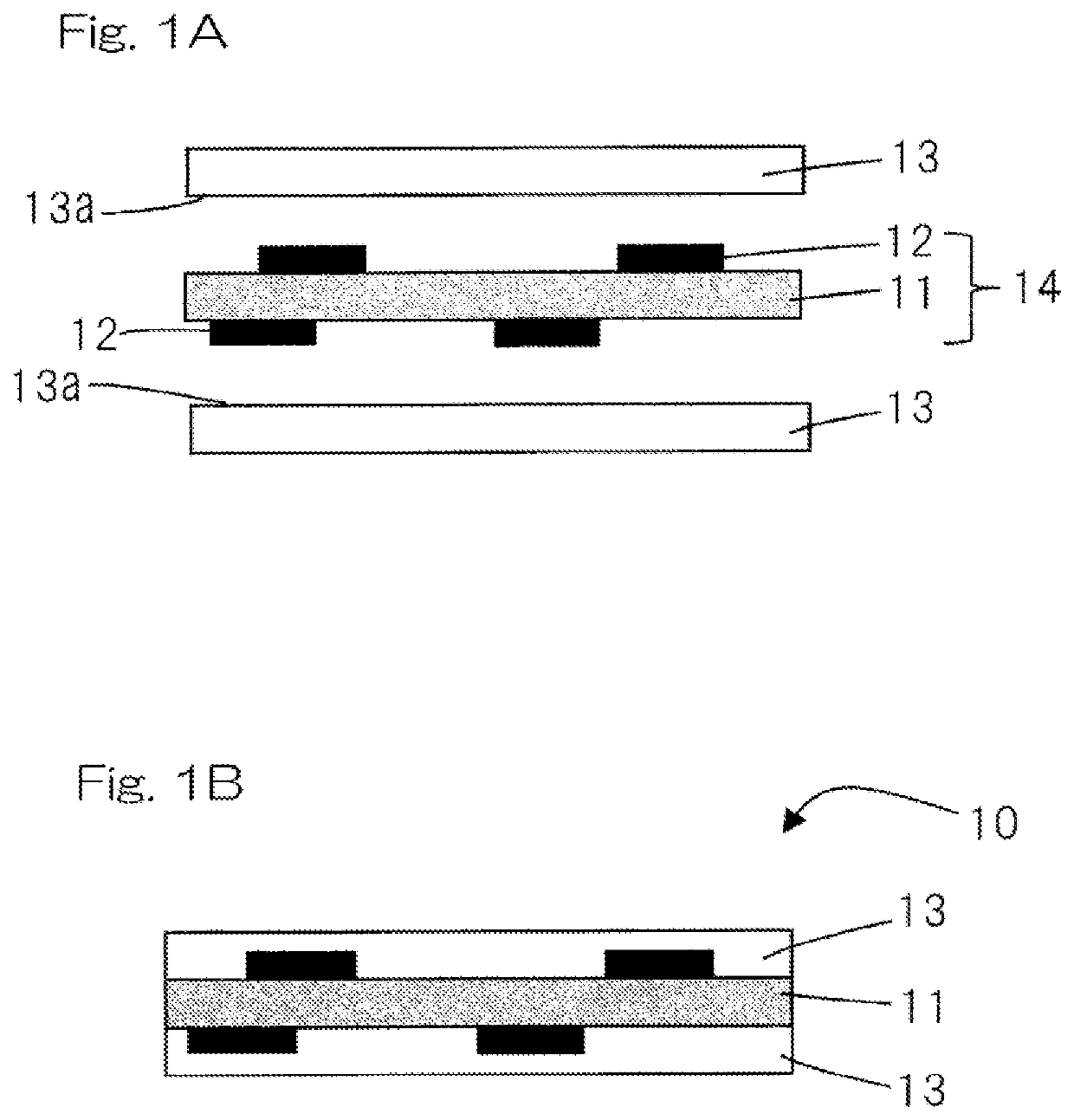
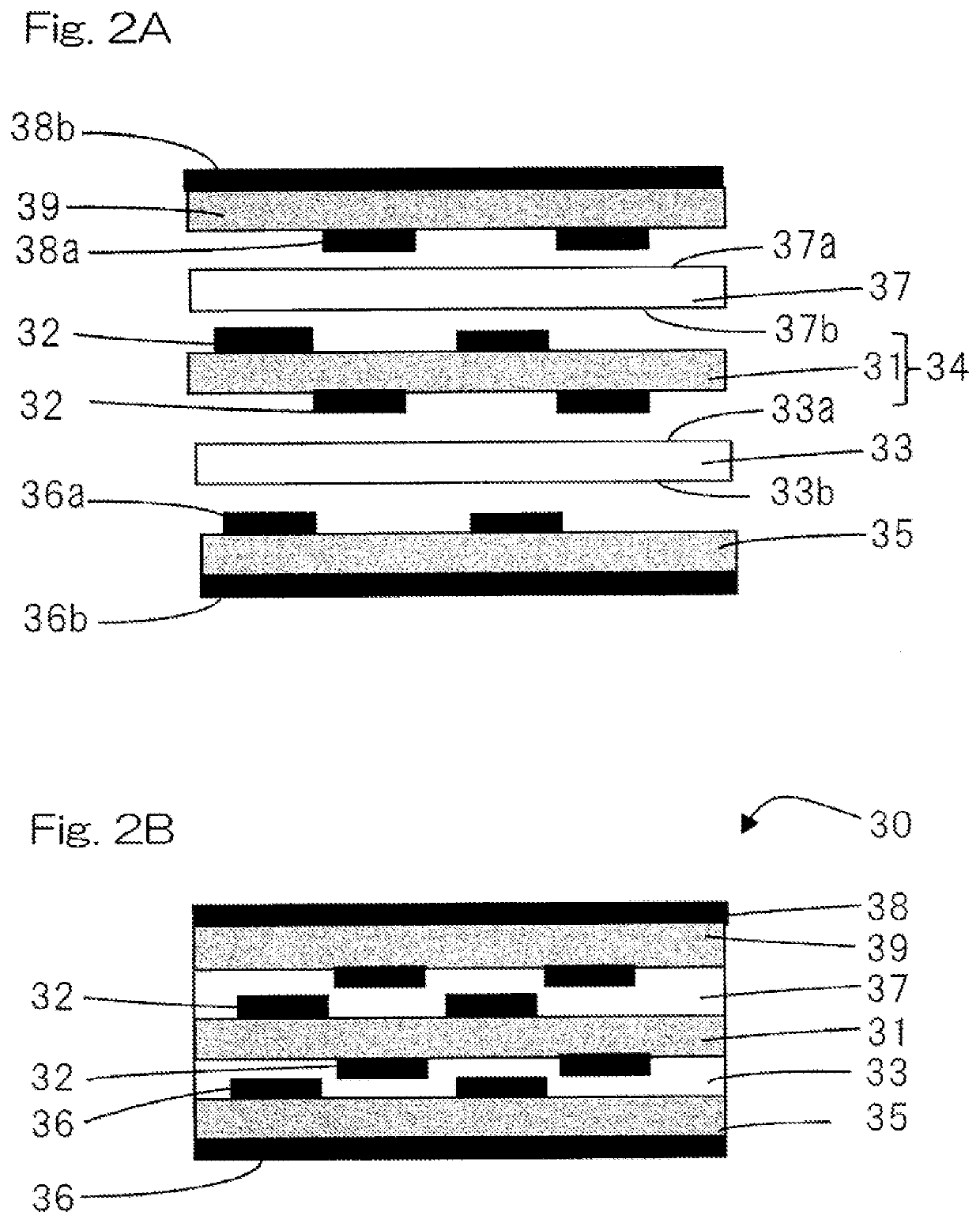
Examples
example 1
(1) Production of Adhesive LCP Film (Adhesive Film)
[0232]From a copolymerization product of p-hydroxybenzoic acid and 6-hydroxy-2-naphthoic acid (mole ratio: 73 / 27) was obtained a TLCP film having a melting point of 280° C. and a film thickness of 50 μm. The TLCP film had a moisture content of 400 ppm and an SOR of 1.02.
(2) Production of Unit Circuit Board (Adherend Film)
[0233]From a copolymerization product of p-hydroxybenzoic acid and 6-hydroxy-2-naphthoic acid (mole ratio: 73 / 27) was obtained a TLCP film having a melting point of 280° C. and a film thickness of 50 μm. The TLCP film was heat-treated under nitrogen atmosphere at 260° C. for 4 hours, and at 280° C. for another 2 hours to increase a melting point into 320° C. to obtain an adherend film. Onto each surface of the film, a rolled copper foil with a thickness of 12 μm and a predetermined surface roughness was set to be laminated using a continuous heat-pressing machine with a pair of rolls at a roll temperature of 300° C....
example 2
[0236]Each of the surfaces to be adhered in the adhesive LCP film and the unit circuit boards obtained in Example 1 was subjected to UV-irradiation by irradiating 254 nm of ultra-violet ray at an irradiation amount of 400 mJ / cm2 at a distance between the light source and the surface to be irradiated of 2 cm for 1.05 minutes using a UV-irradiation machine “UV-surface Treating Machine” available from SEN ENGENEERING CO., LTD.
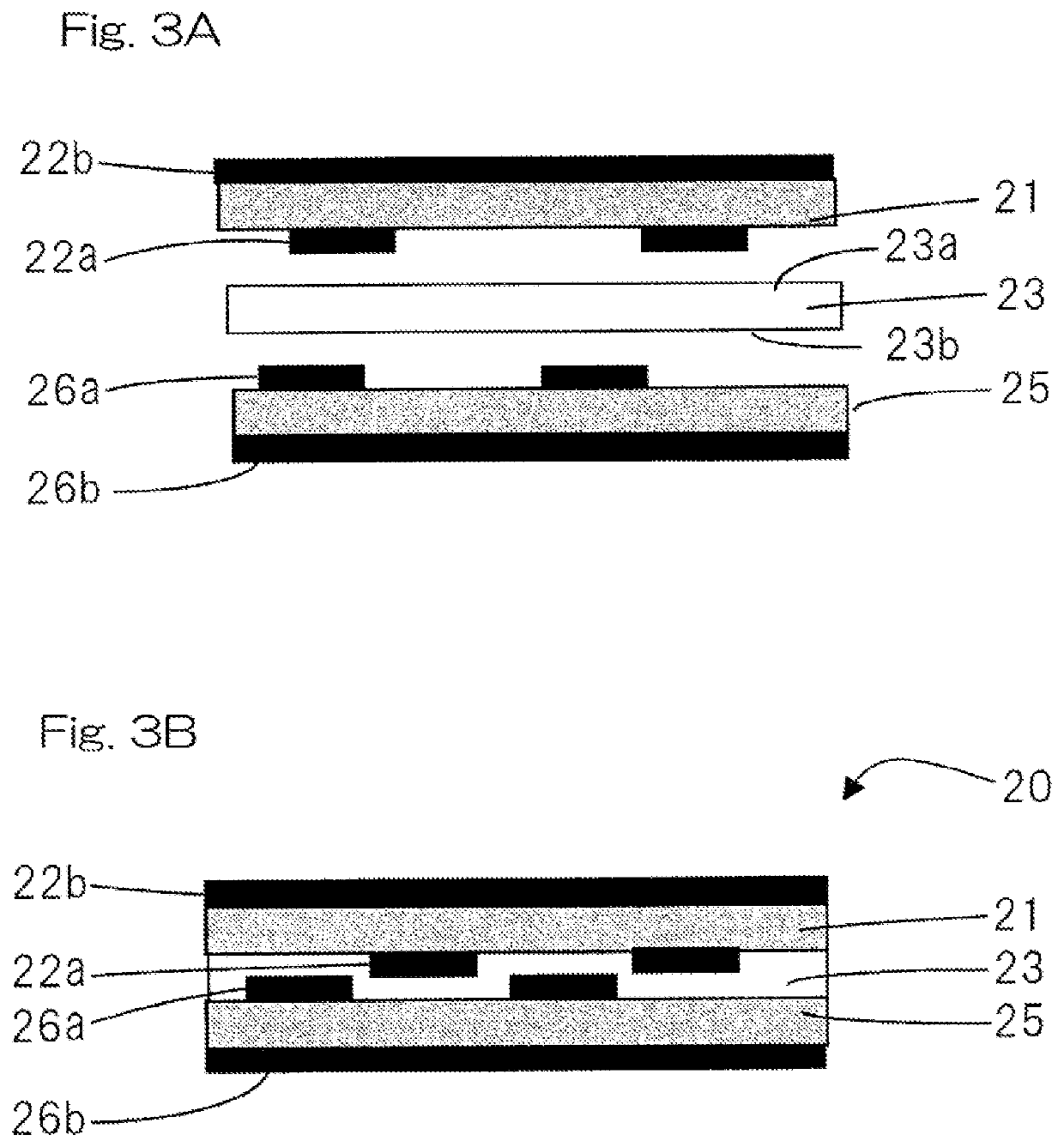
[0237]Thus-obtained adhesive LCP film 23 was used as a bonding sheet. As shown in the circuit board configuration in FIGS. 3A and 3B, the adhesive LCP film 23 was interposed between two sheets of the insulating substrates 21 and 25 to obtain a stacked material. The stacked material was placed in a vacuum heat press apparatus. It should be noted that the insulating substrate 21 had a conductor circuit 22a and a conductor layer 22b on both surfaces, respectively, to configure a unit circuit board; and that the insulating substrate 25 had a conductor circuit 26a and ...
example 3
[0239]Before being placed in a vacuum heat press apparatus, the adhesive LCP film and the unit circuit boards obtained in Example 1 were subjected to degassing under heating so as to decrease moisture contents of them to be 200 ppm or lower. Except for subjecting them to the degassing, the same configuration was adopted with Example 1. It should be noted that degassing under heating was carried out by heating the adhesive films obtained in Example 1 at 120° C. for 60 minutes.
[0240]Thus-obtained adhesive LCP film 23 was used as a bonding sheet. As shown in the circuit board configuration in FIGS. 3A and 3B, the adhesive LCP film 23 was interposed between two sheets of the insulating substrates 21 and 25 to obtain a stacked material. The stacked material was placed in a vacuum heat press apparatus. It should be noted that the insulating substrate 21 had a conductor circuit 22a and a conductor layer 22b on both surfaces, respectively, to configure a unit circuit board; and that the ins...
PUM
| Property | Measurement | Unit |
|---|---|---|
| temperature | aaaaa | aaaaa |
| temperature | aaaaa | aaaaa |
| thickness | aaaaa | aaaaa |
Abstract
Description
Claims
Application Information
 Login to View More
 - R&D
- Intellectual Property
- Life Sciences
- Materials
- Tech Scout
- Unparalleled Data Quality
- Higher Quality Content
- 60% Fewer Hallucinations
Browse by: Latest US Patents, China's latest patents, Technical Efficacy Thesaurus, Application Domain, Technology Topic, Popular Technical Reports.
© 2025 PatSnap. All rights reserved.Legal|Privacy policy|Modern Slavery Act Transparency Statement|Sitemap|About US| Contact US: help@patsnap.com