Unlock instant, AI-driven research and patent intelligence for your innovation.

Selective base etching

Inactive Publication Date: 2005-02-08
INFINEON TECH AG
View PDF16 Cites 3 Cited by
  • Summary
  • Abstract
  • Description
  • Claims
  • Application Information

AI Technical Summary

Benefits of technology

The object of the present invention is to resolve the above problems and thus being able to produce semiconductor components, particularly bipolar transistors, of higher quality and / or higher performance and / or of smaller size than those semiconductor components produced by hitherto known methods.
The resultant structure is patterned, whereafter the dielectric layer and the silicon-germanium layer are etched, preferably dryetched, within a predetermined area. During the etching, end point detection of germanium, e.g. performed by means of emission spectroscopy, may be performed to accurately control the etching of the silicon-germanium layer.
The inventive etching method provides structures, which have sharply defined edges and smooth pronounced etch surfaces in absence of pillar or facet formation tendencies. Further, good etching selectivity between the silicon-germanium and the crystalline silicon is obtained. This results in semiconductor components of improved performance in relation to earlier produced semiconductor components.
Particularly when manufacturing a bipolar transistor having a self-registered base emitter structure the above etching process can be employed when etching the emitter opening and in such a manner semiconductor devices of very small dimensions (length scales in the submicrometer range) can be produced. The advantages obtained with the present method include good etching selectivity when etching silicon-germanium on crystalline silicon, good CD control (Critical Dimension control), i.e. good control of the dimensions of the etched emitter opening, and avoidance of the risk for channeling of dopants.

Problems solved by technology

Those problems that occur when etching selectively a polycrystalline silicon layer from a silicon substrate involve difficulties in stopping the etching process so that the polycrystalline silicon layer is removed completely without etching the substrate too deeply.
Nevertheless the etching selectivity for etching amorphous silicon on monocrystalline silicon may in some instances be too low.
Typically, a certain degree of overetching down into the substrate is allowed but in the manufacture of bipolar transistors having an epitaxially formed base such overetching is not allowed and, thus, the etching selectivity may be insufficient.

Method used

the structure of the environmentally friendly knitted fabric provided by the present invention; figure 2 Flow chart of the yarn wrapping machine for environmentally friendly knitted fabrics and storage devices; image 3 Is the parameter map of the yarn covering machine
View more

Image

Smart Image Click on the blue labels to locate them in the text.
Viewing Examples
Smart Image
  • Selective base etching
  • Selective base etching
  • Selective base etching

Examples

Experimental program
Comparison scheme
Effect test

Embodiment Construction

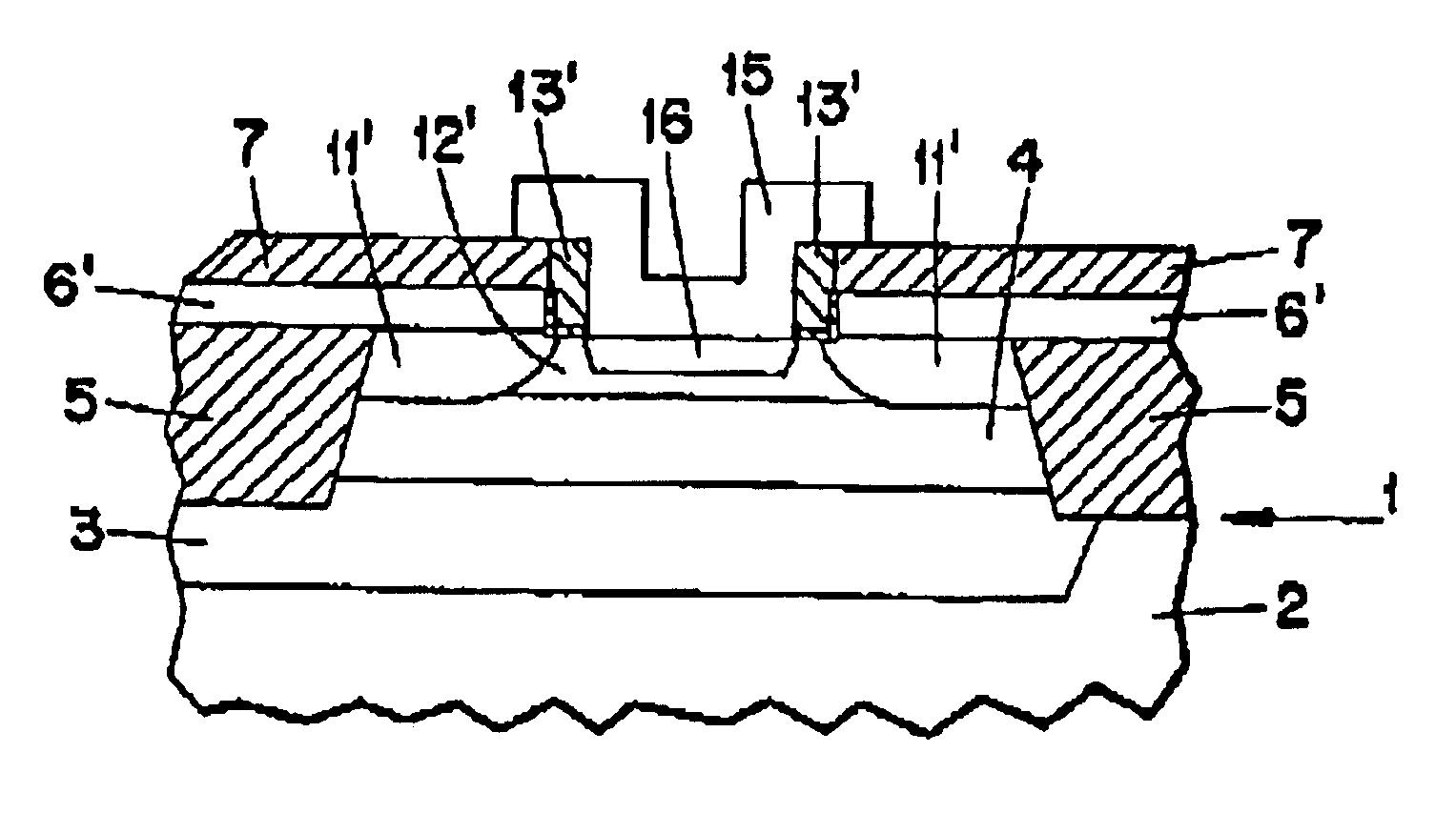
Shown in FIG. 1 is a silicon substrate 1, wherein the silicon may be monocrystalline, polycrystalline or microcrystalline but is preferably monocrystalline. As in FIG. 1 the substrate 1 may have various defined regions 2-5, which will be described below more in detail. Such regions may include a doped region, particularly a region doped with boron, and / or a region containing germanium. The substrate may alternatively be homogeneous. Any surface oxide present on the substrate 1, possibly having a thickness of some nanometers, can be removed by conveniently dipping the substrate in an HF bath or in an HF vapor.

In accordance with the invention there is deposited a layer 6 of silicon-germanium on the substrate 1 to a thickness of some hundreds of nanometers, preferably by employing RP-CVD technique typically in a temperature interval of 500-550 C. The exact temperature to achieve the desired layer structure will depend on the germanium concentration and level of in-situ doping of dopant...

the structure of the environmentally friendly knitted fabric provided by the present invention; figure 2 Flow chart of the yarn wrapping machine for environmentally friendly knitted fabrics and storage devices; image 3 Is the parameter map of the yarn covering machine
Login to View More

PUM

No PUM Login to View More

Abstract

A method for selective etching in the manufacture of a semiconductor device comprises: forming a layer (6) of silicon-germanium on a substrate (1) of monocrystalline silicon or on a substrate at least comprising a surface layer of monocrystalline silicon, depositing at least a dielectric layer (7) on the silicon-germanium layer (6) and patterning the resultant structure (8), whereafter the dielectric layer (7) and the silicon-germanium layer (6) are etched away within a predetermined region (9). Preferably, the silicon-germanium layer (6) is amorphous, whereby the dielectric layer (7) is deposited on the amorphous silicon-germanium layer (6) in such a manner to prevent crystallization of the amorphous layer. After etching the structure may be heat-treated such that the amorphous layer crystallizes. The method is preferably applicable for etching an emitter window in the manufacture of a bipolar transistor having a self-registered base-emitter structure.

Description

TECHNICAL FIELD OF THE INVENTIONThe present invention relates to a method of etching selectively when manufacturing a semiconductor device and to a method in the manufacturing of a bipolar transistor while applying said method of etching selectively.DESCRIPTION OF THE RELATED ARTThe trend in design and manufacture of integrated circuits leans towards progressively smaller individual components of progressively higher performance. The dimensions of bipolar transistors are e.g. becoming progressively smaller, both horizontally and vertically, so as to increase the packing density and transistor speed. The manufacturing precision has therewith become progressively more important, both with regard to individual process steps and with regard to alignment of different layers.In the manufacture of bipolar high frequency transistors there is today normally used a technique that employs a self-registered base-emitter structure (T. H. Ning et al. “Self-aligned npn bipolar transistors” IEDM Te...

Claims

the structure of the environmentally friendly knitted fabric provided by the present invention; figure 2 Flow chart of the yarn wrapping machine for environmentally friendly knitted fabrics and storage devices; image 3 Is the parameter map of the yarn covering machine
Login to View More

Application Information

Patent Timeline
no application Login to View More
IPC IPC(8): H01L21/331H01L21/02H01L21/3213
CPCH01L29/66242H01L21/32137
Inventor JOHANSSON, TEDNORSTROM, HANS
Owner INFINEON TECH AG