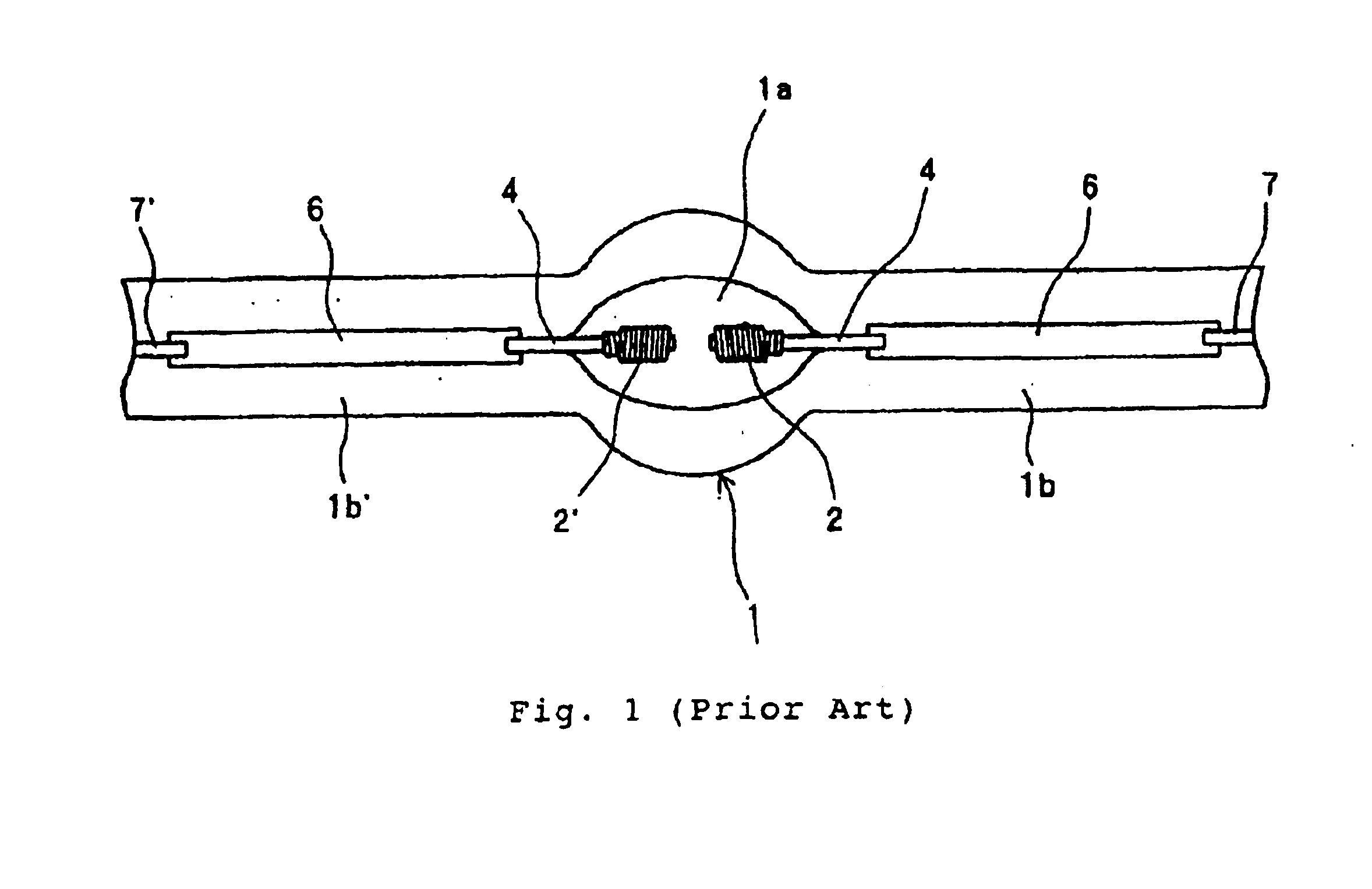
It is an object of the present invention to provide a high-pressure discharge lamp that, in view of the increased operating pressure of 200 atmospheres or more, greatly reduces the causes of breakage of the lamp. To this purpose, the present invention provides a construction of a high-pressure discharge lamp that, in comparison with the prior art, can more effectively eliminate the concentration of stress and glass cracks in the vicinity of the junctions of the electrodes and metal foil parts and more effectively eliminate the effects of corrosion caused by halogen gas in the above-described vicinity of the junctions, these factors being causes for breakdown of a lamp.
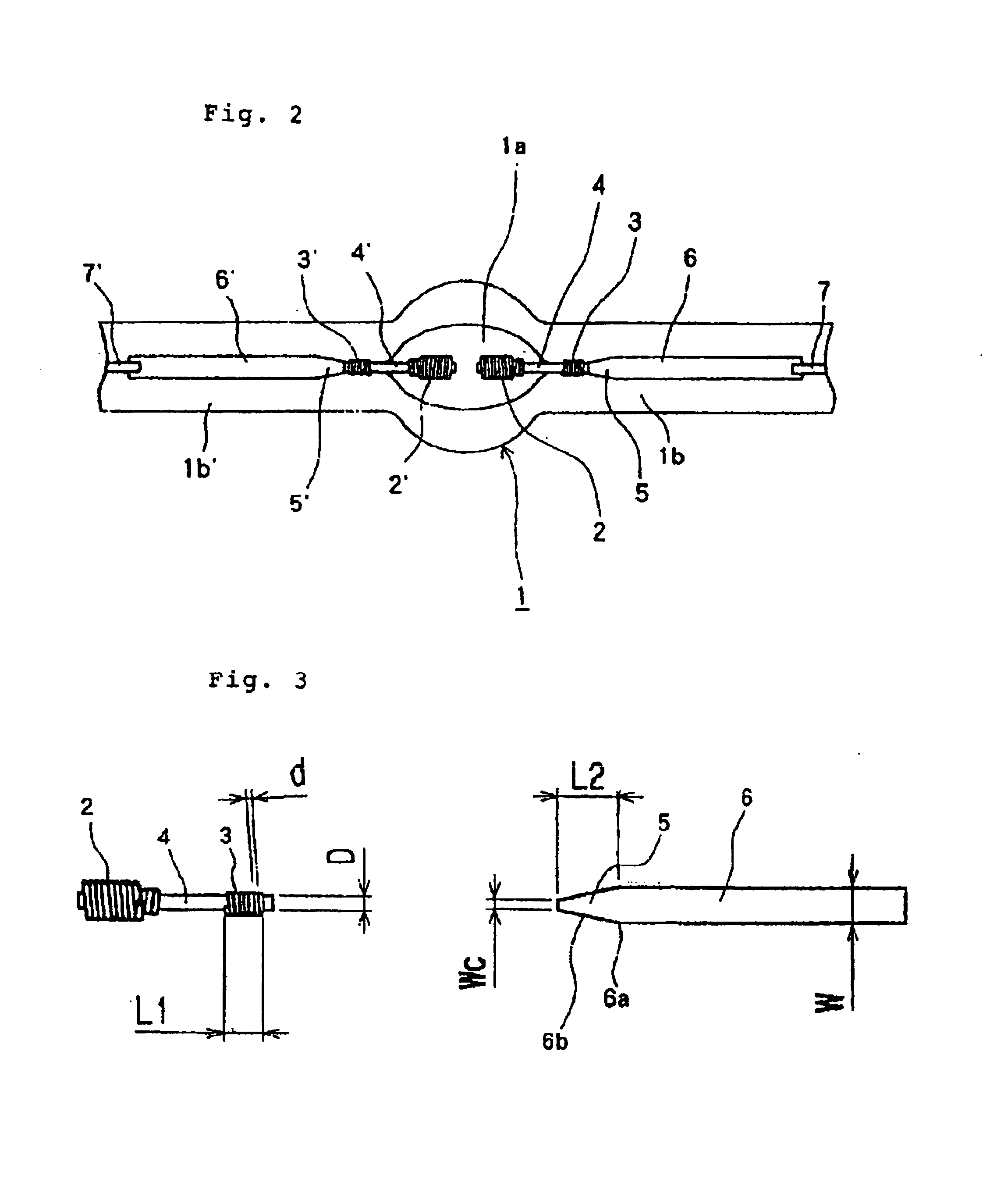
According to this construction, the vicinities of the junctions of the electrodes and metal foil parts with metal coils interposed are buried in glass, thereby enabling a prevention of the occurrence of glass cracks caused by the difference in
thermal expansion between the glass and the electrodes during the process of cooling after forming the sealing sections. Further, due to the tapered form of the electrodes-side ends of the metal foil parts as well as to the provision that the
electrode-side tips of the tapered ends that are bonded to the ends of the electrodes be positioned, with respect to their direction of width, within the width in the radial direction of the electrodes, the metal coils can be arranged in the vicinities of the junctions of the electrodes and metal foil parts without deforming the metal foil parts, whereby the separation of glass at the metal foil parts as well as the concentration of stress in the vicinities of the junctions of the electrodes and metal foil parts can be mitigated. In addition, forming the electrode-side ends of the metal foil parts in a tapered shape and winding the metal coils as far as the ends of the electrodes can alleviate the concentration of stress at not only the ends of the metal foil parts on the side of the electrodes, but at the ends of the electrodes on the side of the metal foil parts. In other words, the construction of the present invention simultaneously solves the various causes of rupture of a lamp that were noted in the constructions of the prior art and can therefore provide a lamp that is subject to a far
lower incidence of breakdown than a lamp of the prior art.
In the above-described high-pressure discharge lamp, the ends of the electrodes on the side of the metal foil parts are preferably covered by metal coils. In other words, covering the metal foil-side ends of the electrodes with metal coils provides a still greater alleviation of the concentration of stress against the metal foil-side ends of the electrodes.
In the above-described high-pressure discharge lamp, mercury is preferably injected to a level of 0.12 mg / mm3 or more; at least one of
chlorine,
bromine, and
iodine is preferably injected as a halogen gas to a halogen gas
partial pressure of 1×10⁻⁸-1×10⁻⁶ μmol / mm3 in the discharge chamber; and the
partial pressure of
residual oxygen in the discharge chamber is preferably 2.5×10⁻³ Pa or less. The introduction of gas in these amounts can suppress halogen gas corrosion of the junctions of the electrodes and the metal foil parts as well as corrosion of the metal foil parts despite the presence of a gap between the electrode surfaces on which the metal coils are not wrapped and the glass that surrounds these electrode surfaces of the portions of the electrodes that are embedded in the glass, and thus can effectively prevent rupture of the lamp. This construction can also prevent darkening of the
glass tube and loss of luminance over long periods of illumination.
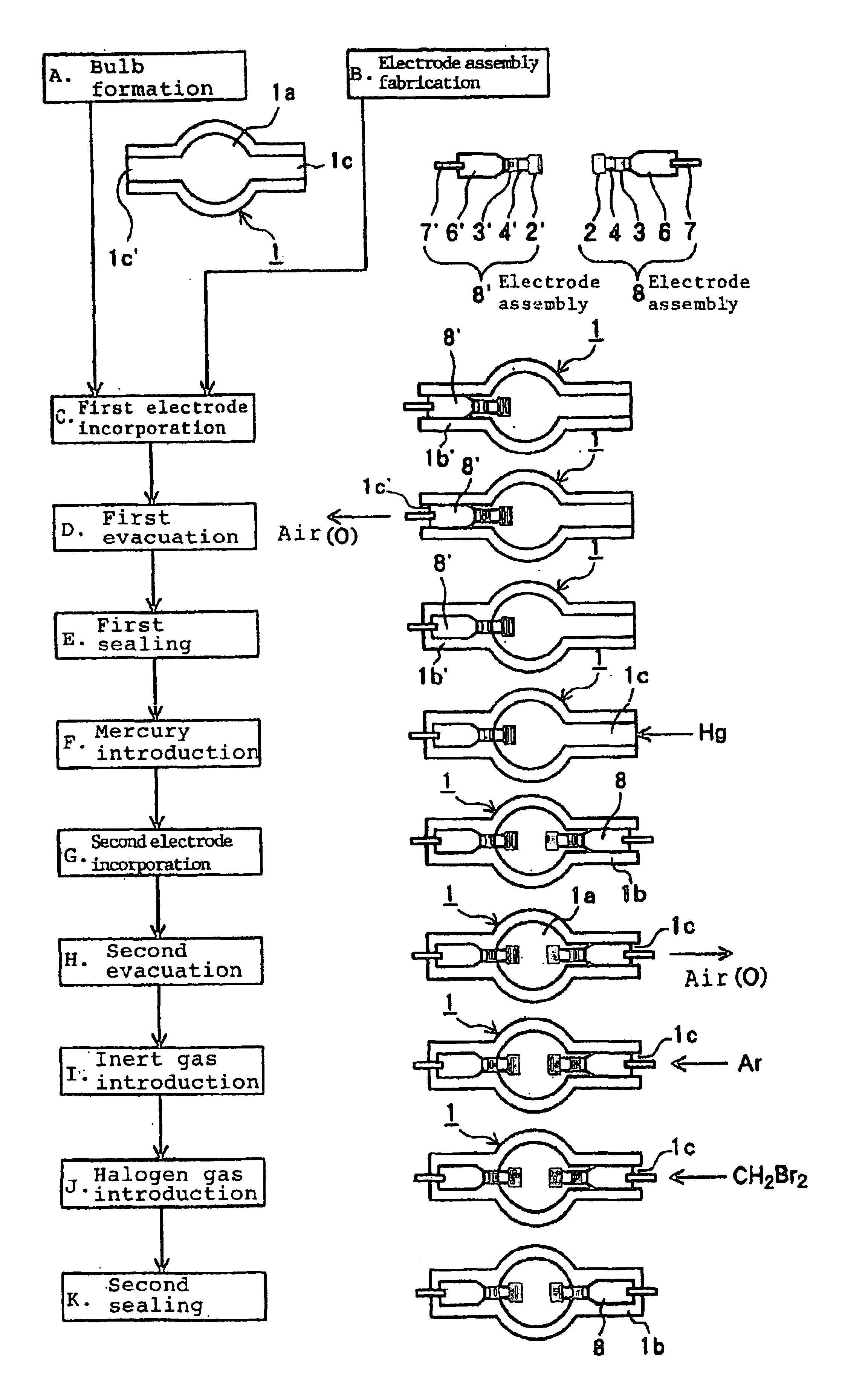
This fabrication method can provide a high-pressure discharge lamp that, in comparison with the prior art, can reduce the concentration of stress and the glass
cracking that results from this stress in the vicinities of the junctions of the electrodes and metal foil parts, and that can prevent rupture of the lamp.
In the above-described fabrication method, the
residual oxygen partial pressure is preferably evacuated to 2.5×10⁻³ Pa or less in the discharge chamber in the evacuation step; an amount of mercury is preferably injected to a level of at least 0.12 mg / mm3 with respect to the
spatial capacity of the discharge chamber in the mercury introduction step; and halogen gas is preferably introduced such that the partial pressure of the halogen gas in the discharge chamber is within the range of 1×10⁻⁸, to 1×10⁻⁶ μmol / mm3 in the halogen gas introduction step. This method of fabrication enables the production of a high-pressure discharge lamp that exhibits relatively little darkening of the
glass tube and little drop in luminance over a long period of illumination, and moreover, that is free from corrosion by halogen gas of the junctions of the electrodes and metal foil parts as well as the metal foil parts itself.


 Login to View More
  Login to View More