Check patentability & draft patents in minutes with Patsnap Eureka AI!

Method of heat-stabilizing α-glucan phosphorylase(GP)

a technology of glucan phosphorylase and gp, which is applied in the direction of enzymology, sugar derivates, transferases, etc., can solve the problems of inability to obtain high molecular weight glucans using gp derived from i>thermus, and inability to synthesize high molecular weight glucans, etc., to achieve excellent thermostability, improve thermostability, and improve thermostability

Inactive Publication Date: 2009-08-04
EZAKI GLICO CO LTD
View PDF1 Cites 0 Cited by
  • Summary
  • Abstract
  • Description
  • Claims
  • Application Information

AI Technical Summary

Benefits of technology

The present invention relates to a new thermostable α-glucan phosphorylase (GP) and a method for producing it. The invention solves the problem of finding a plant-derived GP with heat resistance, as current methods for inactivating phosphatase and amylase activity in Escherichia coli are not effective at high temperatures. The invention provides a new plant-derived GP with heat resistance that can maintain sufficient activity at high temperatures, allowing for its use in industrial production of glucan. The invention also provides a method for improving the thermostability of a GP by substituting a specific amino acid residue with another amino acid residue.

Problems solved by technology

owever, since such the above GP is derived from organisms other than plants, it is unable to synthesize high molecular weight glucans, and is thus less useful.
For this reason, there is the problem that high molecular weight glucans cannot be obtained using GP derived from Thermus.
Theoretical methods for making a general enzyme more thermostable, such as proline theory and amino acid substitution based on enzyme steric structure information have been tried, but have not necessarily succeeded.
However, in any of these methods, every protein must be characterized by trial and error.
However, this Escherichia coli GP, similar to Thermus-derived GP, does not have the ability to synthesize high molecular weight glucans h. Further, the enzyme activity at optimal temperatures for the GP having improved thermostability described in this document, is lower than the enzyme activity at an optimal temperature of natural GP.
Usually, an enzyme protein is unstable, and is sensitive to physical factors such as pH, temperature etc, as well as proteases, and thus may be easily degraded.
Among enzymes, there are also enzymes which become more unstable, and therefore easily degraded, at high degrees of purification.
However, proteins are degraded upon thawing in some cases, and handling is therefore difficult when an enzyme is stored frozen and subsequently thawed.
It has been known that natural potato type L GP is also easily degraded and, even when purified GP is refrigerated and stored, it gradually degrades from the point of purification.

Method used

the structure of the environmentally friendly knitted fabric provided by the present invention; figure 2 Flow chart of the yarn wrapping machine for environmentally friendly knitted fabrics and storage devices; image 3 Is the parameter map of the yarn covering machine
View more

Image

Smart Image Click on the blue labels to locate them in the text.
Viewing Examples
Smart Image
  • Method of heat-stabilizing α-glucan phosphorylase(GP)
  • Method of heat-stabilizing α-glucan phosphorylase(GP)
  • Method of heat-stabilizing α-glucan phosphorylase(GP)

Examples

Experimental program
Comparison scheme
Effect test

example 1

Preparation, Screening and Sequencing of Potato α-Glucan Phosphorylase Having Improved Thermostability

[0405]To briefly outline, a random mutation was introduced into a potato-derived type L α-glucan phosphorylase gene, a gene with a random mutation introduced therein was introduced into Escherichia coli, α-glucan phosphorylase with a random mutation introduced therein was expressed and, Escherichia coli expressing, among expressed α-glucan phosphorylases, α-glucan phosphorylase having improved thermostability having the ability to synthesize a glucan after heating at 60° C. for 10 minutes was selected, a gene of α-glucan phosphorylase having improved thermostability was isolated from this Escherichia coli, and the sequence thereof was determined.

[0406]Details are as follows.

[0407]Firstly, a gene of potato-derived type L α-glucan phosphorylase (GP) was prepared. According to the description of Takaha, et. al. (Journal of Biological Chemistry, vol. 268, pp. 1391-1396, 1993), an mRNA w...

example 2-1a

Preparation of Potato Type L α-Glucan Phosphorylase Having Improved Thermostability by Site-Directed Mutagenesis

[0416]In the present Example, GP having improved thermostability having only one substitution at a position which was found to contribute to improve thermostability in Example 1, GP having improved thermostability having a combination of any two, and GP having improved thermostability having all of 3 were prepared. As an example, an amino acid sequence of GP having improved thermostability having three all mutations (F39L+N135S+T706I) is set forth in SEQ ID NO: 34, and a base sequence encoding such is set forth in SEQ ID NO: 33. For comparison, GP in which amino acids at position 39, position 135 and position 706 was not substituted, and an amino acid at a position having no relationship with these amino acid positions was substituted (GP in which only lysine at 467 position was substituted with asparagine, and GP in which only threonine at position 711 was substituted wit...

example 2-1b

Preparation of Modified Potato Type L α-Glucan Phosphorylase Substituted with Various Amino Acids

[0420]According to the same manner as that of Example 2-1A, except that primers designed so that one place of F39, N135 and T706 was substituted with another amino acid residue were used, a plasmid containing a modified α-glucan phosphorylase gene was prepared, and various modified GP authentic preparations were obtained.

[0421]Thermostability of these modified GP authentic preparations were studied in detail in the Example 3-1 (3-1) below.

the structure of the environmentally friendly knitted fabric provided by the present invention; figure 2 Flow chart of the yarn wrapping machine for environmentally friendly knitted fabrics and storage devices; image 3 Is the parameter map of the yarn covering machine
Login to View More

PUM

PropertyMeasurementUnit
concentrationaaaaaaaaaa
pHaaaaaaaaaa
weight average molecular weightaaaaaaaaaa
Login to View More

Abstract

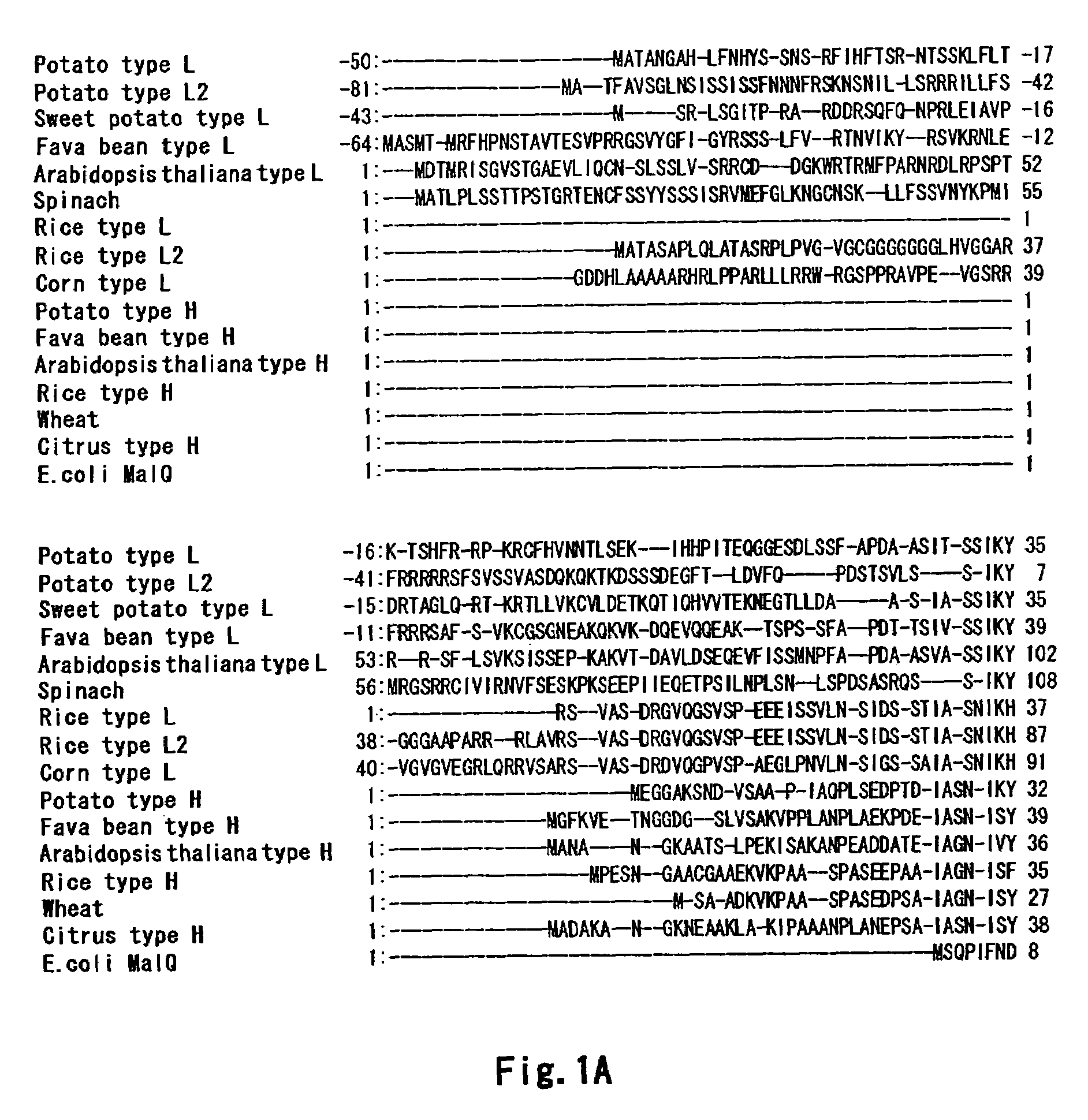
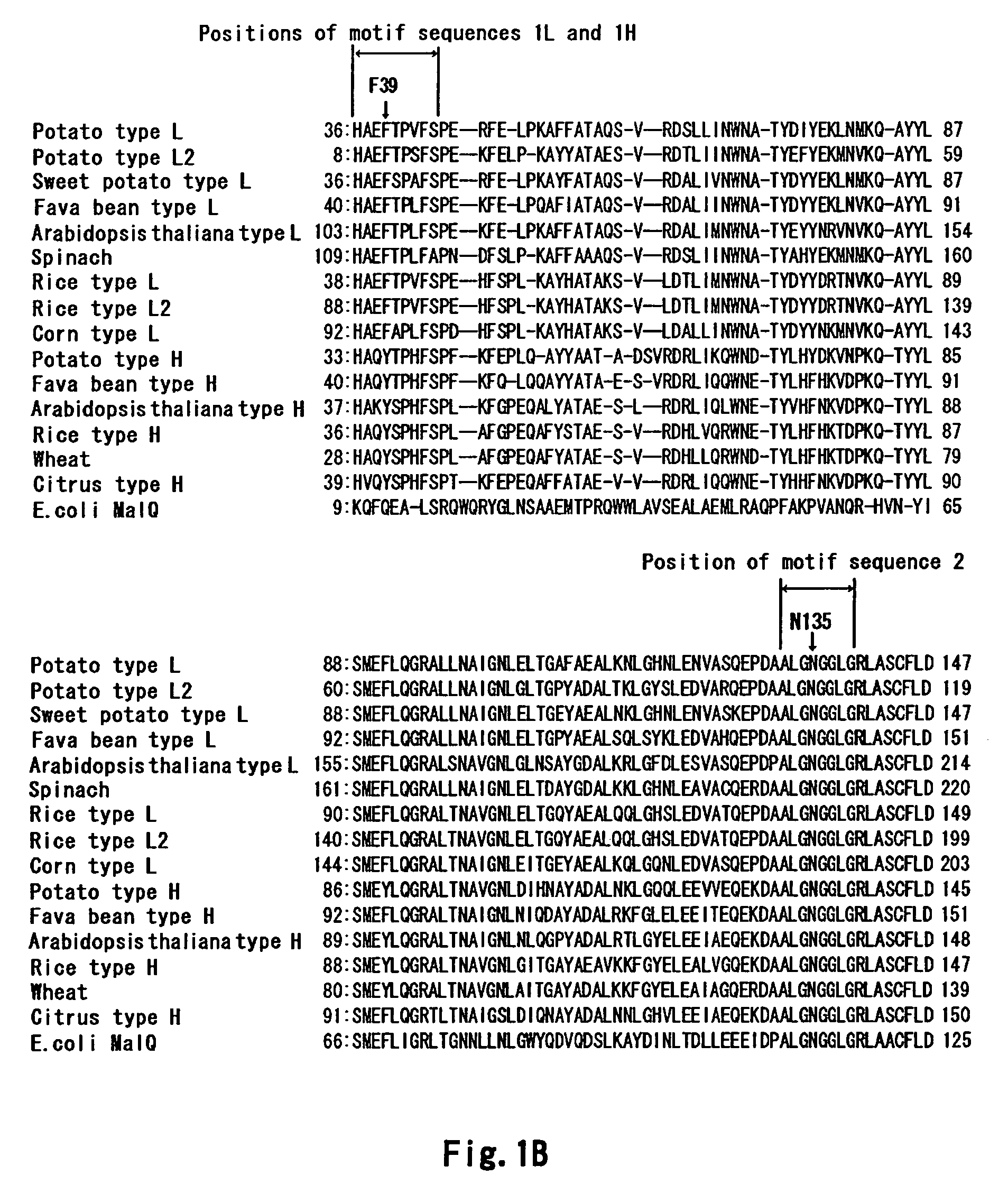
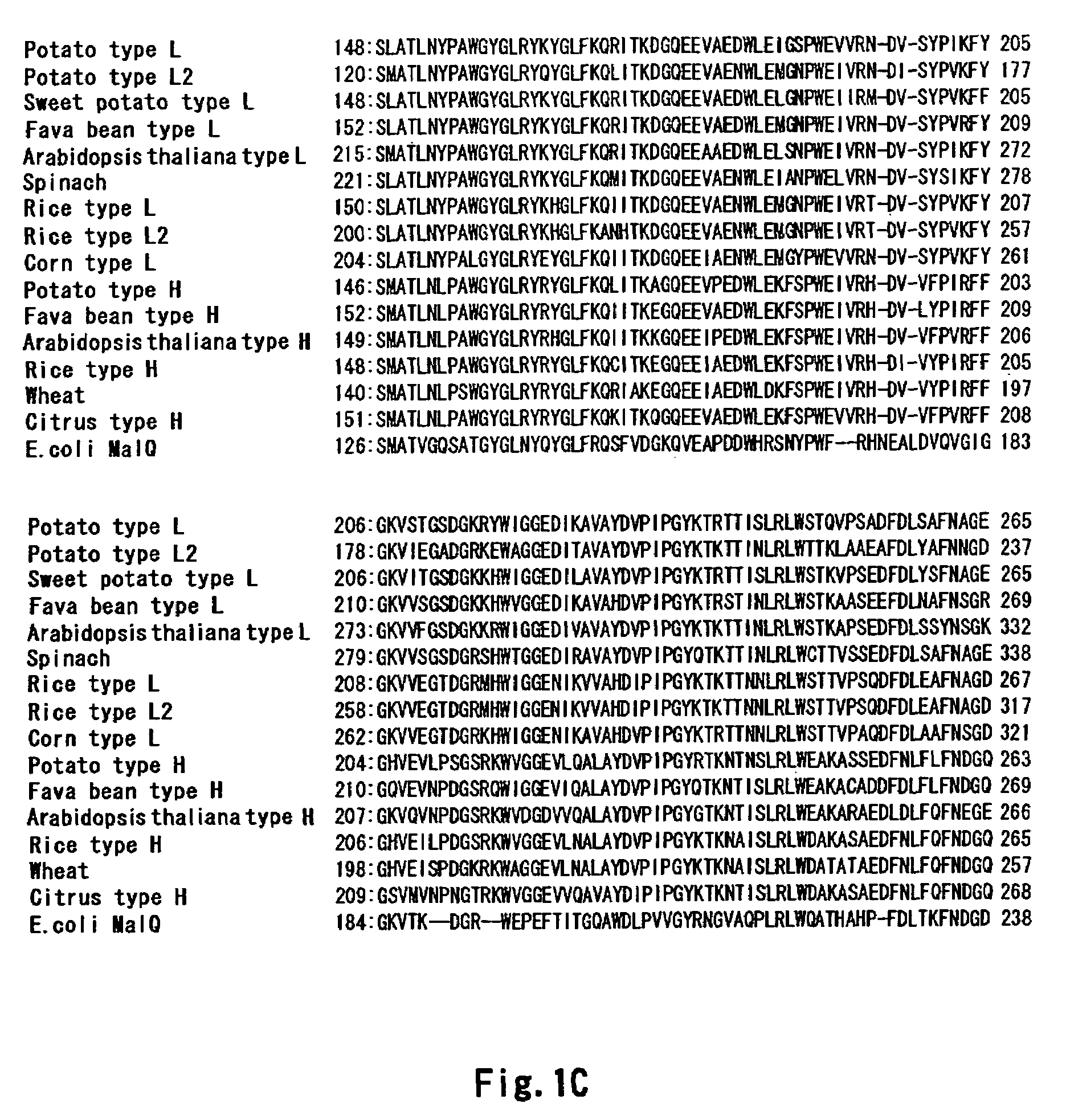
An α-glucan phosphorylase having improved thermostability, which obtained by modifying natural α-glucan phosphorylase, and a method for producing this α-glucan phosphorylase having improved thermostability are provided. The natural α-glucan phosphorylase is derived from a plant, this α-glucan phosphorylase having improved thermostability has an amino acid residue which is different from that of the natural α-glucan phosphorylase in at least one position selected from the group consisting of a position corresponding to position 4 in a motif sequence 1L or 1H, a position corresponding to position 4 in a motif sequence 2, and a position corresponding to position 7 in a motif sequence 3L or 3H, and wherein the enzyme activity of α-glucan phosphorylase having improved thermostability at 37° C., after heating in a 20 mM citrate buffer (pH 6.7) at 60° C. for 10 minutes, is 20% or more of the enzyme activity of the α-glucan phosphorylase having improved thermostability at 37° C., before heating.

Description

TECHNICAL FIELD[0001]The present invention relates to thermostable α-glucan phosphorylase and a gene encoding said thermostable α-glucan phosphorylase. Further, the present invention relates to a method for producing thermostable α-glucan phosphorylase.BACKGROUND ART[0002]α-glucan phosphorylase (hereinafter, also referred to as GP) is an enzyme utilized in, for example, synthesis of glucose-1-phosphate (hereinafter, also referred to as G-1-P), and glucan synthesis. G-1-P is utilized, for example, as a medical antibacterial agent, an anti-tumor agent (as a platinum complex), a drug for treating heart disease (as an amine salt), or a substrate for glucan synthesis. GP is widely distributed in plants, for example in tubers such as potatoes; animals, for example in rabbit muscle; and microorganisms such as yeast.[0003]Among the above, plant-derived GP is useful because it generally has the ability to synthesize glucans having a high molecular weight.[0004]Various GPs can be used to prod...

Claims

the structure of the environmentally friendly knitted fabric provided by the present invention; figure 2 Flow chart of the yarn wrapping machine for environmentally friendly knitted fabrics and storage devices; image 3 Is the parameter map of the yarn covering machine
Login to View More

Application Information

Patent Timeline
no application Login to View More
Patent Type & Authority Patents(United States)
IPC IPC(8): C12N9/12C07H21/04C12N9/10C12P19/02C12P19/04
CPCC12N9/1051C12P19/04C12P19/02
Inventor YANASE, MICHIYOTAKATA, HIROKIFUJII, KAZUTOSHITAKAHA, TAKESHIKURIKI, TAKASHI
Owner EZAKI GLICO CO LTD
Features
  • R&D
  • Intellectual Property
  • Life Sciences
  • Materials
  • Tech Scout
Why Patsnap Eureka
  • Unparalleled Data Quality
  • Higher Quality Content
  • 60% Fewer Hallucinations
Social media
Patsnap Eureka Blog
Learn More