These heart valves may be rendered less effective by acute or chronic
ischemic disease of the heart, congenital, inflammatory, or infectious conditions, or
disease, all of which may lead to dysfunction of the valves over time.
Such degradation may result in serious cardiovascular compromise or even death.
Because the left
ventricle drives
systemic circulation, it generates higher pressures than the right ventricle, and accordingly the aortic and mitral valves are more susceptible to dysfunction, such as
stenosis or regurgitation.
A stenotic mitral valve may impede
blood flow into the heart, causing blood to back up and pressure to build in the lungs.
Consequently, the presence of a stenotic valve may make it difficult for the heart to increase the amount of blood pumped during exercise, producing shortness of breath under
physical activity.
Regurgitation occurs when the mitral valve leaflets do not coapt correctly, thus causing blood to leak backwards into the
left atrium and lungs each time the heart pumps.
Although the heart may compensate for this overload for months to years, provided the progression of the leakage comes gradually, the heart will eventually begin to fail, producing shortness of breath and fatigue.
This loosening, in turn, allows the leaflets of the affected valve to prolapse, causing regurgitation.
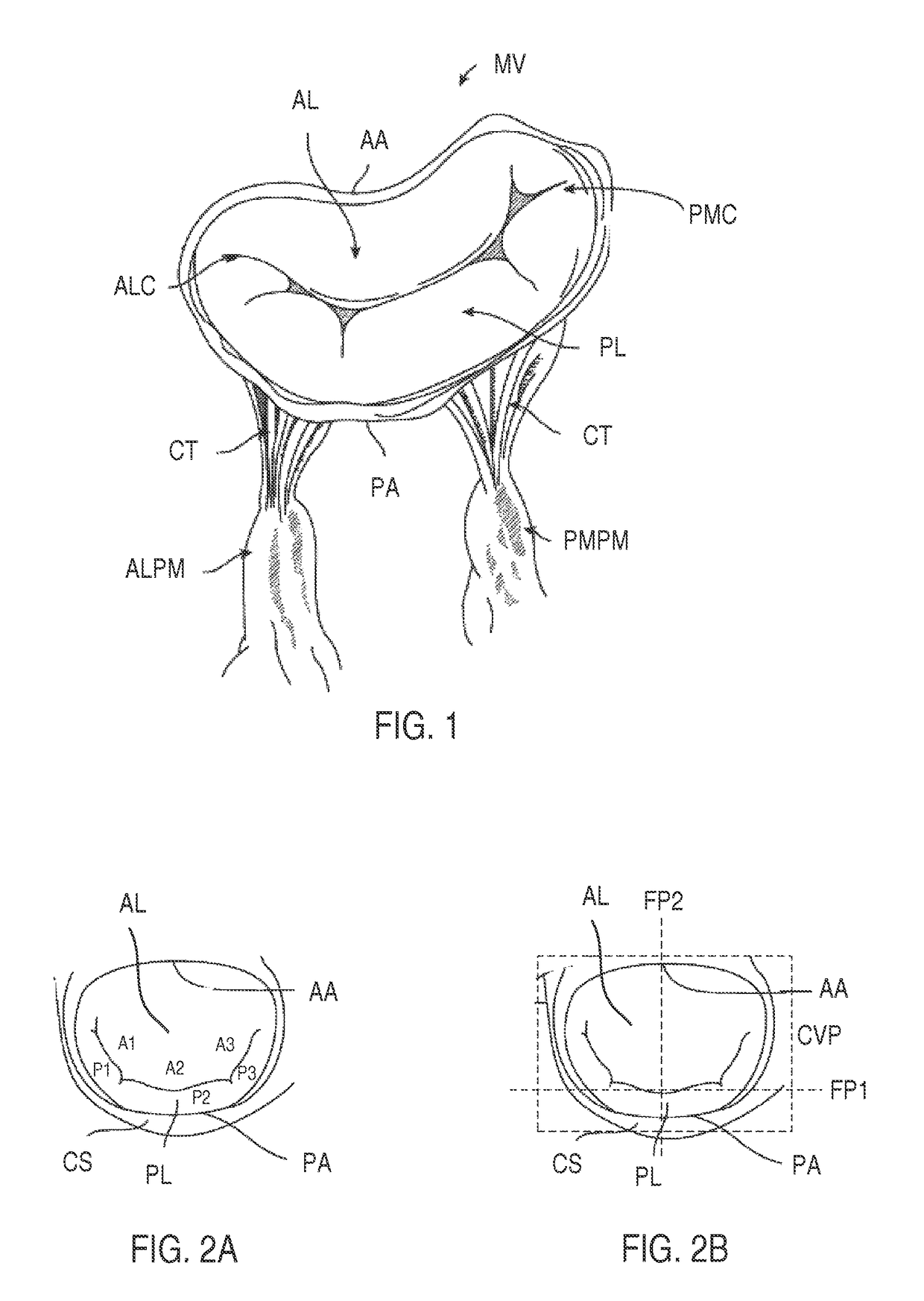
The mitral valve MV illustrated in FIG. 1 is defective as the mitral valve leaflets (AL and PL) do not coapt correctly, leaving one or more gaps between the leaflets, resulting in regurgitation.
Previously-known valve prostheses have some disadvantages, such as need for long-term maintenance with blood thinners, the risk of
clot formation, limited durability, etc.
However, most dysfunctional valves are too diseased to be repaired using previously known methods and apparatus.
However, these surgeries are prone to many complications and long hospital stays for recuperation.
Unfortunately, for a significant percentage of patients, mitral
valve replacement is still necessary due to
stenosis or anatomical limitations, and few less-invasive options are available for replacement procedures.
Anticoagulants may be taken to prevent
blood clotting that may result in thromboembolic complications and catastrophic
heart failure, however, such anti-clotting medication may complicate a patient's health due to the
increased risk of hemorrhage.
A major
disadvantage of tissue valves is they lack the long-term durability of mechanical valves.
Furthermore, valves are subject to stresses from constant mechanical operation within the body.
Such tension causes prosthetic valves to
wear out over time, requiring replacement.
While iterative improvements have been made on surgical bioprosthetic valves over the last several decades, existing bioprosthetic valves still have drawbacks.
One drawback is the mismatch in size and
mass between opposing surfaces of the
stent-like supporting frame.
The mismatch is often due to the variability in the shapes and mechanical characteristics of the
stent-like supporting frame.
For prosthetic valves with
balloon-expandable
stent-like supporting frames, the
recoil of the supporting frames post-
balloon-inflation may lead to perivalvular leaks around the circumference of the
prosthetic valve and potential slippage and migration of the valve post-implantation.
Another risk associated with prosthetic valves having
balloon-expandable supporting frames is potential damage to the leaflets of the
prosthesis during implantation, when the leaflets may be compressed between the balloon and the supporting frame.
For prosthetic valves with self-expanding stent-like supporting frames, mismatch may arise due to the deformation / movement of the supporting frame, e.g., slight deformation of the frame into a less than circular shape during normal cardiac movement.
Another drawback in the construction of existing bio-prosthetic valves with self-expanding supporting frames is the potential for damage to the leaflet tissue arising from the spacing between the struts of the frame.
For example, when the stent-like supporting frame is deployed, the distance between struts during expansion of the frame may stretch both the surrounding tissue and the leaflet tissue further apart than designed, potentially resulting in damage to surrounding tissue and leaflet tissue.
With use of an oblong or circular radially self-expanding frame applied on the majority of the mitral valve, there is risk of left-
ventricular outflow tract (LVOT) obstruction.
Because the clip transforms the mitral orifice into two orifices, the clip may significantly obstruct the flow of blood through the valve.
These techniques have the drawback of replacing a mitral valve that is itself generally normal or subnormal.



 Login to View More
  Login to View More