Detection method for PEG modification capability of protein alkylation modifier, and application thereof
A technology of modification ability and detection method, which is applied in the direction of material analysis by observing the influence on chemical indicators, and analysis by making materials undergo chemical reactions, etc., which can solve the problem of unquantitative detection of activated PEG-modified proteins, unsatisfactory results, Long operation time and other issues, to achieve important promotion and application value, avoid waste, clear mechanism effect
- Summary
- Abstract
- Description
- Claims
- Application Information
AI Technical Summary
Problems solved by technology
Method used
Image



Examples
Embodiment 1
[0048] 1. Preparation of reagents
[0049] (1) 1.0mmol / L GSH solution:
[0050] GSH 3.07mg was dissolved in 0.1mol / L barbiturate sodium-hydrochloride buffer solution with pH9.0, diluted to 10mL, and prepared immediately.
[0051] (2) 0.32mol / L Na 2 HPO 4 Solution:
[0052] Na 2 HPO 4 Dissolve 29.92g of double distilled water and dilute to 200mL.
[0053] (3) 1.0mmol / L DTNB (5,5'-dithio-p-dinitrobenzoic acid) chromogenic solution:
[0054] Weigh 20mg of DTNB and 500mg of trisodium citrate, dissolve in double distilled water and dilute to 50mL (the brown bottle should be kept in a refrigerator at 4°C in the dark).
[0055] (4) 5mmol / L activated mPEG5000 solution:
[0056] A. Activation of modifiers
[0057] Refer to the method of Abuchowski (1977) and improve and optimize: cyanuric chloride is recrystallized twice with anhydrous benzene (3A molecular sieve to remove water) before use; take 5.5g of secondary recrystallized cyanuric chloride and dissolve it in 400mL con...
Embodiment 2
[0066] 1. Preparation of reagents
[0067] (1) 1.0mmol / L GSH solution, 0.32mol / L Na 2 HPO 4 The preparation method of the solution and 1.0mmol / L DTNB (5,5'-dithio-p-dinitrobenzoic acid) chromogenic solution is the same as in Example 1.
[0068] (2) 5mmol / L activated mPEG10000 solution:
[0069] A. Activation of modifiers
[0070] Refer to the method of Abuchowski (1977) and improve and optimize: cyanuric chloride is recrystallized twice with anhydrous benzene (3A molecular sieve to remove water) before use; take 5.5g of secondary recrystallized cyanuric chloride and dissolve it in 400mL containing Add 100g of mPEG10000 to 10g of anhydrous sodium carbonate in anhydrous benzene, stir overnight at room temperature, filter, take about 400mL of the filtrate and slowly add 600mL of diethyl ether while stirring, and continue stirring for 20min after the white product precipitates, then filter with suction, and then use 400mL of Water and benzene are dissolved, and such precipit...
Embodiment 3
[0078] Example 3 The Determination Test of the Optimum Measuring Conditions of the Method of the Invention
[0079] In order to determine the best reaction conditions, the present invention has carried out a large number of long-term experimental explorations including single factor experiments and comparative analysis. The final experimental results are described as follows:
[0080] (1) Selection of the optimal molar ratio of modifier to GSH reaction mass
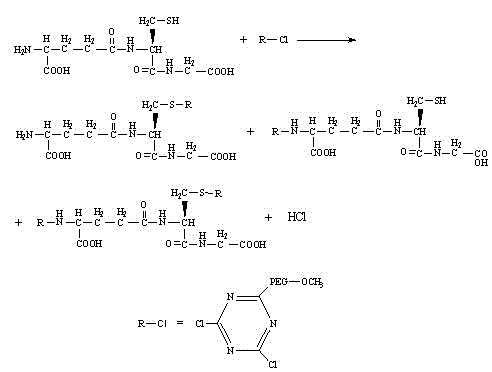
[0081] According to the analysis of the reaction mechanism, the inventors determined that the mass ratio of mPEG to GSH reaction in the method of the present invention is carried out in a molar ratio of 2:1. GSH has two reactive groups, amino and thiol, so one molecule of GSH can react with two molecules of mPEG, so the mass ratio of mPEG to GSH is 2:1, which is convenient for the calculation of the modification ability of modifiers. The experiment proves that the modification ability of the modifier can be accura...
PUM
 Login to View More
 Abstract
Description
Claims
Application Information
 Login to View More
 - R&D
- Intellectual Property
- Life Sciences
- Materials
- Tech Scout
- Unparalleled Data Quality
- Higher Quality Content
- 60% Fewer Hallucinations
Browse by: Latest US Patents, China's latest patents, Technical Efficacy Thesaurus, Application Domain, Technology Topic, Popular Technical Reports.
© 2025 PatSnap. All rights reserved.Legal|Privacy policy|Modern Slavery Act Transparency Statement|Sitemap|About US| Contact US: help@patsnap.com