CHANGCHUN INST OF APPLIED CHEMISTRY - CHINESE ACAD OF SCI
View PDF9 Cites 14 Cited by
Summary
Abstract
Description
Claims
Application Information
AI Technical Summary
This helps you quickly interpret patents by identifying the three key elements:
Problems solved by technology
Method used
Benefits of technology
Problems solved by technology
The transition metal compound with heterocyclic condensed five-membered ring π ligand and the olefin polymerization reaction using the transition metal compound have been studied now. They have the advantages of high activity and high molecular weight, but they all contain side chains, and they have greater The study of open-space monometallocene complexes without side chains has not been reported
Method used
the structure of the environmentally friendly knitted fabric provided by the present invention; figure 2 Flow chart of the yarn wrapping machine for environmentally friendly knitted fabrics and storage devices; image 3 Is the parameter map of the yarn covering machine
View more
Image
Smart Image Click on the blue labels to locate them in the text.
Viewing Examples
Smart Image
Click on the blue label to locate the original text in one second.
Reading with bidirectional positioning of images and text.
Smart Image
Examples
Experimental program
Comparison scheme
Effect test
preparation example Construction
[0063] The present invention provides a method for preparing the metallocene complex represented by the above formula (I), comprising:
[0064] When the metallocene complex X shown in formula (I) 1 with X 2 When each is independently a C1-C20 alkoxy group, the metallocene complex represented by the formula (I) is prepared according to the following steps: under the condition of inertgas protection, the cyclopentadiene compound represented by the formula (II) The alkenyl ligand is reacted with the rare earth compound in the first organic solvent to obtain the metallocene complex represented by formula (I).
[0067] R 1 , R 2 , R 3 , R 4 with R 5 each independently selected from H, C1-C20 alkyl, C1-C20 alkyl containing acetal, C1-C20 alkyl containing ketal, C1-C20 alkyl containing ether group, C1-C20 Alkenyl group, C1-C20 alkenyl group con...
Embodiment 1
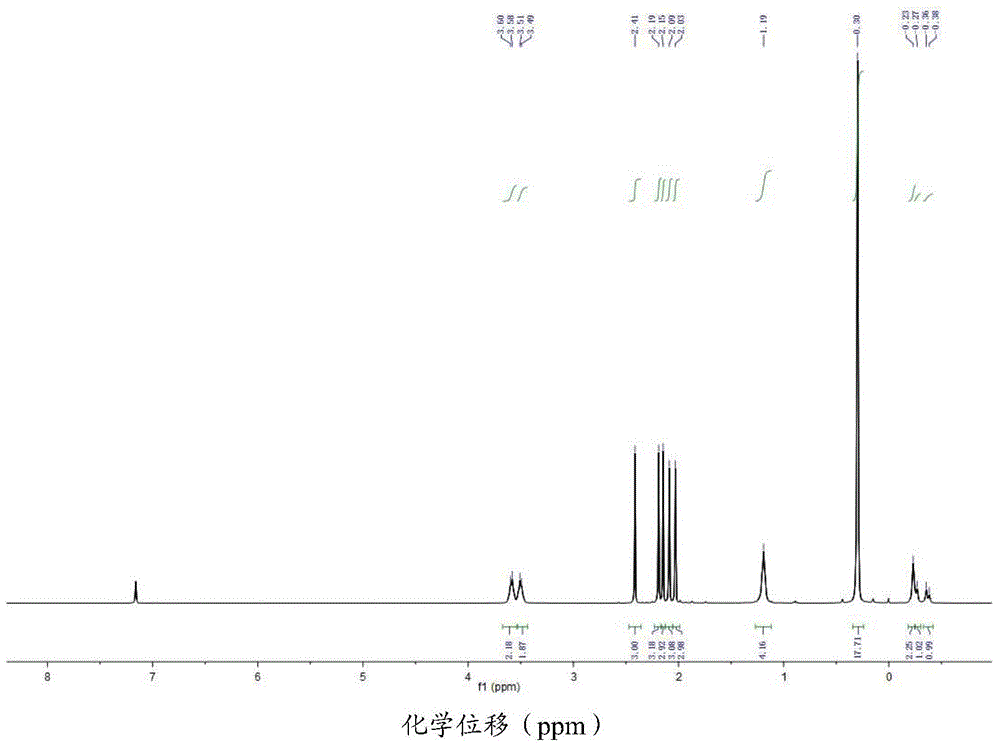
[0105] Under the condition of nitrogen protection, 0.3g (1.56mmol) of thiophene-fused cyclopentadienyl ligand 1 was dissolved in 8ml of n-hexane, and added dropwise to the solution containing 0.7g (1.56mmol) of Sc(CH 2 SiMe 3 ) 3 (thf) 2 In n-hexane solution, react for 12h, concentrate the reaction solution, and recrystallize to obtain 0.57g of pale yellow thiophene-fused scandium-type scandium complex (I-1), molecular formula C 22 h 41 OSScSi 2 , the productive rate is 75%, and the reaction formula is as follows:
[0106]
[0107] The elemental analysis (%) of the scandium alkyl complex (I-1) obtained in Example 1 was analyzed, and the elemental analysis (%) result was: C58.52; H8.85.
Embodiment 2
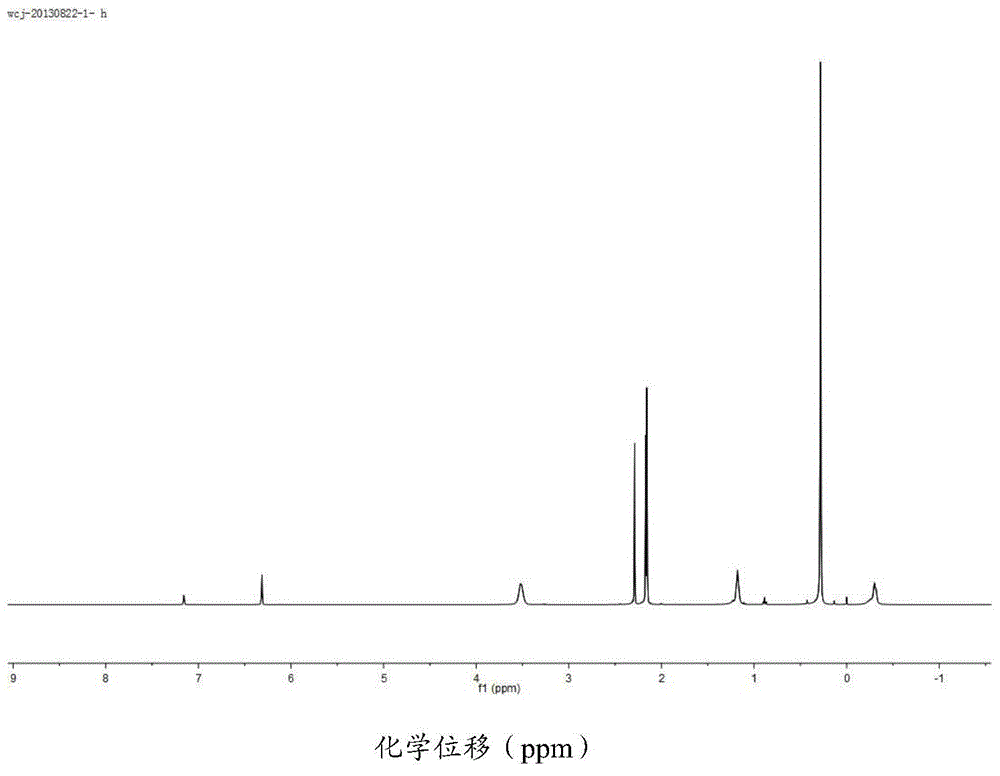
[0109] Ligand 1 in Example 1 was replaced by ligand 2, and the rest of the steps were the same to obtain a thiophene-fused scandium-type complex (I-2), molecular formula C 24 h 45 OSScSi 2 , the reaction formula is as follows:
the structure of the environmentally friendly knitted fabric provided by the present invention; figure 2 Flow chart of the yarn wrapping machine for environmentally friendly knitted fabrics and storage devices; image 3 Is the parameter map of the yarn covering machine
Login to View More
PUM
Property
Measurement
Unit
melting point
aaaaa
aaaaa
melting point
aaaaa
aaaaa
number average molecular weight
aaaaa
aaaaa
Login to View More
Abstract
Provided are a metallocene complex, a preparation method therefor, and a catalyst composition. The catalyst composition comprises a metallocene complex as represented by formula (I) and an organic boron salt. In contrast to the prior art, the metallocene complex as represented by the catalyst formula (I) used in the present invention contains no side chain, and has a large open degree of coordination space of the central metal, therefore having a higher catalytic activity and a higher insertion rate for strongly sterically hindered monomers. Moreover, the metallocene complex as represented by formula (I) used in the present invention is a fused heterocyclic cyclopentadienyl ligand, wherein the heterocycle has a strong capacity of supplying electrons, which can be used for fusing the cyclopentadienyl and changing the electronic effect in the metal centre so as to increase the activity of the catalyst. Hence, the metallocene complex as represented by formula (I) can be used for the preparation of a copolymer of ethylene and other alkenes with a high activity and a high insertion rate, and can also be used for catalyzing the polymerization of styrene and substituted styrene with high syndiotacticity and high activity.
Description
technical field [0001] The invention belongs to the technical field of catalysts, and in particular relates to a metallocene complex, a preparation method thereof, and a catalyst composition. Background technique [0002] Metallocene complexes refer to compounds in which the central metal is coordinated with one or more cyclopentadienyl groups or their derivatives, and play a very important role as catalysts in various polymerization reactions. Among them, a metal complex combined with one cyclopentadienyl group or one derivative becomes a monometallocene complex. Due to the different types of central metals, the metallocene complexes have completely different characteristics, such as catalytic activity for polymerization reactions, especially in the successful preparation and as an efficient activating reagent organoborane B (C 6 f 5 ) 3 and organoboron salts [Ph 3 C][B(C 6 f 5 ) 4 ] and [PhNMe 2 H][B(C 6 f 5 ) 4 ] Afterwards, monocene rare earth metal-organic co...
Claims
the structure of the environmentally friendly knitted fabric provided by the present invention; figure 2 Flow chart of the yarn wrapping machine for environmentally friendly knitted fabrics and storage devices; image 3 Is the parameter map of the yarn covering machine
Login to View More
Application Information
Patent Timeline
Application Date:The date an application was filed.
Publication Date:The date a patent or application was officially published.
First Publication Date:The earliest publication date of a patent with the same application number.
Issue Date:Publication date of the patent grant document.
PCT Entry Date:The Entry date of PCT National Phase.
Estimated Expiry Date:The statutory expiry date of a patent right according to the Patent Law, and it is the longest term of protection that the patent right can achieve without the termination of the patent right due to other reasons(Term extension factor has been taken into account ).
Invalid Date:Actual expiry date is based on effective date or publication date of legal transaction data of invalid patent.



 Login to View More