
LAMP primer group for detecting broad-spectrum mycoplasma, kit and application of LAMP primer group
A detection kit and mycoplasma detection technology, which is applied in the biological field, can solve the problems of broad-spectrum mycoplasma without LAMP, and achieve the effects of shortening detection time, easy observation, and easy detection
- Summary
- Abstract
- Description
- Claims
- Application Information
AI Technical Summary
Problems solved by technology
Method used
Image

Examples
Embodiment 1
[0024] Embodiment 1, primer design
[0025] The ITS-23srRNA sequences of 8 kinds of mycoplasma M.hyorhinis, M.fermentans, M.arginini, M.hominis, M.orale, M.salivarium, M.pirum, and AcholeplasmaLaidlawii commonly found in cell culture were retrieved from the American gene database Genbank, Homologous sequence analysis and alignment was performed by clustalX software to find specific conserved target gene fragments. In this example, the 5' end region of the 23srRNA sequence was selected, and primerexplorerV4 was used for online LAMP primer design to obtain F3 / B3 and FIP / BIP primers, and then appropriate loop primers were selected through manual adjustment. The designed primers were analyzed online for their specificity and broad-spectrum through the primer-blast software, and the final optimized primers were as follows:
[0026] Outer primer F3:
[0027] 5'-AAGAGTTTTTGGTGGATGC-3' (as shown in SEQ ID NO.1)
[0028] Outer primer B3:
[0029] 5'-CTGCTGCTACTGAGATGTT-3' (as shown...
Embodiment 2
[0038] Embodiment 2, setting up mycoplasma LAMP reaction system
[0039]Set different final concentrations of magnesium ions (4mM, 6mM, 8mM), dNTP concentrations (1mM, 1.2mM, 1.4mM), betaine (Betaine) concentrations (0.6M, 0.8M, 1M) and Bst2.0 enzyme (BstDNA polymerization enzyme) concentration (4U, 6U, 8U, 10U).
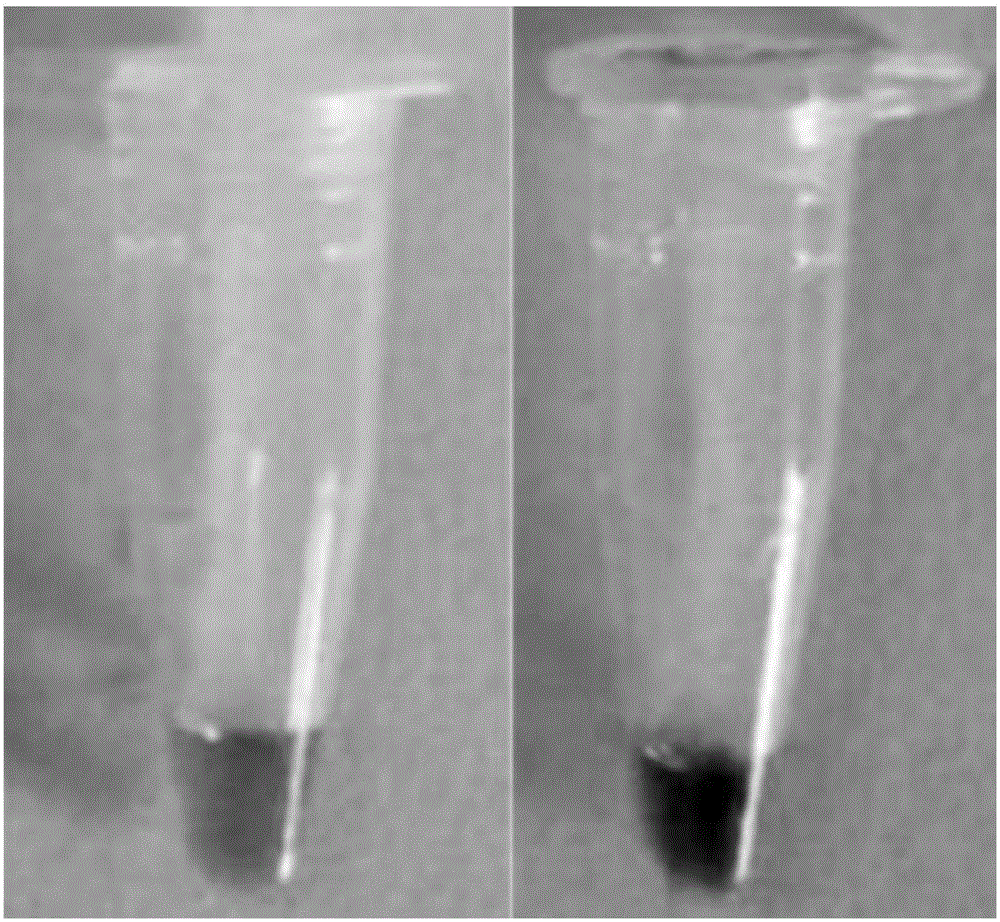
[0040] After the reaction, the color change of the system can be observed with the naked eye, such as figure 1 As shown, the negative is blue-purple (left picture), and the positive is sky blue (right picture).
[0041] The most preferred mycoplasma LAMP reaction system was determined through trial and error, that is, the preparation ratio of 25 μl LAMP reaction solution was: 10×Isothermal Amplification Buffer (isothermal amplification buffer) 2.5 μl, 10×LAMPprimermix (primer mixture) 2.5 μl, 10mMdNTPs 3 μl, 100mM MgSO 4 1.5 μl, 5MBetaine 4μl, 3mM hydroxynaphthol blue (HNB) 1μl, 8U / μl Bst2.0 enzyme (BstDNA polymerase) 1μl, template 1μl, sterilized ultrapure water ...
Embodiment 3
[0047] Broad-spectrum and specificity evaluation of embodiment 3 mycoplasma LAMP detection kit
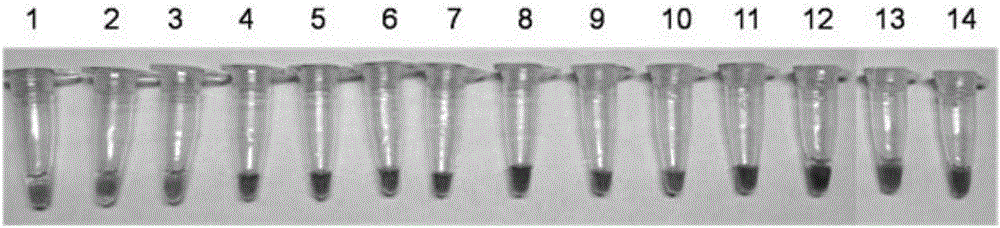
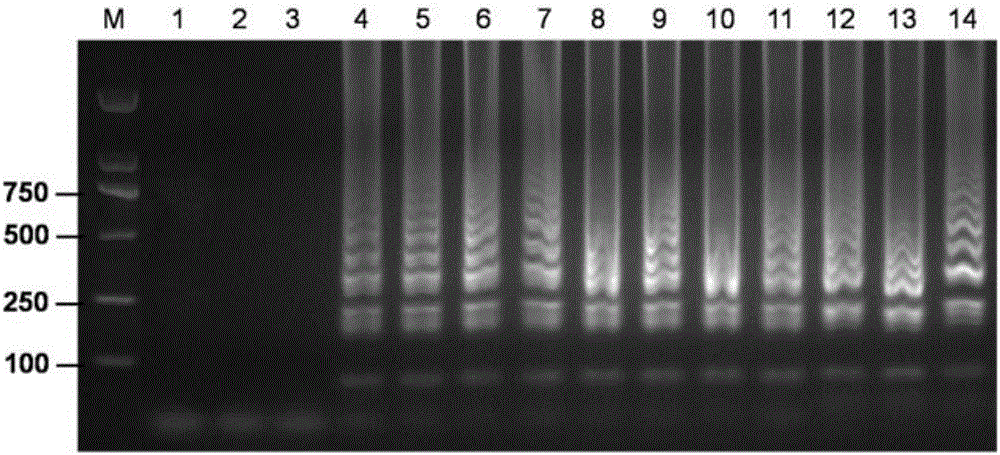
[0048] The purpose of the present invention is to develop a kit capable of detecting common mycoplasma contamination in the cell culture process, which not only satisfies broad-spectrum mycoplasma detection, but must be specific to non-mycoplasma samples. This embodiment uses ten kinds of mycoplasma samples M.hyorhinis, M.fermentans, M.arginini, M.hominis, M.orale, M.salivarium, M.pirum, M.pulmonis, M.bovis, M.buccale as broad-spectrum Specific detection objects, Escherichia coli, Salmonella enteritidis and Staphylococcus aureus as specific detection objects. The results show that the LAMP reaction system has good broad-spectrum and specificity, and can detect the above ten kinds of mycoplasma samples, and the detection of three non-mycoplasma environmental microorganisms is negative, such as Figure 2a shown. Figure 2b The results of electrophoresis on 2% agarose gel are shown....
PUM
 Login to View More
 Abstract
Description
Claims
Application Information
 Login to View More