
Multicore and multivariable metal-organic framework materials and their synthesis and application
A metal-organic framework, multi-variable technology, applied in separation methods, products, dispersed particle separation, etc., can solve the problems of low acetylene yield and purity, high energy consumption of separation process, low acetylene selectivity, etc., and achieve easy implementation. , The effect of low adsorption cost and stable skeleton
- Summary
- Abstract
- Description
- Claims
- Application Information
AI Technical Summary
Problems solved by technology
Method used
Image

Examples
Embodiment 1
[0042] In this embodiment, a method for preparing a multi-nuclear and multi-variable metal-organic framework Co-PTB-BDC-ina is involved, including the following steps:
[0043] (1) Under sealed conditions, the H 3 PTB (0.05 mmol), CoCl 2 ·6H 2 O (0.1 mmol), Hina (0.1 mmol) and H 2 BDC (0.05 mmol) was added to 2 mL of N,N-dimethylacetamide ( ) and mix well, add 6 drops of fluoboric acid.
[0044] (2) Heating and reacting at 120°C for 2 days to obtain pink blocky crystals, which are multi-nuclear and multi-variable metal-organic framework materials.
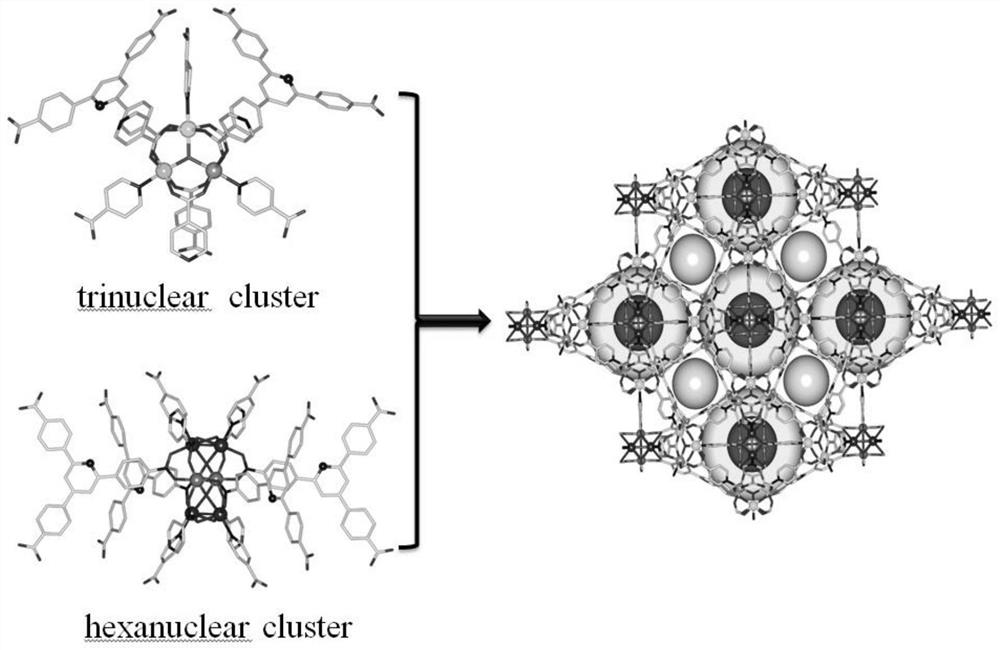
[0045] The structure of the crystal was determined by Agilent Technologies SuperNova single crystal diffractometer test, the test results showed that: its molecular formula is {(NH 2 (CH 3 ) 2 )[Co 9 (µ 3 -OH) 2 (µ 4 -OH)(PTB) 2 (ina) 8 (BDC)]} n , where H 3 PTB is 4, 4’,4’’’-(pyridine-2,4,6-triyl)tribenzoic acid, the structural formula is , Hina is isonicotinic acid, H 2 BDC is terephthalic acid.
[0046] The ...
Embodiment 2
[0049] This embodiment relates to the preparation method of Co-PTB-NDC-ina multi-core multi-variable metal-organic framework, including the following steps:
[0050] Experimental procedure is consistent with embodiment 1, except ligand terephthalic acid (H 2 BDC) was replaced by naphthalene dicarboxylic acid (H 2 NDC), pink crystals were obtained.
[0051] Its structure is similar to that of Example 1, except that the ligand is changed from H 2 Change BDC to H 2 NDC.
Embodiment 3
[0053] This embodiment relates to the preparation method of Co-PTB-BDC-Fina multi-core multi-variable metal-organic framework, including the following steps:
[0054] The experimental procedure was the same as in Example 1, except that the ligand was changed from isonicotinic acid (Hina) to trifluoroisonicotinic acid (FHina), and pink crystals were obtained.
[0055] Its structure was tested by single crystal diffraction to be similar to the crystal structure of Example 1, except that the ligand was changed from Hina to FHina.
PUM
| Property | Measurement | Unit |
|---|---|---|
| specific surface area | aaaaa | aaaaa |
| adsorption capacity | aaaaa | aaaaa |
| specific surface area | aaaaa | aaaaa |
Abstract
Description
Claims
Application Information
 Login to View More