Preparation method and application of composite photocatalyst for catalyzing water photolysis for hydrogen production
A catalyst and composite light technology, applied in organic compound/hydride/coordination complex catalysts, physical/chemical process catalysts, chemical instruments and methods, etc. Large and other problems, to achieve the effect of high-efficiency catalytic water splitting for hydrogen production
- Summary
- Abstract
- Description
- Claims
- Application Information
AI Technical Summary
Problems solved by technology
Method used
Image



Examples
Embodiment 1
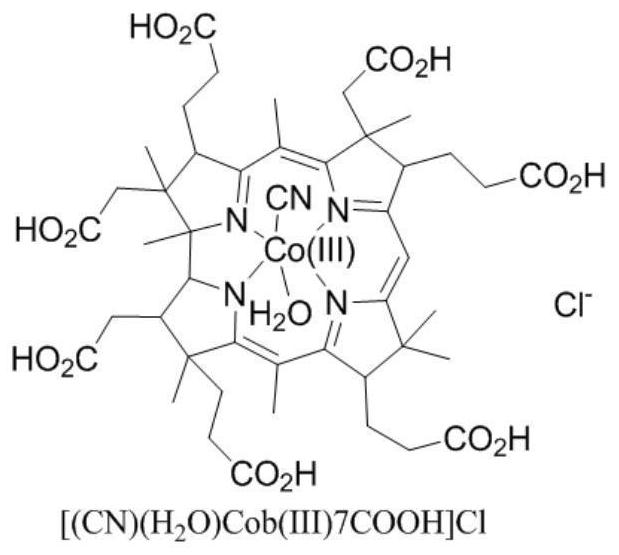
[0017] Example 1 Composite photocatalyst (Cu-TiO 2 -B 12 )
[0018] (1) The preparation method is as follows:
[0019] 1. Ultra-thin TiO 2 Preparation of nanosheets
[0020] Add 10 mL of tetrabutyl titanate and 1.2 mL of HF to 40 mL of absolute ethanol, stir for 30 min, transfer to a hydrothermal kettle, heat at 180 °C for 2 h, centrifuge, and wash the solid repeatedly with distilled water. Finally, vacuum drying at 60 °C for 24 h.
[0021] 2. Copper-doped ultrathin TiO 2 Nanosheets (Cu-TiO 2 ) preparation
[0022] In 40 mL of absolute ethanol, add 10 mL of tetrabutyl titanate, 1.2 mL of HF and 400 mg of Cu(NO) 3 ) 2 ·3H 2 O, stirred for 30 min, transferred to a hydrothermal kettle, heated at 180 °C for 2 h, centrifuged, and the solid was repeatedly washed with distilled water. Finally, vacuum drying at 60 °C for 24 h.
[0023] 3. Composite Cu-TiO 2 -B 12 preparation
[0024] Take the copper-doped ultrathin TiO obtained in step 2 2 Nanosheets (Cu-TiO 2 ) (50mg...
Embodiment 2
[0029] Example 2 Composite photocatalyst (Cu-TiO 2 -B 12 ) Catalytic water splitting for hydrogen production
[0030] The method is as follows: composite photocatalyst Cu-TiO 2 -B 12 (50 mg) ultrasonically dispersed in 100 mL of 5% glycerol aqueous solution by volume. The reaction is carried out in a quartz reactor. Before the reaction, the reaction mixture was evacuated for 30 minutes and then purged with nitrogen for 30 minutes to remove oxygen. The reaction was carried out under simulated sunlight for 5 h. After the reaction was completed, the evolved gas was analyzed by a gas chromatograph (GC-7900) every 1 hour. The reaction principle is as Image 6 shown, the results are shown in Table 1 and Figure 7 .
[0031] Table 1 Cu-TiO 2 -B 12 Photocatalytic water splitting reaction data for hydrogen production
[0032]
[0033] By comparing Table 1 and Figure 7 From the data, it can be found that under the same reaction conditions, when the composite TiO 2 -B 12...
PUM
| Property | Measurement | Unit |
|---|---|---|
| thickness | aaaaa | aaaaa |
Abstract
Description
Claims
Application Information
 Login to View More