
Anti-H7N9 whole-human monoclonal antibody 7T33 and preparation method therefor and application of anti-H7N9 whole-human monoclonal antibody 7T33
A monoclonal antibody, fully human technology, applied in the field of immunology, can solve the problems of drug resistance and no effective treatment methods, and achieve the effect of high affinity and specificity, good biocompatibility, and simple and fast operation.
- Summary
- Abstract
- Description
- Claims
- Application Information
AI Technical Summary
Problems solved by technology
Method used
Image

Examples
Embodiment 1
[0053] (1) Construction of NTH-3T3 cell line (3T3-CD40L) stably expressing CD40L
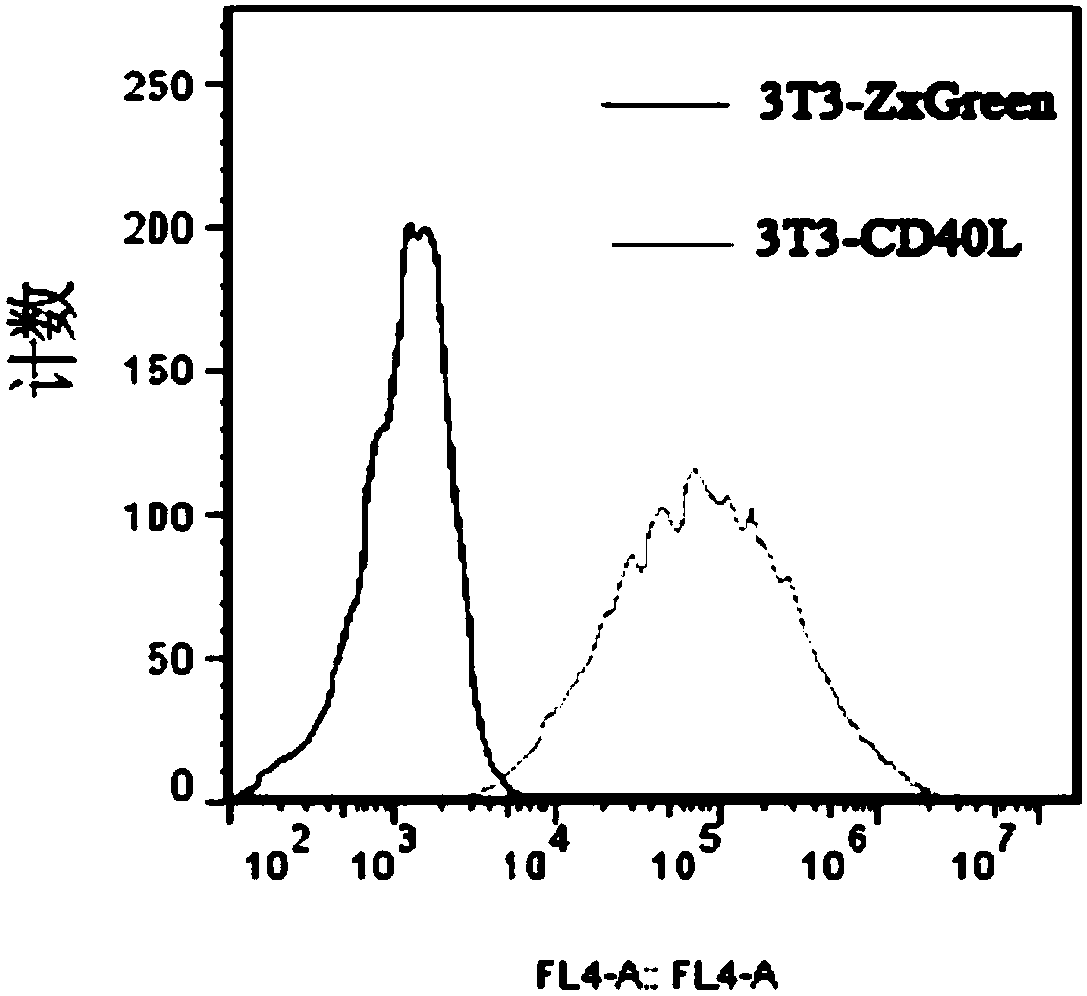
[0054] Use lentivirus to establish 3T3-CD40L feeder cells. The lentiviral expression vector pLVX-CD40L was constructed and transfected into 293T cells. The viral supernatant was collected on the fourth day of transfection. Activated NIH-3T3 cells, cultured for 3 generations and then infected with lentivirus, continued to culture and passage 3 times. Use flow cytometry to sort cells with FITC fluorescence intensity near MFI, and re-add them to the culture flask, 37°C, 5% CO 2 Culture and test in an incubator, the test results are as follows figure 1 As shown, 3T3 cells expressing CD40L and 3T3 cells transfected with empty vector pLVX (with ZxGreen) were stained with anti-CD40L with APC, and then analyzed by flow cytometry. It was found that all 3T3-CD40L feeder cells expressed CD40L. When the cells grow to 80%~90%, digest and collect the cells at a concentration of 1×10 per ml 7 cell. Place in a ...
Embodiment 2
[0075] Example 2 Cloning, Recombination, Expression and Purification of Humanized Monoclonal Antibody 7T33 Gene
[0076] The B cells that can secrete the 7T33 antibody that binds to the H7N9 virus obtained in Example 1 were lysed, and the lysate was taken for reverse transcription of RNA to obtain the PCR template cDNA of the human antibody gene. Design and synthesize primers for cloning antibody genes, use cDNA as template to clone antibody heavy and light chain genes, and recombine them in eukaryotic cells 293F or HEK293 for expression and purification. specifically:
[0077] (1) Transfer the lysed B cell liquid to a 96-well plate (Eppendorf, 030133366).
[0078] (2) Reverse transcription system: 150ng random primers (invitrogen, 48190-011), 0.5μl 10mM dNTP (Invitrogen, 18427-088), 1μl 0.1M DTT (Invitrogen, 18080-044), 0.5%v / v Igepal CA -630 (Sigma, I3021-50ML), 4U RNAsin (Promega), 6U Prime RNAse Inhibitor (Eppendorf) and 50U III reverse transcriptase (Invitrogen, 18080-044), s...
Embodiment 3
[0132] Example 3 Neutralization experiment and antibody affinity experiment of purified fully human monoclonal antibody 7T33
[0133] (1) Experimental purpose
[0134] Using a virus-infected cell model (canine kidney cell MDCK), the inhibitory effect and effect of 7T33 antibody on H7N9 influenza virus were evaluated by micro-neutralization-ELISA experiment, and the anti-influenza virus activity of the antibody was detected.
[0135] (2) Experimental steps
[0136] (2.1) Cell plating
[0137] Trypsin digestion of logarithmic growth phase MDCK canine kidney cells, centrifuge and collect after termination, blow evenly to prepare a single cell suspension; adjust the cell concentration to 5×10 with cell culture medium 4 Pcs / ml, seeded on 96-well cell culture plate, and placed cells at 37℃, 5% CO 2 Cultivate overnight in an incubator.
[0138] (2.2) Pretreatment of 7T33 antibody and H7N9 virus (the virus A / Anhui / 1 / 2013 was taken from the Institute of Microbiology, Chinese Academy of Sciences) ...
PUM
| Property | Measurement | Unit |
|---|---|---|
| affinity | aaaaa | aaaaa |
Abstract
Description
Claims
Application Information
 Login to View More