
A light-responsive engineered bacteria intestinal targeting optogenetic carrier system and its construction method and application
A technology of engineering bacteria and photoresponse, which is applied in the fields of biotechnology and medicine, can solve the problems of undiscovered patent documents, etc., and achieve the effects of time and space accuracy, good dispersion, and disease course suppression
- Summary
- Abstract
- Description
- Claims
- Application Information
AI Technical Summary
Problems solved by technology
Method used
Image

Examples
preparation example Construction
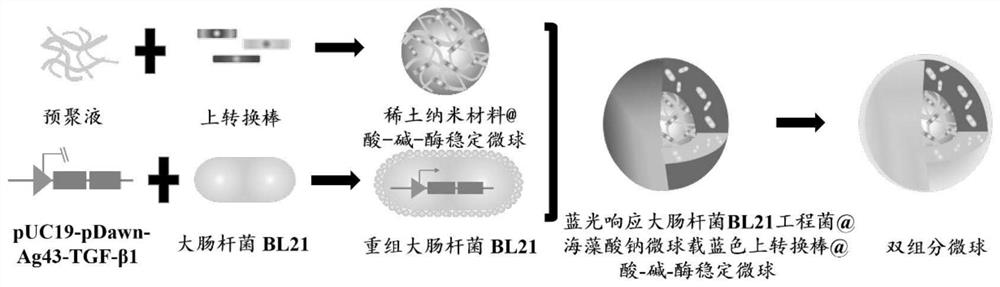
[0052] The preparation method of the above-mentioned carrier system, the concrete method is as follows:
[0053] (1) Preparation of rare earth nanomaterials@acid-alkali-enzyme stabilized microspheres: Weigh rare earth nanomaterials (such as blue upconversion rods, which can be referred to as upconversion rods) and dissolve them in the prepolymer solution. The ratio g:mL is 0.1-0.5:1-5, and the composition ratio of the prepolymer solution is: polyethylene glycol diacrylate-200: polyethylene glycol-700 (wherein, 200 and 700 are the molecular weights of these two substances ): the volume ratio of 2-hydroxy-2-methyl-1-phenyl-1-acetone is 5:4-3:1-2, when the prepolymer solution is prepared, the polyethylene glycol diacrylate- 200: polyethylene glycol-700: 2-hydroxy-2-methyl-1-phenyl-1-acetone mixed in proportion; ultrasonically dispersed, stored in the dark, as the internal solution; dimethyl silicone oil as the external solution. Then prepare rare earth nanomaterials@acid-alkali-...
Embodiment 1
[0067] Preparation of rare earth nanomaterials@acid-alkali-enzyme stabilized microspheres: Weigh 0.4g of rare earth nanomaterial rods and dissolve them in 2mL of prepolymerization solution. The composition ratio of the prepolymerization solution is PEGDA-200:PEG-700:HMPP=5:3 :2. Ultrasonic dispersion, protected from light, as an internal solution. Dimethicone was used as the external liquid. Relying on the microfluidic platform built by the Nanotechnology Laboratory, School of Life Sciences, Tianjin University, rare earth nanomaterials@acid-alkali-enzyme stabilized microspheres with uniform particle size were prepared.
Embodiment 2
[0069] Construction of blue light-responsive E. coli BL21 engineering strain: PCR technology was used to amplify the pDawn-Ag43 fragment from the template (Addgene#107742). The vector pUC19 was linearized by PCR technology, and the original promoter region was avoided. Using homologous recombination, the pDawn-Ag43 fragment was ligated with the pUC19 vector, and the constructed plasmid pUC19-pDawn-Ag43 was first transformed into a DH5a competent strain and sequenced to obtain a recombinant-positive plasmid. On this basis, the E. coli BL21 expression plasmid pUC19-pDawn-Ag43-TGF-β1 containing transforming growth factor (TGF-β1) immune factor was constructed.
PUM
| Property | Measurement | Unit |
|---|---|---|
| particle diameter | aaaaa | aaaaa |
| particle diameter | aaaaa | aaaaa |
Abstract
Description
Claims
Application Information
 Login to View More