Supercharge Your Innovation With Domain-Expert AI Agents!

Preparation method of a hydrogel flexible strain sensor

A strain sensor, hydrogel flexible technology, applied in the direction of electric/magnetic solid deformation measurement, electromagnetic measurement device, etc., can solve the problems of sensor performance degradation, breaking or bending, plastic deformation, etc., and achieve wide linear detection range and response speed Fast and excellent dynamic durability

Active Publication Date: 2022-05-17
XIAMEN UNIV
View PDF5 Cites 1 Cited by
  • Summary
  • Abstract
  • Description
  • Claims
  • Application Information

AI Technical Summary

Problems solved by technology

In order to meet the needs of low cost and large area, the current flexible strain sensors generally use silicon-based elastomer or rubber as the substrate, but this material is prone to fatigue and plastic deformation under high-strength stress, and then breaks or bends. Causes the inevitable degradation of sensor performance over time

Method used

the structure of the environmentally friendly knitted fabric provided by the present invention; figure 2 Flow chart of the yarn wrapping machine for environmentally friendly knitted fabrics and storage devices; image 3 Is the parameter map of the yarn covering machine
View more

Image

Smart Image Click on the blue labels to locate them in the text.
Viewing Examples
Smart Image
  • Preparation method of a hydrogel flexible strain sensor
  • Preparation method of a hydrogel flexible strain sensor
  • Preparation method of a hydrogel flexible strain sensor

Examples

Experimental program
Comparison scheme
Effect test

Embodiment 1

[0035] Fabrication of hydrogel flexible strain sensors:

[0036] (1) Choline chloride and urea were mixed in a molar ratio of 1:1 and placed in a flask, and magnetically stirred in an oil bath at 60° C. for 2 hours to form a clear deep eutectic solvent for later use.

[0037] (2) Add 20 mL DMSO to the above 10 mL deep eutectic solvent and continue stirring for 30 min. Subsequently, 0.5 g of polyvinyl alcohol was added and stirred, and 1 mL of cellulose nanocrystal solution and 1 mL of graphitic carbon nitride solution were added, and the stirring was continued for 5 h.

[0038] (3) Pour the material obtained in step (2) into a petri dish, place it in the refrigerator, and freeze it at -20°C for 20 hours to freeze and polymerize to form a polyvinyl alcohol network. Take it out and place it at room temperature for 2 hours before placing it in the refrigerator. Store at 20°C for 6 hours to obtain a hydrogel.

[0039] (3) Clean and dry the above hydrogel, install conductive elec...

Embodiment 2

[0041] Fabrication of hydrogel flexible strain sensors:

[0042] (1) Choline chloride and glucose were mixed in a molar ratio of 1:2, placed in a flask, and magnetically stirred in an oil bath at 100° C. for 2 hours to form a clear deep eutectic solvent for later use.

[0043] (2) Add 20 mL DMSO to the above 10 mL deep eutectic solvent and continue stirring for 30 min. Then 1 g of polyvinyl alcohol was added and stirred, 1 mL of cellulose nanocrystal solution and 1 mL of graphitic carbon nitride solution were added, and the stirring was continued for 5 h.

[0044] (3) Pour the material obtained in step (2) into a petri dish, place it in the refrigerator, and freeze it at -20°C for 20 hours to freeze and polymerize to form a polyvinyl alcohol network. Take it out and place it at room temperature for 2 hours before placing it in the refrigerator. Store at 20°C for 6 hours to obtain a hydrogel.

[0045] (3) Clean and dry the above hydrogel, install conductive electrodes, and pa...

Embodiment 3

[0047] Fabrication of hydrogel flexible strain sensors:

[0048] (1) Choline chloride and glycerol were mixed in a molar ratio of 1:3 and placed in a flask, and magnetically stirred in an oil bath at 90° C. for 2 hours to form a clear deep eutectic solvent for later use.

[0049] (2) Add 20 mL DMSO to the above 10 mL deep eutectic solvent and continue stirring for 30 min. Then, 2.0 g of polyvinyl alcohol was added and stirred, and 1 mL of cellulose nanocrystal solution and 1 mL of graphitic carbon nitride solution were added, and the stirring was continued for 5 h.

[0050] (3) Pour the material obtained in step (2) into a petri dish, place it in the refrigerator, and freeze it at -20°C for 20 hours to freeze and polymerize to form a polyvinyl alcohol network. Take it out and place it at room temperature for 2 hours before placing it in the refrigerator. Store at 20°C for 6 hours to obtain a hydrogel.

[0051](3) Clean and dry the above hydrogel, install conductive electrode...

the structure of the environmentally friendly knitted fabric provided by the present invention; figure 2 Flow chart of the yarn wrapping machine for environmentally friendly knitted fabrics and storage devices; image 3 Is the parameter map of the yarn covering machine
Login to View More

PUM

PropertyMeasurementUnit
diameteraaaaaaaaaa
lengthaaaaaaaaaa
Login to View More

Abstract

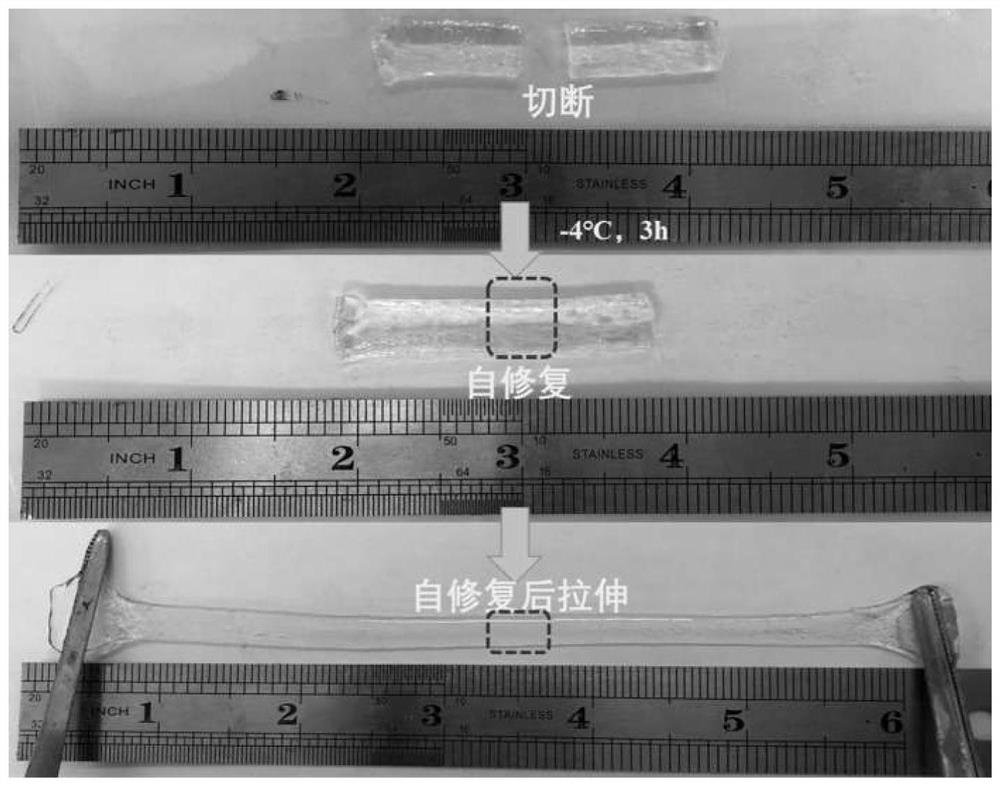
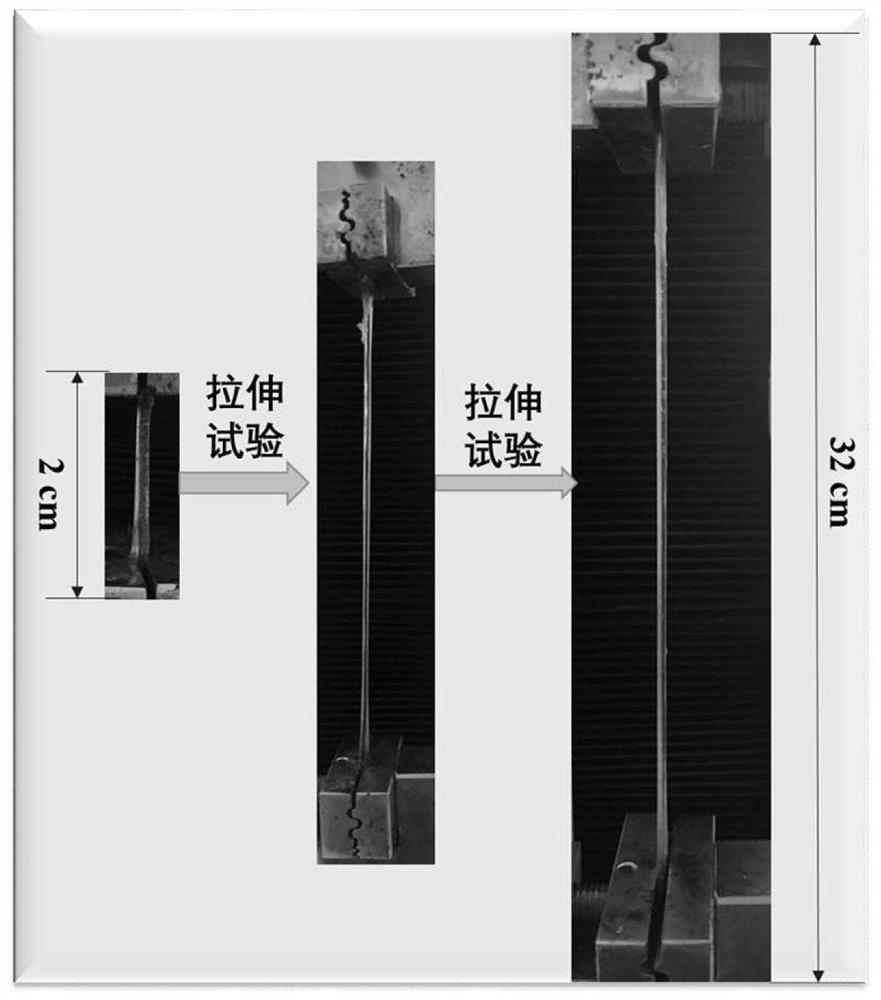
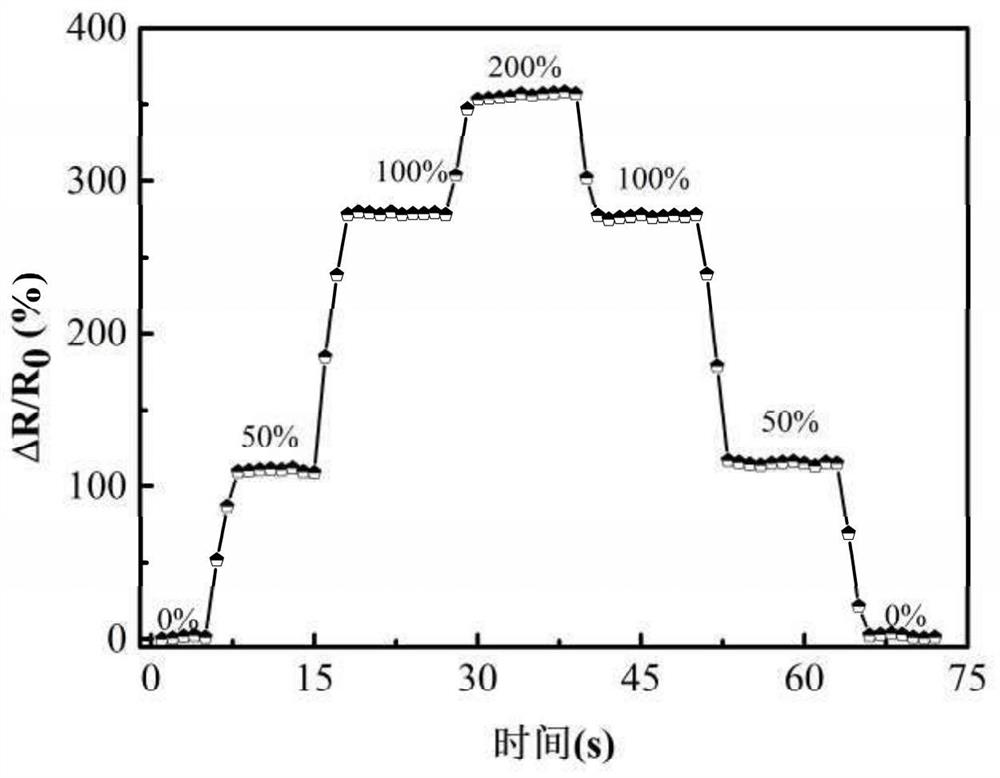
The invention discloses a method for preparing a hydrogel flexible strain sensor, which uses a choline chloride-based deep eutectic solvent as a raw material and combines polyvinyl alcohol polymers to prepare a double-network hydrogel. By adding cellulose nano Crystalline and graphitic carbon nitride nanosheets have excellent self-healing properties, frost resistance, and strong tensile properties. The hydrogel flexible strain sensor prepared by the invention has the advantages of self-repairability and stretchability, good sensitivity and wide linear detection range, fast response speed, excellent dynamic durability, and can realize tiny and violent human body Real-time monitoring of motion can be applied in fields such as wearable devices, soft robots, electronic skin and healthcare.

Description

technical field [0001] The invention belongs to the technical field of tensile strain testing equipment, and in particular relates to a preparation method of a hydrogel flexible strain sensor. Background technique [0002] With the rise of wearable devices, the demand and research of flexible sensors are increasing, and the demand for sensors with strong stretchability, ductility, sensitivity, heat resistance, low power consumption and quality is increasing rapidly. If it is Skin-friendly sensors may also be biocompatible. Flexible sensors can be widely used in human health monitoring, human motion monitoring, human-computer interaction, and soft robotics. As a basic sensor, the strain sensor in the flexible sensor has produced many research results. This type of strain sensor is generally divided into resistive and capacitive. So far, researchers have used different materials to make strain sensors, but these different materials have their own advantages and disadvantage...

Claims

the structure of the environmentally friendly knitted fabric provided by the present invention; figure 2 Flow chart of the yarn wrapping machine for environmentally friendly knitted fabrics and storage devices; image 3 Is the parameter map of the yarn covering machine
Login to View More

Application Information

Patent Timeline
no application Login to View More
Patent Type & Authority Patents(China)
IPC IPC(8): G01B7/16C08J3/075C08L29/04C08L1/04C08K3/28C08J3/24
CPCG01B7/18C08J3/075C08J3/246C08J2329/04C08J2301/04C08K3/28
Inventor 曾宪海王晖强许凤唐兴孙勇林鹿
Owner XIAMEN UNIV
Features
  • R&D
  • Intellectual Property
  • Life Sciences
  • Materials
  • Tech Scout
Why Patsnap Eureka
  • Unparalleled Data Quality
  • Higher Quality Content
  • 60% Fewer Hallucinations
Social media
Patsnap Eureka Blog
Learn More