
Screening kit for early esophageal squamous cell carcinoma based on a set of tumor-associated antigens
A technology of tumor-associated antigen and esophageal squamous cell carcinoma, which is applied in the field of medicine and biology, can solve the problems of no screening of esophageal squamous cell carcinoma, the detection rate of esophageal cancer is less than 2%, and the mortality rate has not been significantly improved, so as to ensure detection sensitivity and avoid Physical and mental pain, strong balance effect
Patent Information
- Authority / Receiving Office
- CN · China
- Patent Type
- Patents(China)
- Current Assignee / Owner
- Publication Date
- 2022-02-01
Smart Images
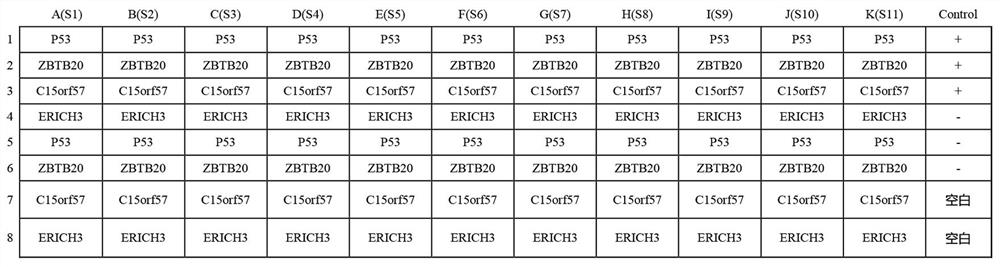
Figure 1 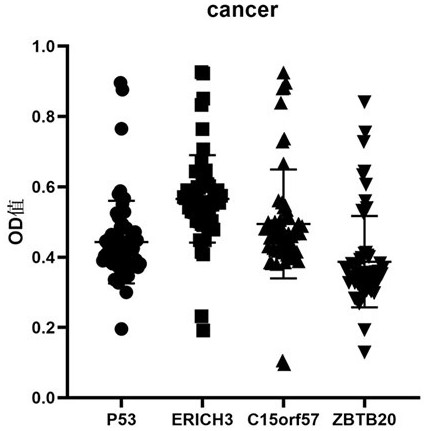
Figure 2 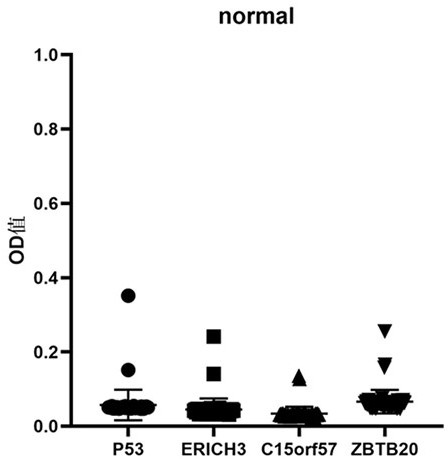
Figure 3
Abstract
Description
technical field
[0001] The invention belongs to the field of medical biotechnology, and in particular relates to the application of FCRL1 protein or its specific antibody in the screening of cardia cancer. Background technique
[0002] Esophageal cancer is one of the six most common malignant tumors in the world. It has significant regional distribution differences and family aggregation. my country is the country with the highest incidence and mortality of esophageal cancer in the world. Every year, about 500,000 cases, more than half occurred in China. In China, half of the patients occurred in the Taihang Mountain area at the junction of Henan, Hebei, and Shanxi provinces. Among them, Linxian County, Henan Province has the highest incidence and mortality rate of esophageal cancer in the world, which is a hundred times higher than that in Western countries. Esophageal cancer is a disease with Chinese characteristics. In China, the pathological type of esophageal cancer is ...
Examples
Embodiment 1
[0039] Embodiment 1: the preparation of kit
[0040] According to the principle of indirect ELISA, the invention prepares an autoantibody combined detection ELISA kit that can be used for screening and diagnosing early esophageal squamous cell carcinoma. The principle of indirect enzyme-linked immunoassay is to connect the antigen to a solid-phase carrier, and the antibody to be tested in the sample combines with it to form a solid-phase antigen-test antibody complex, and then use the enzyme-labeled secondary antibody and the solid-phase antigen-test antibody to The antibodies in the complex combine to form a solid-phase antigen-test antibody-enzyme-labeled secondary antibody complex, and then measure the degree of color development after adding the substrate to determine the content of the antibody to be tested.
[0041] 1. Experimental materials and reagents:
[0042] (1) Four kinds of tumor-associated antigen proteins (P53, ZBTB20, ERICH3 and C15orf57), purchased from Wuha...
Embodiment 2
[0076] Embodiment 2: the usage method of kit
[0077] 1. Serum sample incubation:
[0078] Dilute the serum sample to be tested with the sample diluent at a ratio of 1:500, and then add the diluted serum sample to the reaction wells of the 96-well microplate plate coated with antigen, with a sample volume of 100 μl / well, Place in a constant temperature incubator at 37°C and incubate for 1 h, then discard the liquid in the reaction well, and wash with washing solution 3 times, each time for 3 min.
[0079] 2. Enzyme-labeled secondary antibody incubation:
[0080] Dilute the horseradish peroxidase-labeled RecA protein with the secondary antibody diluent at a ratio of 1:40000, and then add the diluted horseradish peroxidase-labeled RecA protein to the reaction wells of the 96-well microtiter plate In this method, the sample volume was 100 μl / well, placed in a 37°C constant temperature incubator and incubated for 50 minutes, then the liquid in the sample wells was discarded, and...
Embodiment 3
[0085] Embodiment 3: Analysis of the diagnostic value of the kit of the present invention
[0086] In this example, the kit prepared in Example 1 is used to detect the serum samples of patients with early esophageal squamous cell carcinoma and normal people according to the method described in Example 2, so as to evaluate and analyze the kit of the present invention for screening and screening of early esophageal squamous cell carcinoma. diagnostic value.
[0087] 1. Sample source
[0088] 200 serum samples were collected from the State Key Laboratory of Esophageal Cancer Prevention and Control in the First Affiliated Hospital of Zhengzhou University, including 100 samples of normal human serum (control group) and 100 serum samples of patients with early esophageal squamous cell carcinoma (esophageal squamous cell carcinoma group). 100 cases of normal human serum were collected from the healthy physical examination center of the laboratory's cooperative hospital, without any ...