A water-soluble fluorescein polymer probe for mercury ion detection and its preparation and application
A fluorescein and water-soluble technology, which is applied in the field of organic synthesis and spectral detection, can solve the problems that the detection selectivity is easily interfered by iron ions, cannot effectively realize the detection of low-concentration mercury ions, and is difficult to achieve the best detection effect. Good water solubility, improved biocompatibility, and improved water solubility
- Summary
- Abstract
- Description
- Claims
- Application Information
AI Technical Summary
Problems solved by technology
Method used
Image

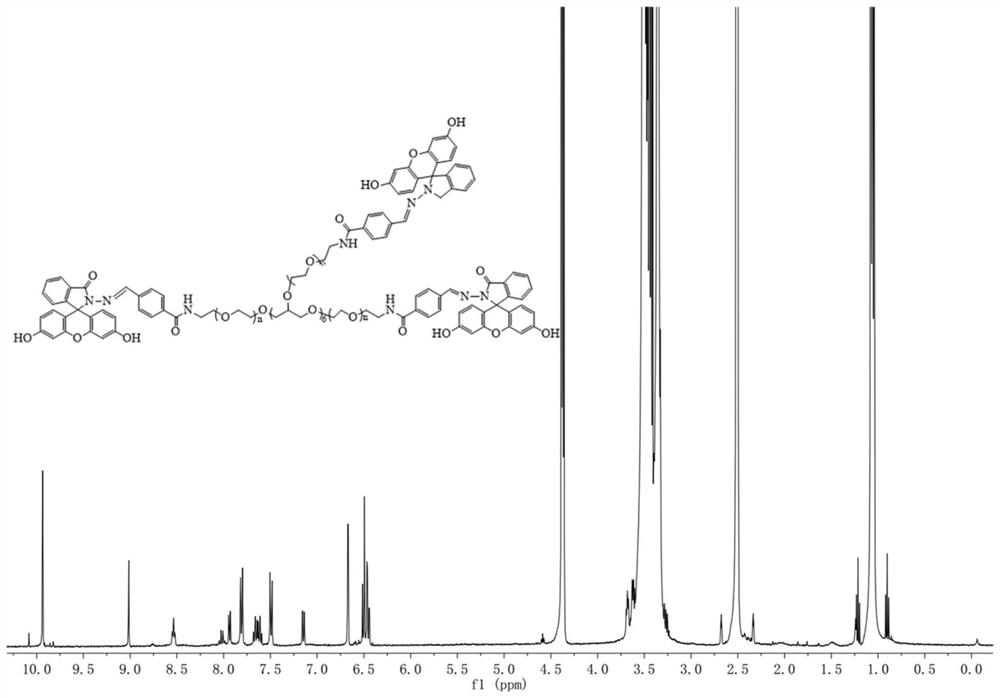


Examples
Embodiment 1
[0049] A preparation method of a water-soluble fluorescein polymer probe for mercury ion detection: dissolve 0.665g of fluorescein in 30mL of ethanol, under stirring at room temperature, dropwise into 9mL of hydrazine hydrate (mass concentration 50%) for 20min After the inner dropwise addition was completed, the temperature of the system was raised to 78°C by heating, the reaction was refluxed for 5 hours, cooled, and rotary evaporated. The crude product was washed with ethanol / water, filtered, and dried under vacuum to obtain fluorescein hydrazide.
[0050] Dissolve 0.5g (0.025mmol) of eight-arm polyethylene glycol benzaldehyde (the Mw of polyethylene glycol segment in eight-arm polyethylene glycol benzaldehyde = 20,000, commercially available) in 30 mL of acetone to obtain reaction solution 1; Dissolve 0.083 g (0.24 mmol) of fluorescein hydrazide in 10 mL of acetone to obtain reaction solution 2; under stirring and refluxing state, add reaction solution 1 dropwise to reaction...
Embodiment 2
[0054] A preparation method of a water-soluble fluorescein polymer probe for mercury ion detection: dissolve 0.665g of fluorescein in 30mL of methanol, under stirring at room temperature, dropwise into 7mL of hydrazine hydrate (mass concentration 50%), 20min After the inner dropwise addition was completed, the temperature of the system was raised to 65°C by heating, the reaction was refluxed for 5 hours, cooled, and rotary evaporated. The crude product was washed with ethanol / water, filtered, and dried under vacuum to obtain fluorescein hydrazide.
[0055] Dissolve 0.5g (0.025mmol) of eight-arm polyethylene glycol benzaldehyde (Mw of polyethylene glycol segment in eight-arm polyethylene glycol benzaldehyde)=20,000 in 30mL of acetone to obtain reaction solution 1; 0.083g ( 0.24mmol) fluorescein hydrazide was dissolved in 10mL of acetone to obtain reaction solution 2; under stirring and refluxing state, reaction solution 1 was added dropwise to reaction solution 2, and then 1 dro...
Embodiment 3
[0057] A preparation method of a water-soluble fluorescein polymer probe for mercury ion detection: dissolve 0.33 g of fluorescein in 20 mL of methanol, and under stirring at room temperature, dropwise into 2 mL of hydrazine hydrate (mass concentration 85%) for 10 min After the dropwise addition was completed, the temperature of the system was raised to 65°C by heating, the reaction was refluxed for 10 hours, cooled, and rotary evaporated. The crude product was washed with ethanol / water, filtered, and dried in vacuo to obtain fluorescein hydrazide.
[0058] Dissolve 0.5g (0.025mmol) of eight-arm polyethylene glycol benzaldehyde (Mw of polyethylene glycol segment in eight-arm polyethylene glycol benzaldehyde)=20,000 in 30mL of acetone to obtain reaction solution 1; 0.104g ( 0.30mmol) fluorescein hydrazide was dissolved in 20mL of acetone to obtain reaction solution 2; under stirring and refluxing state, reaction solution 1 was added dropwise to reaction solution 2, and then 2 dr...
PUM
 Login to View More
 Abstract
Description
Claims
Application Information
 Login to View More