Check patentability & draft patents in minutes with Patsnap Eureka AI!

Preparation method of 1-(2, 3-dichlorophenyl) piperazine

A technology of dichlorophenyl and dichloroaniline, which is applied in the field of preparation of 1-piperazine, can solve the problems of relatively large harm to the human body and the environment, high equipment requirements, serious problems, etc., so as to avoid harm to people and the environment, and the product The effect of high purity and yield and short reaction time

Pending Publication Date: 2022-07-15
GAOYOU CITY ORGANIC CHEM FACOTRY
View PDF0 Cites 0 Cited by
  • Summary
  • Abstract
  • Description
  • Claims
  • Application Information

AI Technical Summary

Problems solved by technology

[0021] This route needs to be reacted at about 220°C, which requires high equipment. Concentrated hydrochloric acid is easy to volatilize and escape at high temperature, and pollutes the environment and is not suitable for production.
[0022] The disadvantages of the prior art are: bis(2-haloethyl)amine hydrochloride is poisonous when inhaled, ingested or absorbed through the skin, and has mutagenic effects on humans; when preparing or using bis-(2-haloethyl) When using amine hydrochloride, it will cause great harm to the human body and the environment, especially after the reaction, a large amount of waste liquid will be generated, and the pollution will be very serious.

Method used

the structure of the environmentally friendly knitted fabric provided by the present invention; figure 2 Flow chart of the yarn wrapping machine for environmentally friendly knitted fabrics and storage devices; image 3 Is the parameter map of the yarn covering machine
View more

Image

Smart Image Click on the blue labels to locate them in the text.
Viewing Examples
Smart Image
  • Preparation method of 1-(2, 3-dichlorophenyl) piperazine
  • Preparation method of 1-(2, 3-dichlorophenyl) piperazine
  • Preparation method of 1-(2, 3-dichlorophenyl) piperazine

Examples

Experimental program
Comparison scheme
Effect test

Embodiment 1

[0042] Synthesis of Compound 1

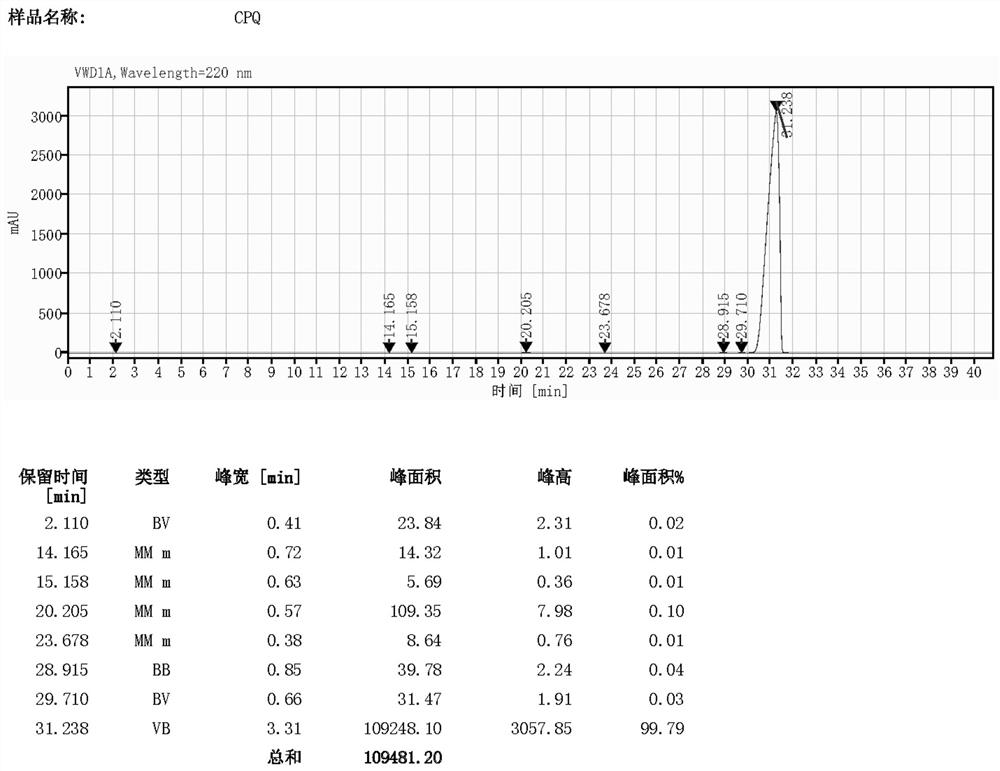
[0043] In a 500mL reaction flask, add 105.5g of diethanolamine, heat it to 120-130°C, and pass 240g of hydrogen bromide gas. At 150°C, 135.5 g of 2,3-dichloroaniline was slowly added dropwise for about 6 hours. After the dropwise addition, continue to react until the molar amount is “2 / (2+1) is less than 5%”; after the reaction ends, slowly add 20% sodium hydroxide dropwise to pH=9-10, and keep 1 at 90-100°C 300 mL of toluene was added and stirred for 1 hour; left to stand for stratification, and the water layer was discarded; the organic layer was recovered solvent toluene, and the residue was subjected to vacuum distillation, and the fractions at 170-175 °C / 10 mmHg were collected to obtain 137.6 g of compound 1, HPLC The purity was 99.79%, and the yield was 71.2%.

[0044] The reaction temperature of diethanolamine and hydrogen bromide can be selected in the range of 100-200°C, and the hydrolysis temperature can be selected in the range of ...

Embodiment 2

[0049] Synthesis of Compound 1

[0050] In a 1000mL reaction flask, add 105.5g diethanolamine and 600g 48% hydrobromic acid solution, the reaction mixture is heated to 120-130°C for 3 hours; then the temperature is raised to 150-160°C, and 135g of 2,3 - Dichloroaniline, about 6 hours. After the dropwise addition, continue to react until the molar amount is "2 / (2+1) less than 5%"; after the reaction is over, slowly add 20% sodium hydroxide dropwise to pH=9-10, and keep 1.5 at 90-100°C 300 mL of toluene was added and stirred for 1 hour; left to stand for stratification, and the aqueous layer was discarded; the organic layer was decompressed to recover solvent toluene, and the residue was subjected to vacuum distillation to collect fractions at 170-175 °C / 10 mmHg to obtain 122.3 g of compound 1 , the HPLC purity was 99.70%, and the yield was 63.5%.

Embodiment 3

[0052] Synthesis of Compound 1

[0053]In a 1000mL reaction flask, add 105.5g diethanolamine and 135.2g 2,3-dichloroaniline, heat the reaction mixture to 120-130°C, and slowly introduce 230g hydrogen bromide gas, the exotherm is very obvious and needs to be controlled Introduce speed reaction for 3 hours; then heat up to 130-150 ° C, continue to react until the molar amount "2 / (2+1) is less than 5%"; after the reaction is over, slowly add 20% sodium hydroxide dropwise to pH=9 -12, keep at 90-100 ℃ for 1 hour; add 300 mL of toluene and stir for 1 hour; let stand for stratification, and discard the water layer; the organic layer is decompressed to recover solvent toluene, and the residue is subjected to vacuum distillation to collect 170-175 ℃ / 10 mmHg fraction, 126.5 g of compound 1 was obtained, the HPLC purity was 99.56%, and the yield was 65.6%.

the structure of the environmentally friendly knitted fabric provided by the present invention; figure 2 Flow chart of the yarn wrapping machine for environmentally friendly knitted fabrics and storage devices; image 3 Is the parameter map of the yarn covering machine
Login to View More

PUM

No PUM Login to View More

Abstract

The invention provides a preparation method of 1-(2, 3-dichlorophenyl) piperazine in the technical field of medicine production, which comprises the following steps: reacting diethanol amine with hydrogen bromide at high temperature, then dropwise adding 2, 3-dichloroaniline, and continuously keeping the reaction; after the reaction is finished, adding sodium hydroxide to hydrolyze residual bis (2-bromoethyl) amine at high temperature, then adding a solvent, and standing for layering; and rectifying an organic layer under reduced pressure to obtain the compound 1-(2, 3-dichlorophenyl) piperazine. The preparation method has the advantages of low raw material cost, short reaction time, high product purity, high yield and the like, solves the harm of bis-(2-haloethyl) amine to human and environment, and meets the requirements of green chemical processes.

Description

technical field [0001] The invention relates to a preparation method of 1-(2,3-dichlorophenyl)piperazine, and belongs to the technical field of pharmaceutical production. Background technique [0002] The English name of 1-(2,3-dichlorophenyl)piperazine (CPQ) is: 1-(2,3-dichlorophenyl)piperazine; CAS#: 41202-77-1; product appearance is off-white to light yellow Solid, melting point; 62-66°C; bp: 179°C / 15 Torr or 128-130°C / 0.5 Torr. [0003] The structure is as follows: [0004] [0005] 1-(2,3-Dichlorophenyl)piperazine is a key intermediate in the synthesis of Cariprazine and Aripiprazole. [0006] [0007] Aripiprazole is a quinolone derivative jointly developed by Otswka and Bristol-Myers Squibb for the treatment of schizophrenia, bipolar disorder and mental disorders with Alzheimer's dementia. In November, it was approved by the US FDA for the treatment of schizophrenia. [0008] On September 17, 2015, Actavis and Gedeon Richter announced that the U.S. Food and ...

Claims

the structure of the environmentally friendly knitted fabric provided by the present invention; figure 2 Flow chart of the yarn wrapping machine for environmentally friendly knitted fabrics and storage devices; image 3 Is the parameter map of the yarn covering machine
Login to View More

Application Information

Patent Timeline
no application Login to View More
Patent Type & Authority Applications(China)
IPC IPC(8): C07D295/073
CPCC07D295/073
Inventor 瞿军胡忠高德华吴宏祥掌鹏程薛红兰
Owner GAOYOU CITY ORGANIC CHEM FACOTRY
Features
  • R&D
  • Intellectual Property
  • Life Sciences
  • Materials
  • Tech Scout
Why Patsnap Eureka
  • Unparalleled Data Quality
  • Higher Quality Content
  • 60% Fewer Hallucinations
Social media
Patsnap Eureka Blog
Learn More