Fibrous nanometer catalyst material excited with natural light and its prepn process

A nano-catalyst and natural light technology, which is applied in the field of environmental purification materials, can solve the problem that high polymer materials cannot be used, and achieve the effects of easy separation and recovery, mild reaction conditions and high activity.

A nano-catalyst and natural light technology, which is applied in the field of environmental purification materials, can solve the problem that high polymer materials cannot be used, and achieve the effects of easy separation and recovery, mild reaction conditions and high activity.

CN1846850AInactive Publication Date: 2006-10-18北京纳诺天地科技有限公司

Image

Smart Image Click on the blue labels to locate them in the text.
Viewing Examples
Smart Image
  • Fibrous nanometer catalyst material excited with natural light and its prepn process
  • Fibrous nanometer catalyst material excited with natural light and its prepn process
  • Fibrous nanometer catalyst material excited with natural light and its prepn process

Examples

Experimental program
Comparison scheme
Effect test

specific Embodiment

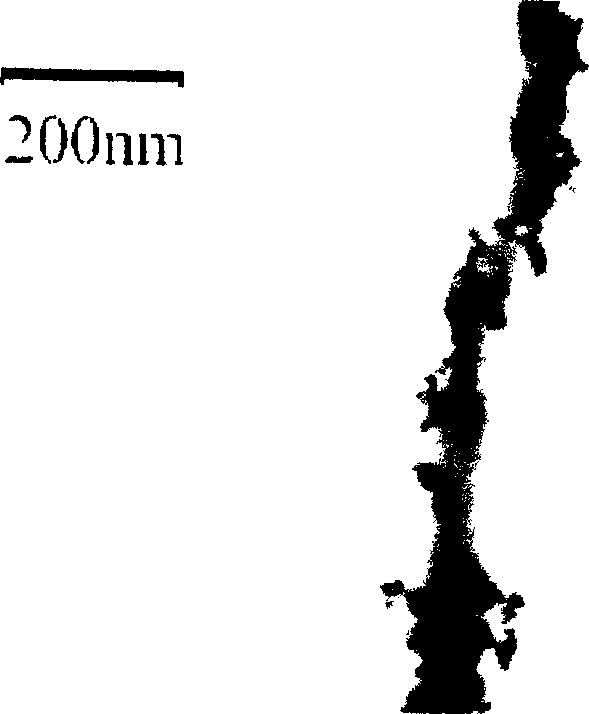
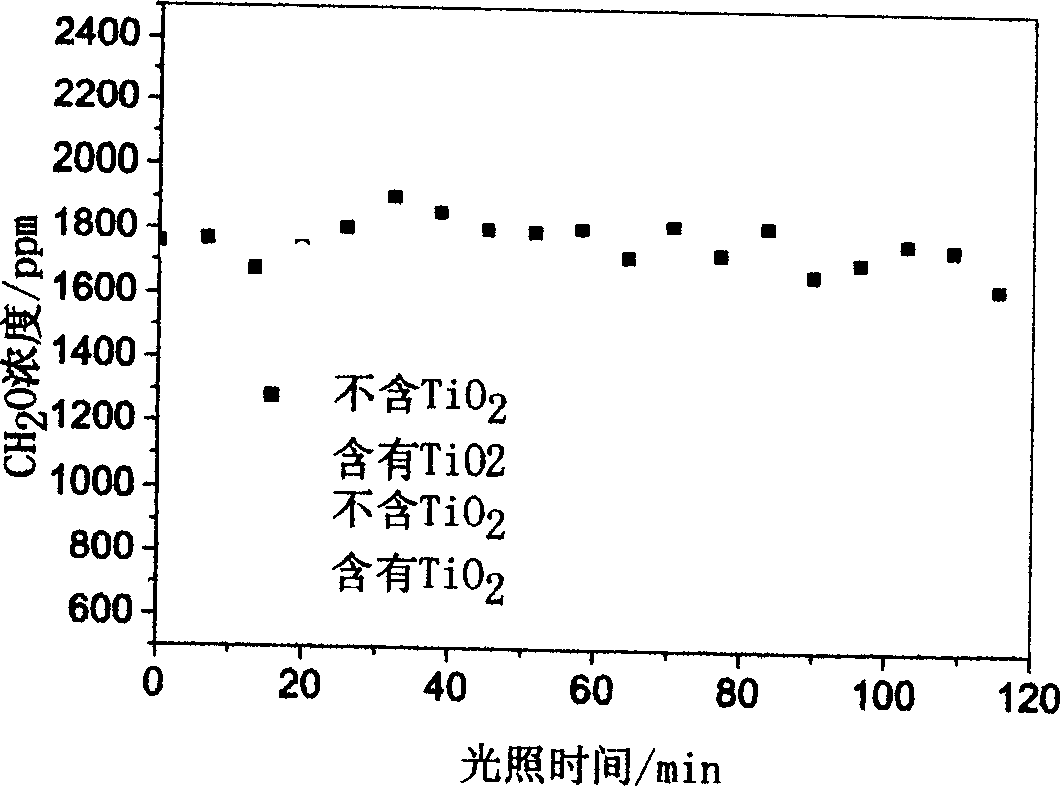
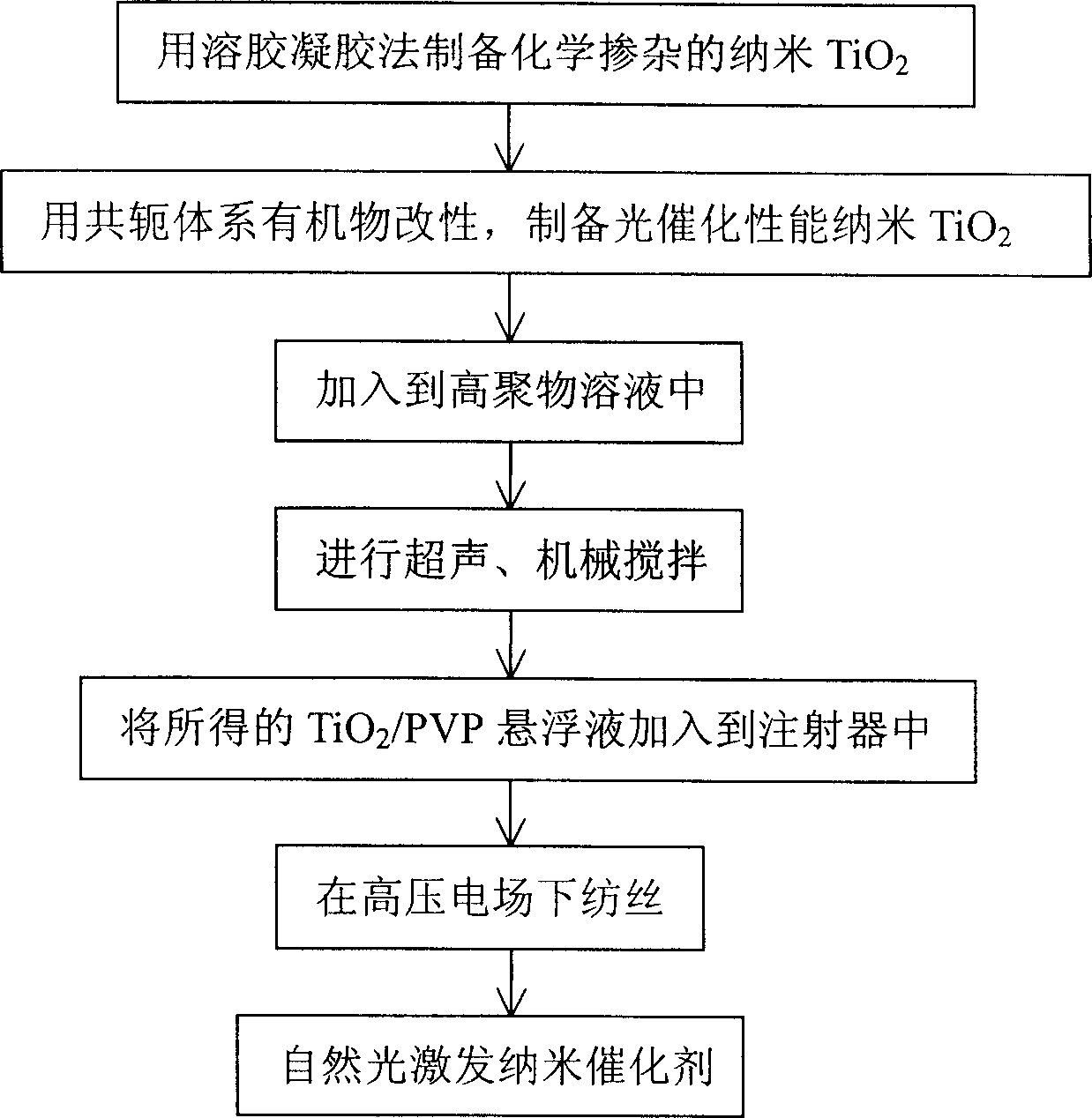
[0009] refer to figure 1 , showing the TEM image of the fibrous nanocatalyst material excited by natural light, refer to figure 2 , is the curve graph of the above materials degrading formaldehyde under visible light. refer to image 3 , has shown the process flow chart of manufacturing above-mentioned material, provides specific embodiment as follows in conjunction with this figure:

Embodiment

[0011] Step 1: Nano TiO 2 Preparation and modification Dissolve 19 g (0.15 mol) of zinc nitrate in 1000 ml of 5% NH4OH aqueous solution at room temperature. Then, using a frozen water bath, slowly drop 0.6 mol of industrial grade titanium tetrachloride into the solution, and uniformly produce a white precipitate under constant stirring. Then, 0.15 mol hydrochloric acid was added under stirring to dissolve the white precipitate and obtain a transparent liquid. The liquid was heated at 95° C. to evaporate for 2 h to remove excess water to obtain a sol-gel. The resulting sol-gel was filtered and washed 4 times with 500 ml of water to bring its pH to 7. The washed sol-gel was dried at 20° C. and 10 mmHg for 3 h to obtain a white micropowder, which is a metastable titanium dioxide precursor. Calcinate the white powder in a muffle furnace at 860°C for 1 hour to obtain a zinc oxide-doped nano-TiO2 matrix, grind the matrix, disperse it into 200ml of pure water at 50°C, and add 0.2g...

the structure of the environmentally friendly knitted fabric provided by the present invention; figure 2 Flow chart of the yarn wrapping machine for environmentally friendly knitted fabrics and storage devices; image 3 Is the parameter map of the yarn covering machine
Login to View More

PUM

PropertyMeasurementUnit
diameteraaaaaaaaaa
diameteraaaaaaaaaa
diameteraaaaaaaaaa
Login to View More

Abstract

The fibrous nanometer catalyst material excited with natural light and its preparation process belongs to the field of environment purifying material technology. The nanometer photocatalytic particle and polymer carrier solution are high voltage electrostatic spun to form nanometer fiber with nanometer TiO2 particle. The preparation process includes sol-gel process to prepare chemically doped nanometer TiO2; modifying with conjugated organic matter; adding the prepared nanometer TiO2 particle into polymer solution and spinning in high voltage electric field to obtain fibrous nanometer catalyst. The fibrous nanometer catalyst material needs no ultraviolet ray excitation, and may be excited with natural light to degrade organic pollutant. The present invention may be used in purifying air and water.

Description

technical field [0001] The invention belongs to the field of environmental purification materials, and in particular relates to a fibrous nano-catalyst material excited by natural light and a preparation method thereof. technical background [0002] With the rapid development of modern industrial technology, human beings are facing many environmental problems. It has become a difficult problem to deal with highly toxic and biodegradable organic pollutants. Such substances are difficult to remove by biological methods, thus causing great harm to the environment. As an advanced oxidation technology, photocatalysis uses photogenerated strong oxidants to completely oxidize organic pollutants into small molecules such as H2O and CO2, so it is an environmentally friendly green water treatment technology. In 1976, Carey et al. carried out pioneering work on photocatalytic degradation of pollutants in water, opening up the application prospect of photocatalytic technology in the fie...

Claims

the structure of the environmentally friendly knitted fabric provided by the present invention; figure 2 Flow chart of the yarn wrapping machine for environmentally friendly knitted fabrics and storage devices; image 3 Is the parameter map of the yarn covering machine
Login to View More

Application Information

Patent Timeline
18 Oct 2006
Publication
CN1846850A
IPC
B01J21/06; B01J35/06; B01J37/34
Inventors
李俊录; 刘太奇