The relatively
slow speed of memory controllers and memory devices limits the data bandwidth between the processor and the memory devices.
In addition to the limited bandwidth between processors and memory devices, the performance of computer systems is also limited by latency problems that increase the time required to read data from system memory devices.
Therefore, although SDRAM devices can synchronously output burst data at a
high data rate, the delay in initially providing the data can significantly slow the operating speed of a computer system using such SDRAM devices.
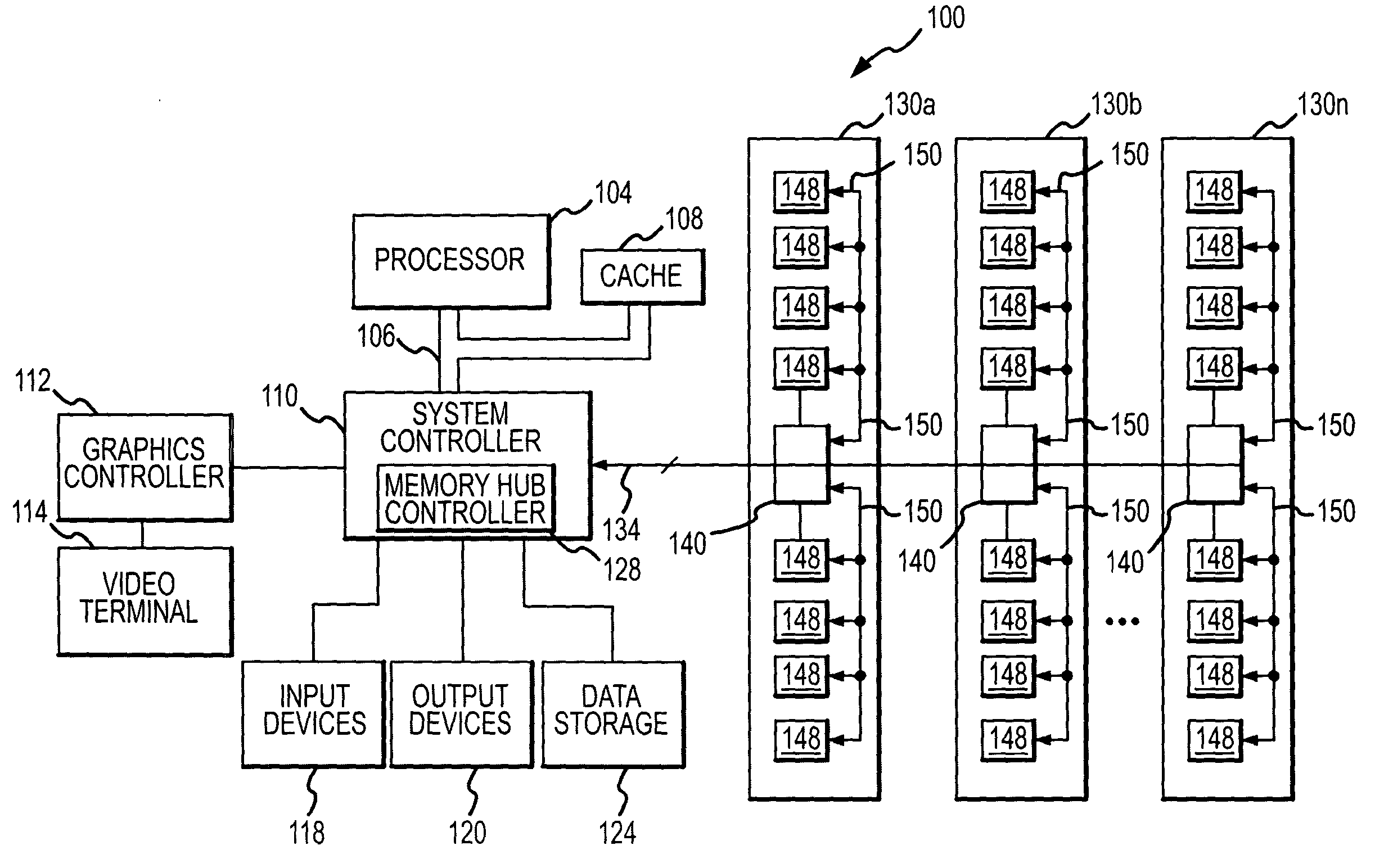
Although there are advantages to utilizing a memory hub for accessing memory devices, the design of the hub memory system, and more generally, computer systems including such a memory hub architecture, becomes increasingly difficult.
However, as transfer rates increase, the time for which a
signal represents valid information is decreasing.
In the case of timing
skew of signals, it often arises from a variety of timing errors such as loading on the lines of the
bus and the physical lengths of such lines.
As data eyes of the signals decrease at higher transfer rates, it is possible that one or more of a group of signals provided in parallel will have arrival times such that not all signals are simultaneously valid at a receiving entity, and thus cannot be successfully captured that entity.
In this situation, the signals having non-overlapping data eyes are not valid at the same time as the rest of the signals, and consequently, cannot be successfully captured by the receiving entity.
Clearly, as those ordinarily skilled in the art will recognize, the previously described situation is unacceptable.
As it is further recognized by those familiar in the art of high speed digital systems,
signal timing is an issue that has become increasingly more significant in the design of systems capable of transferring and transmitting information at high speeds because
signal timing can be affected by many things.
However, such probes can introduce loading effects that change the characteristic of the signals being evaluated.
Although probes are specifically designed to have
high impedance and low
capacitance to minimize loading issues and the introduction of
noise, there is still in many cases, an unacceptable level of loading that changes the character of a signal to such a degree that it cannot be accurately evaluated.
However, there can be no assurance that the command and address signals and the write data signals are actually coupled to circuit nodes in the memory device with this same range of timing relationships.
Therefore, the memory device may not actually function properly with the timing relationships that were used during the testing.
The difficulty in accurately controlling and / or determining the actual timing relationships between signals applied to or internal to memory devices is exacerbated when the memory devices are accessible only through interface circuitry.
Although
production testing equipment may be able to accurately control and determine the timing relationships between signals applied to the interface circuitry, such equipment cannot control or determine the timing relationships of the signals in the memory devices after the devices have been packaged with the interface circuitry so that the signals coupled to and from the memory devices must be coupled through the interface circuitry.
Another problem that can be encountered in testing high-speed memory devices using conventional
production testing equipment is associated with obtaining control over the
memory bus in order to perform evaluation.
Again, this problem is exacerbated when memory devices are accessible to
production testing equipment only through interface circuitry, such as a memory hub.
Unless control over the
memory bus can be obtained, analysis becomes a difficult task.
However, obtaining control over the
memory bus is a difficult task in itself because conventional approaches often interfere with the normal operation of the computer system, thus, preventing accurate analysis of the memory system under true, normal operating conditions.


 Login to View More
  Login to View More