
CMP slurry for forming aluminum film, CMP method using the slurry, and method for forming aluminum wiring using the CMP method
- Summary
- Abstract
- Description
- Claims
- Application Information
AI Technical Summary
Benefits of technology
Problems solved by technology
Method used
Image

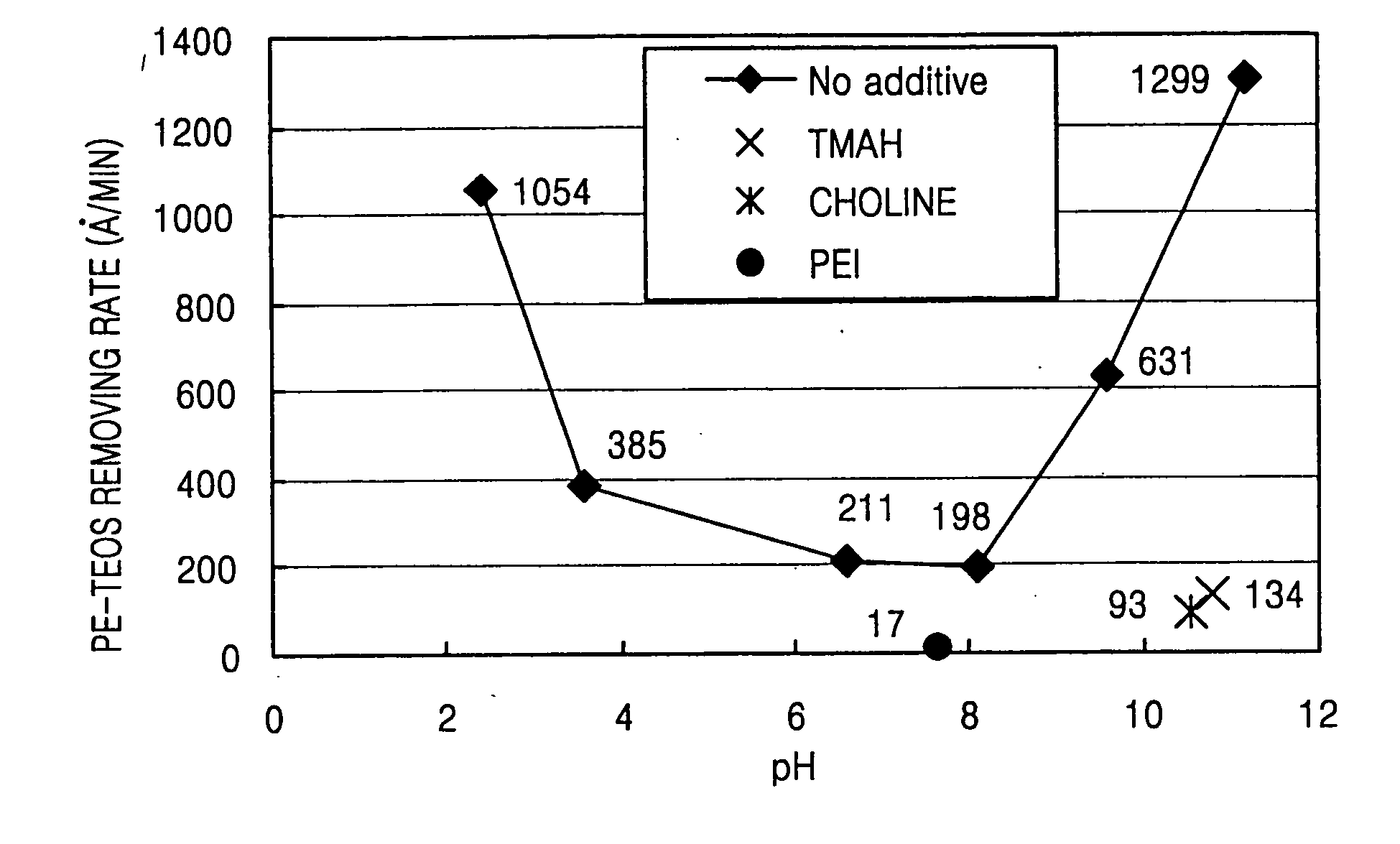
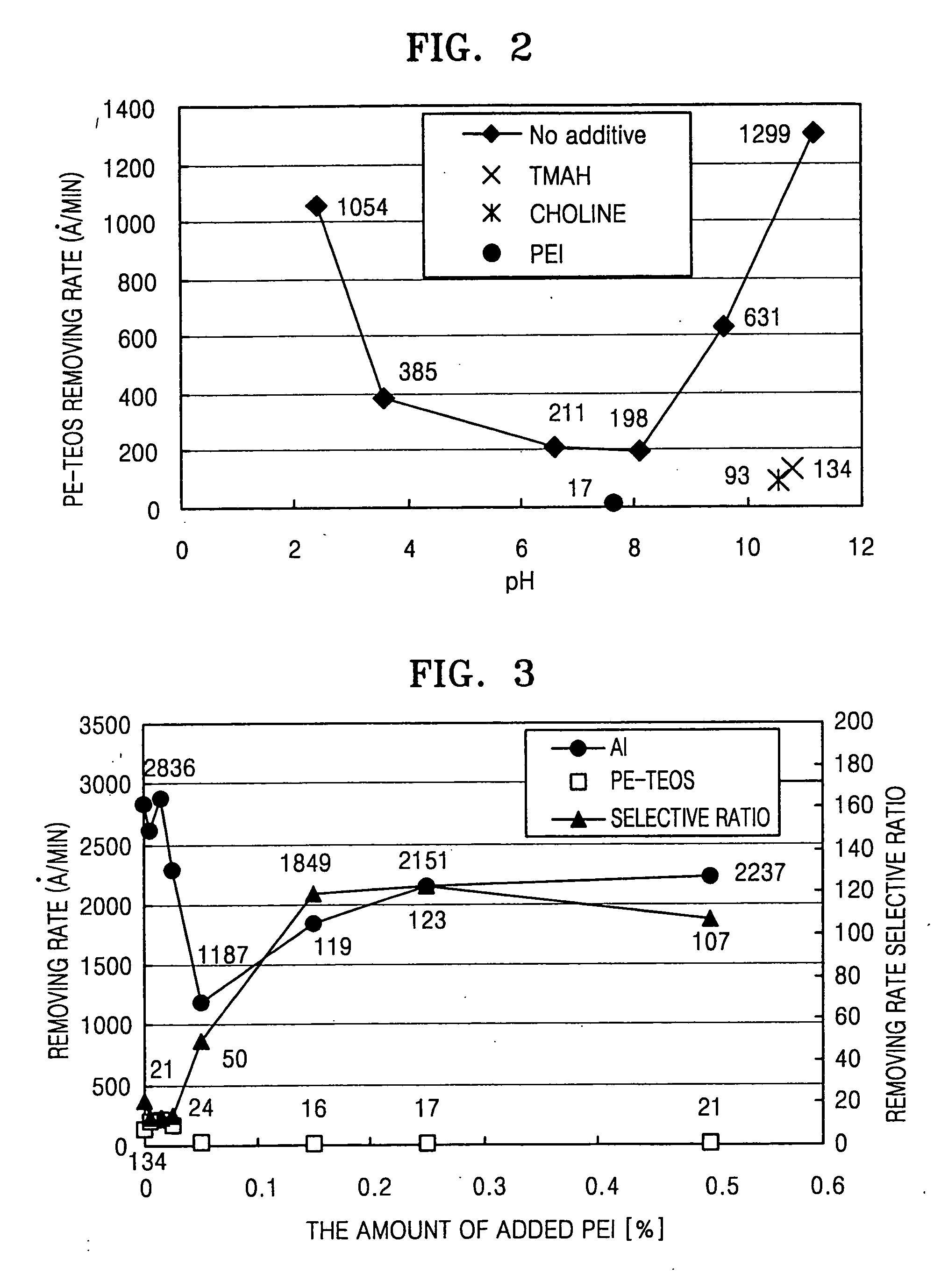
Examples
first embodiment
CMP Slurry of a First Embodiment
[0034] A slurry for CMP of an aluminum film according to a first embodiment of the present invention is a compound containing a polishing agent, an oxidant, a pH control additive, and an oxide film removal retarder which reduces a removal rate of a silicon oxide film.
[0035] Colloidal silica (SiO2) is a preferred polishing agent for the slurry of the first embodiment. Other exemplary compounds that can be alternatively or additionally used as a polishing agent are alumina (Al2O3), ceria (CeO2), mangania (MnO2), or zirconia (ZrO2), or a composite of two or more of these materials. The polishing agent should cause minimum scratching on the surface of the aluminum film during a CMP process, and accordingly, the polishing agent should preferably have a small and uniform particle size distribution. Colloidal silica meets this characteristic requirement. A desirable ratio of the polishing agent in the first slurry to a total weight of the first slurry is 2-...
first experiment
[0039] CMP equipment designated as F-REX 200 and manufactured by Ebara Co. was used for the experiments described herein. The polishing pads used were an IC 1000 pad for the top polishing pad and a SUBA 4 pad for the sub polishing pad. All experimental data were obtained under the following operating conditions: (1) contact pressure (polishing load) of the wafer to the polishing pad was 250 hPa, and (2) rotational speed of the polishing plate, to which the polishing pad was attached, was 80 rpm.
[0040] In order to observe the effect of the oxidants in the CMP process, a removal rate of an aluminum film, a removal rate of a PE-TEOS film (inter metal dielectric (IMD) layer), and a reflective index (RI) after a CMP process were measured with respect to different oxidants contained in respective CMP slurries. Each slurry contained 10 wt % colloidal silica, and oxidant concentration of each was 0.1 M. The results of the first experiment are summarized in Table 1. Referring to Table 1, in...
second experiment
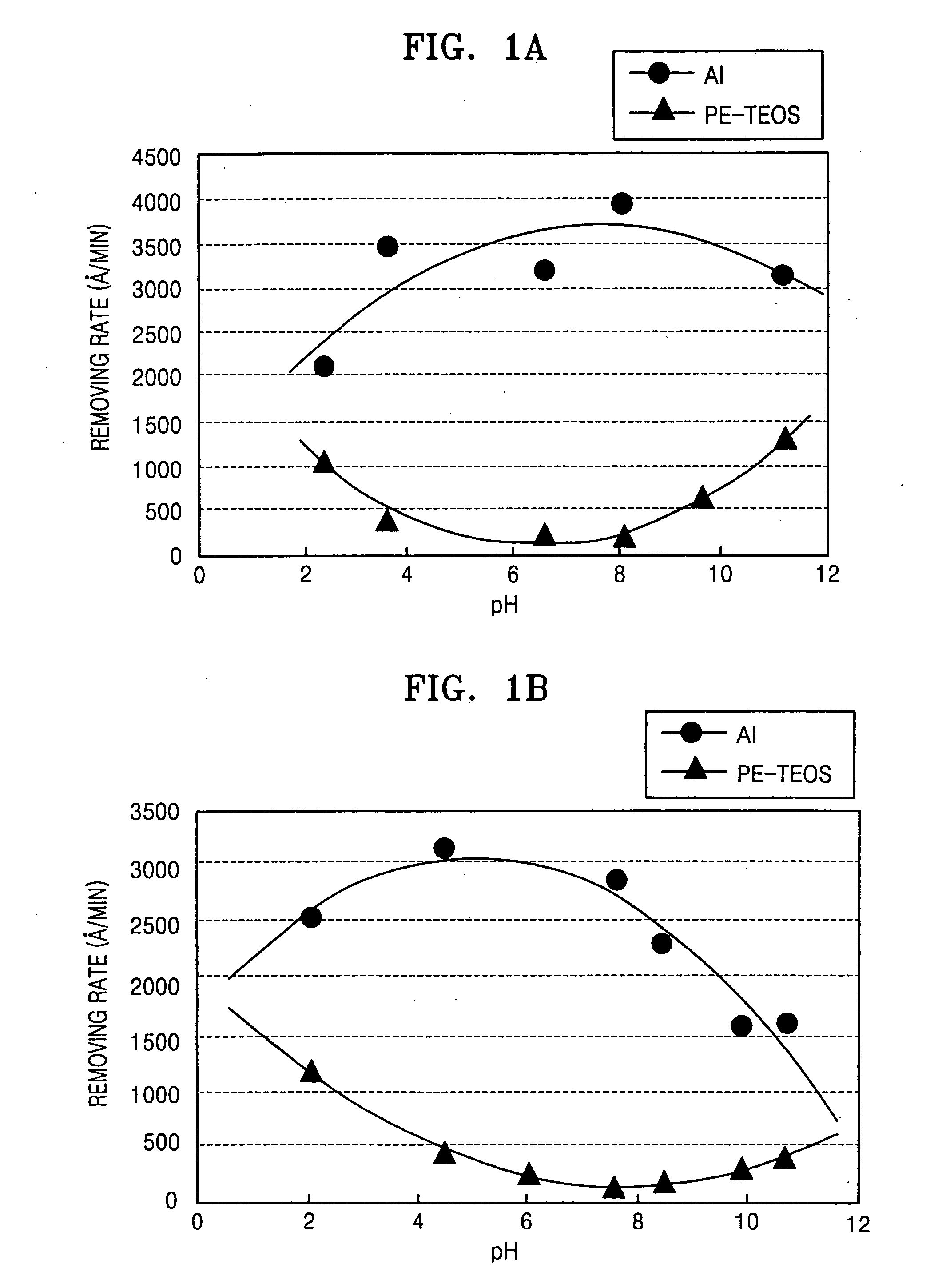
[0041] In order to observe the effect of the pH of the slurry in the CMP process, the removal rate of the aluminum film and the removal rate of the PE-TEOS film were measured while varying the pH of the slurry. Nitric acid and potassium hydroxide were used for the titrant, i.e., as additives for adjusting the p H. In the second experiment, a slurry having 10 wt % colloidal silica and 10 wt % hydrogen peroxide was prepared. Afterward, measurements were carried out using slurries in which the pH was controlled by adding the titrant. The results are summarized in Table 2 and depicted in FIG. 1A. Referring to Table 2 and FIG. 1A, the removal rate of the aluminum film and the silicon oxide film varied according to the pH of the slurry. In particular, when the pH of the first slurry is in a range of 4˜9, the removal rate selectivity of the aluminum film to the silicon oxide film is the greatest.
TABLE 2RemovalRemovalRemoval raterate ofrate ofselectivitypH ofaluminum filmPE-TEOS film(Al:P...
PUM
| Property | Measurement | Unit |
|---|---|---|
| Weight | aaaaa | aaaaa |
| Corrosion properties | aaaaa | aaaaa |
| Exposure limit | aaaaa | aaaaa |
Abstract
Description
Claims
Application Information
 Login to View More