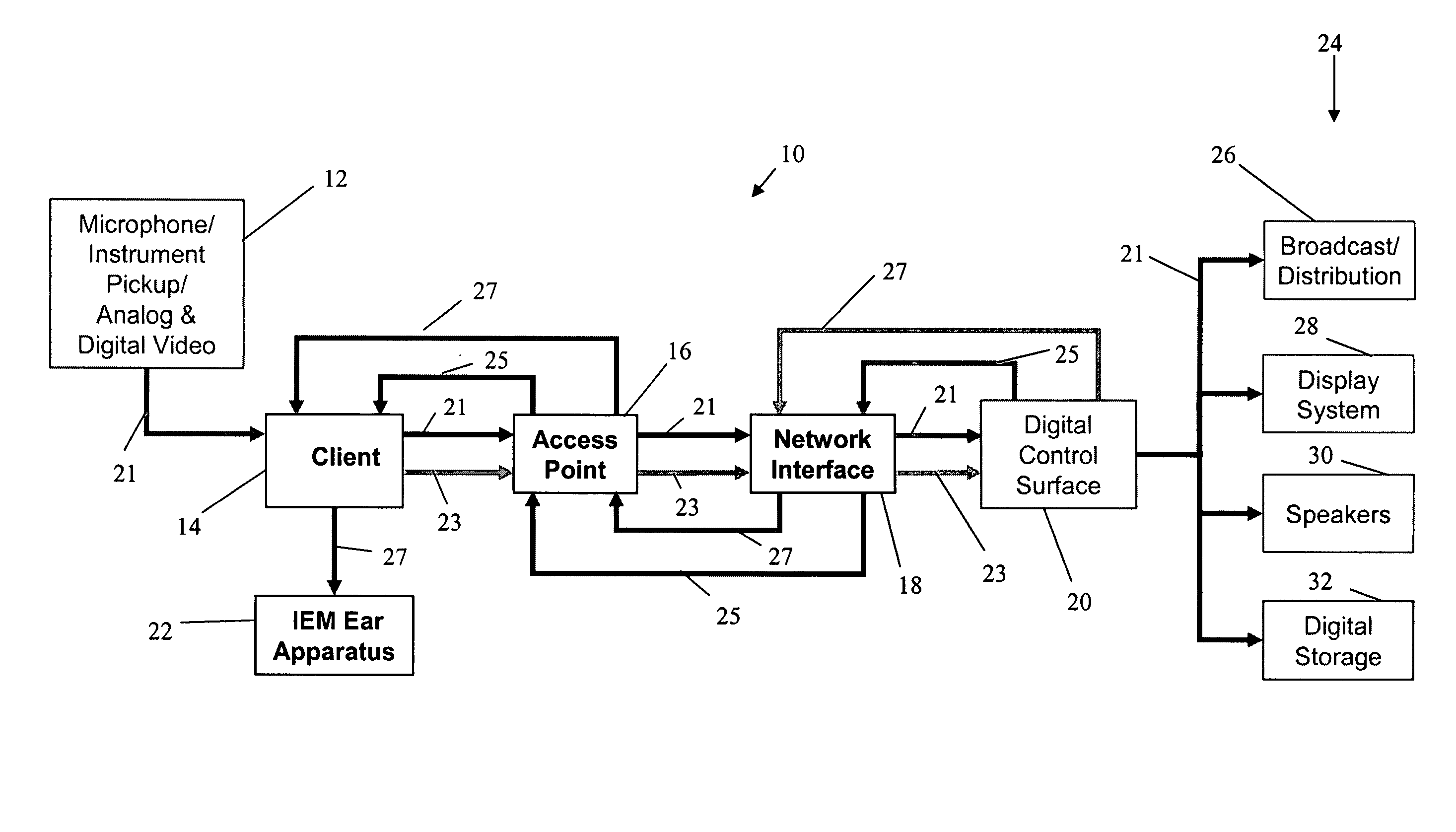
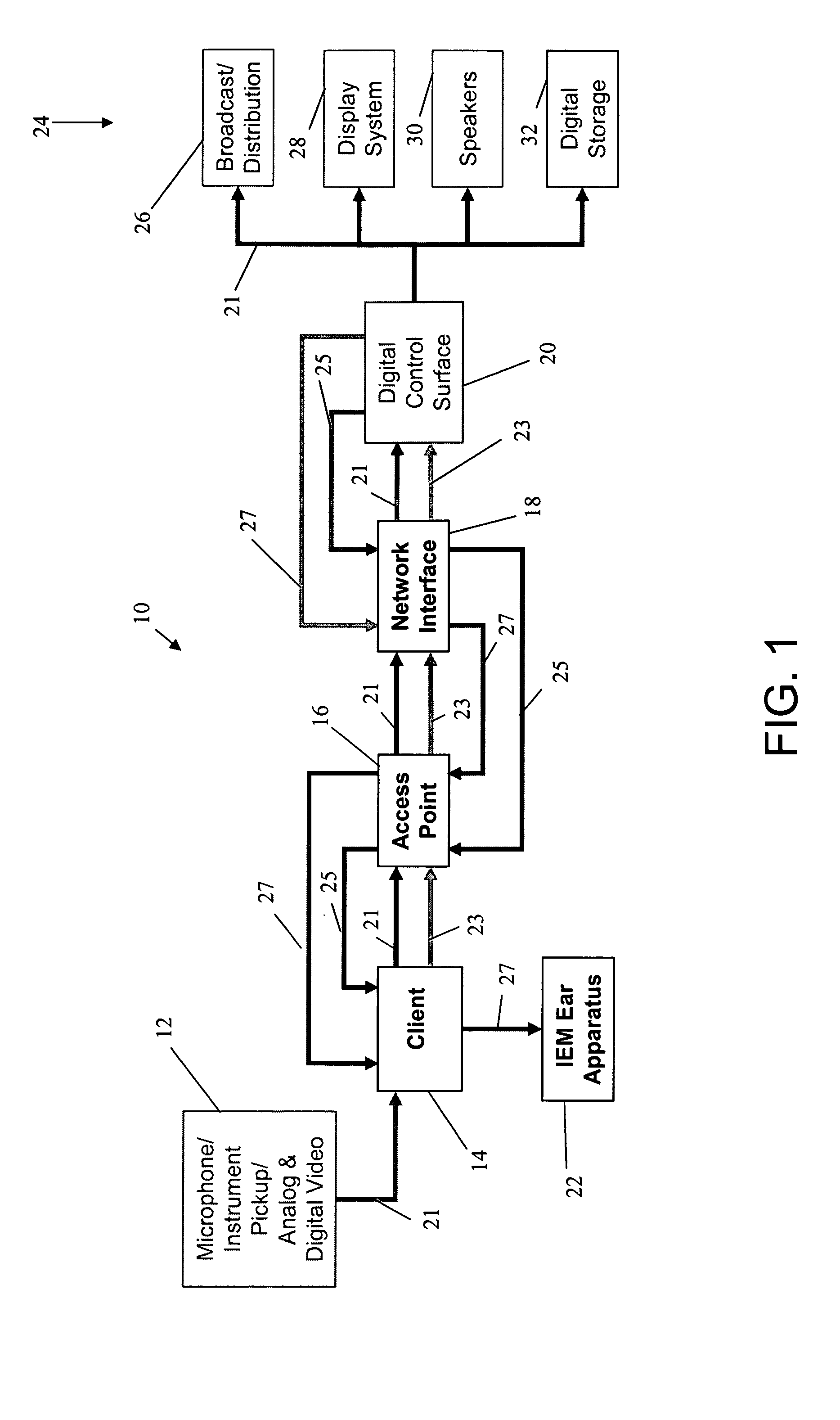
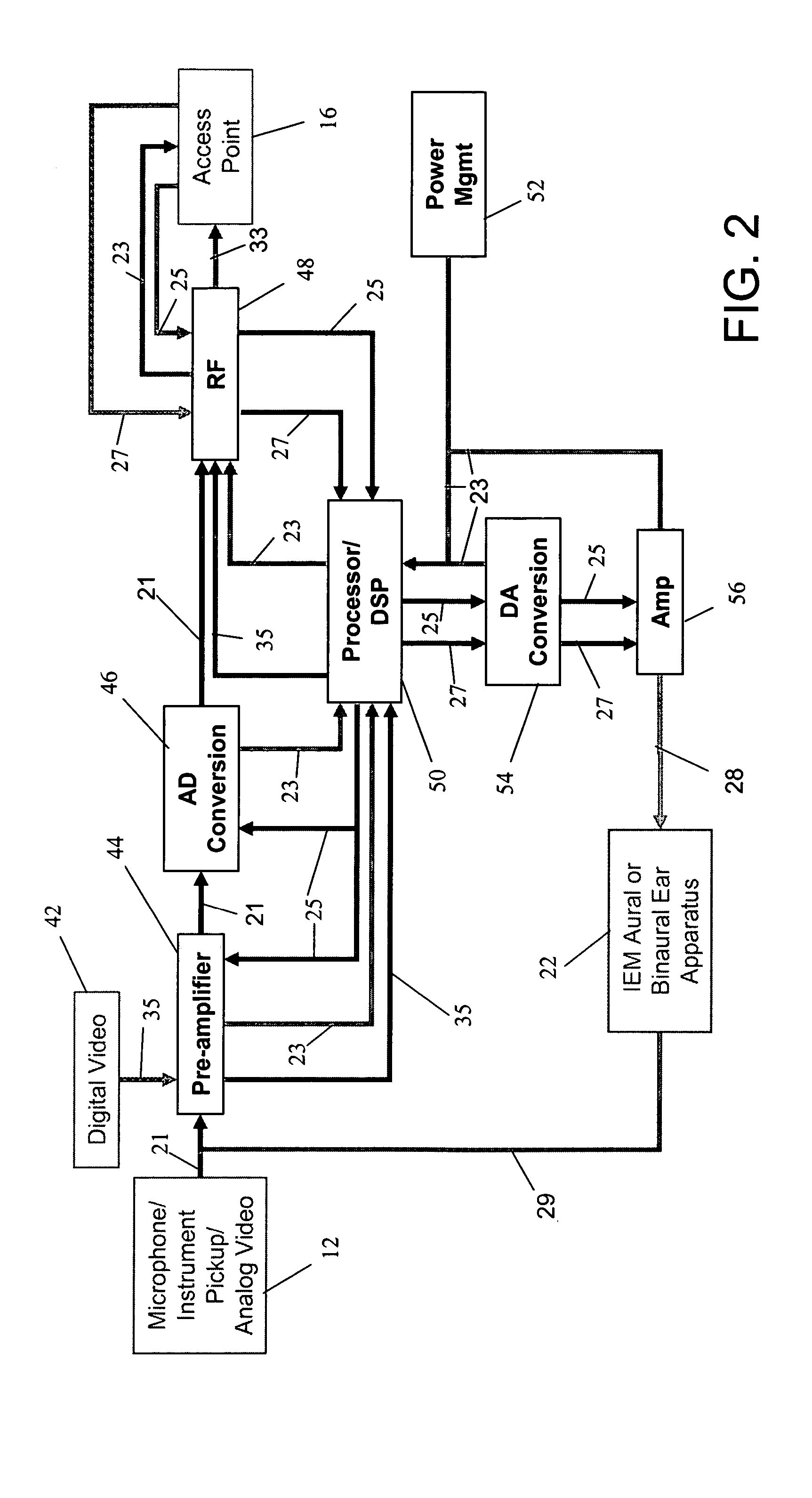
[0017] The present invention creates a paradigm shift by creating a digital, bi-directional communication system that combines a wireless media or multi-media system and wireless IEM system into one system. In one embodiment, the present invention comprises an access point, one or more clients, a network, an ear apparatus and system management
software. The clients, e.g., transceivers, can be embodied as a body pack or handheld device, for example. In an illustrative embodiment, the ear apparatus can be integrated into a
headset capable of holding a microphone. The present invention also provides a method for bi-directional communication between the remote components and the access point enabling
remote system management. In one embodiment, the present invention can support dozens, if not a practically unlimited number of clients per access point.
[0018] In an illustrative embodiment, the present invention provides a
Quality of Service (QoS) optimized for low latency, real time audio transmission, supports 802.11 protocols and standards (e.g., 802.11a, 802.11g, 802.11d, 802.11e, 802.11f, 802.11h, 802.11j, and 802.11n), supports 802.16 protocols and standards, transmits over unlicensed bands (e.g., ISM (Industrial, Scientific and Medical) band and U-NII (Unlicensed National
Information Infrastructure) band), with the ability to operate in multi-band, multi-mode transmission mode, and can further transmit over the VHF or UHF bands. Further, in one embodiment, the present invention can process media in a continuous
stream without packetization based on these protocols.
[0020] In one embodiment, the present invention uses
phased array antennas to reduce
power consumption, increase range, and track
transceiver location while improving
immunity to interference. Also, the present invention can further provide
signal encryption for secure transmissions in compliance with AES standards. In an illustrative embodiment, the present invention supports AES / EBU standards for transmitting
digital audio. In another embodiment, the invention also supports AES-47. In one embodiment, the present invention can provide for transmitted sampling rates of 48 kHz, 96 kHz, and 192 kHz with a 24-bit resolution. Higher sampling rates can also be accommodated. Sample rates and sample formats can be selected automatically using the system management
programming of the present invention, or manually such as by an engineer, for example. In terms of
video quality, the present invention can support formats such as SDTV and HDTV, for example.
[0022] In addition to the above advantages, the present invention provides a level of flexibility,
scalability, and upgradeability unavailable in today's multi-media industry using modular
plug and play sub-systems, on-line
firmware and
software upgrades. The present invention further provides an
open source software platform to allow
third party development of plug-ins. The present invention also tracks, sequences, and records an engineer's settings and preferences, allowing this information to be stored as a group and recalled at a later date. Groups can be sequenced and stored for future use as super sets, i.e., scenes. In one embodiment, this capability encompasses lighting systems and audio / visual equipment. The present invention further allows for
remote management of user devices by an engineer or
technician, for example.
[0023] Further, the present invention can create an acoustic or visual model for a venue and store it in a
database for future reference. The model can store characteristics for the space, such as
reverberation, hot spots,
harmonics, standing
waves, lighting effects, pan and
zoom range, and other audio and visual characteristics as are known in the art. In one embodiment, the present invention analyzes and recommends parameter settings for a particular venue based on a system generated acoustic and / or visual model of the venue, a stored
record of the engineer's typical settings and preferences, and the engineer's settings and preferences for that venue and venues with similar acoustic and / or visual models. The present invention can automatically scan a venue to evaluate the local RF environment,
ranking potential sources of interference, recommending interference free,
intermodulation free settings, configuring the
RF components to maximize reception and
immunity, and providing
dynamic channel selection and dynamic RF
power regulation. By providing for
dynamic channel selection and
dynamic modulation, the present invention assists in maximizing the
spectral efficiency of the available bandwidth. With higher and higher efficiencies, the required power decreases; as such, the present invention assists with
power management in connection with the present invention.
[0025] In addition, the present invention can track the position of active transceivers and use this information to automatically adjust control surface panning controls. This capability effectively eliminates the subjectivity of locating and tracking a media source within the sound or visual field of a stereo,
surround sound or visual recording, broadcast, or reinforcement system, thereby improving realism, efficiency, and accuracy. The present invention further provides digital interfaces operable to comply with AES, Firewire 2,
Ethernet, and ATM standards.


 Login to View More
  Login to View More