
QWIP with electron launcher for reducing dielectric relaxation effect in low background conditions
a dielectric relaxation and electron launcher technology, applied in the field of quantum well infrared photodetector (qwip), can solve the problems of dielectric relaxation effect, non-uniform field distribution cost, flow through, etc., and achieve the effect of reducing both resistance (r) and capacitance (c) of qwip and effectively reducing the dielectric relaxation
- Summary
- Abstract
- Description
- Claims
- Application Information
AI Technical Summary
Benefits of technology
Problems solved by technology
Method used
Image

Examples
Embodiment Construction
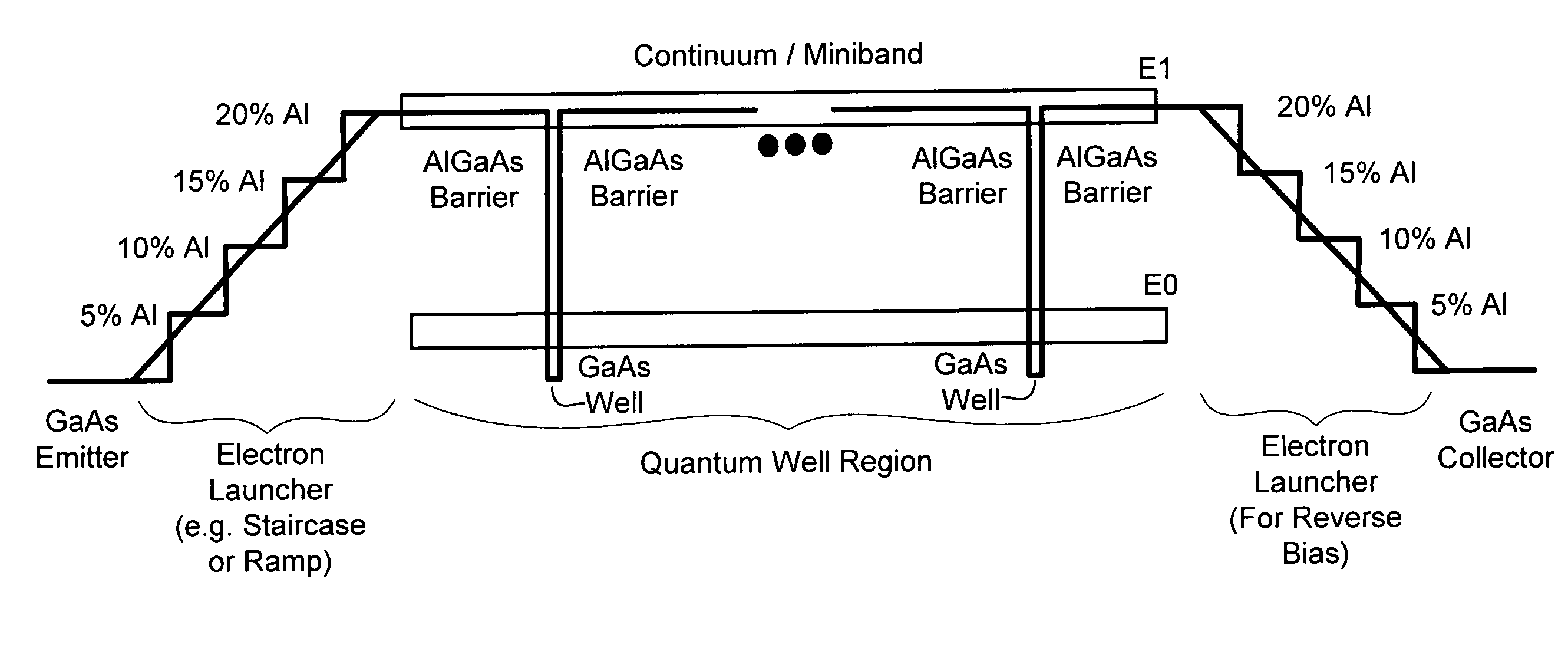
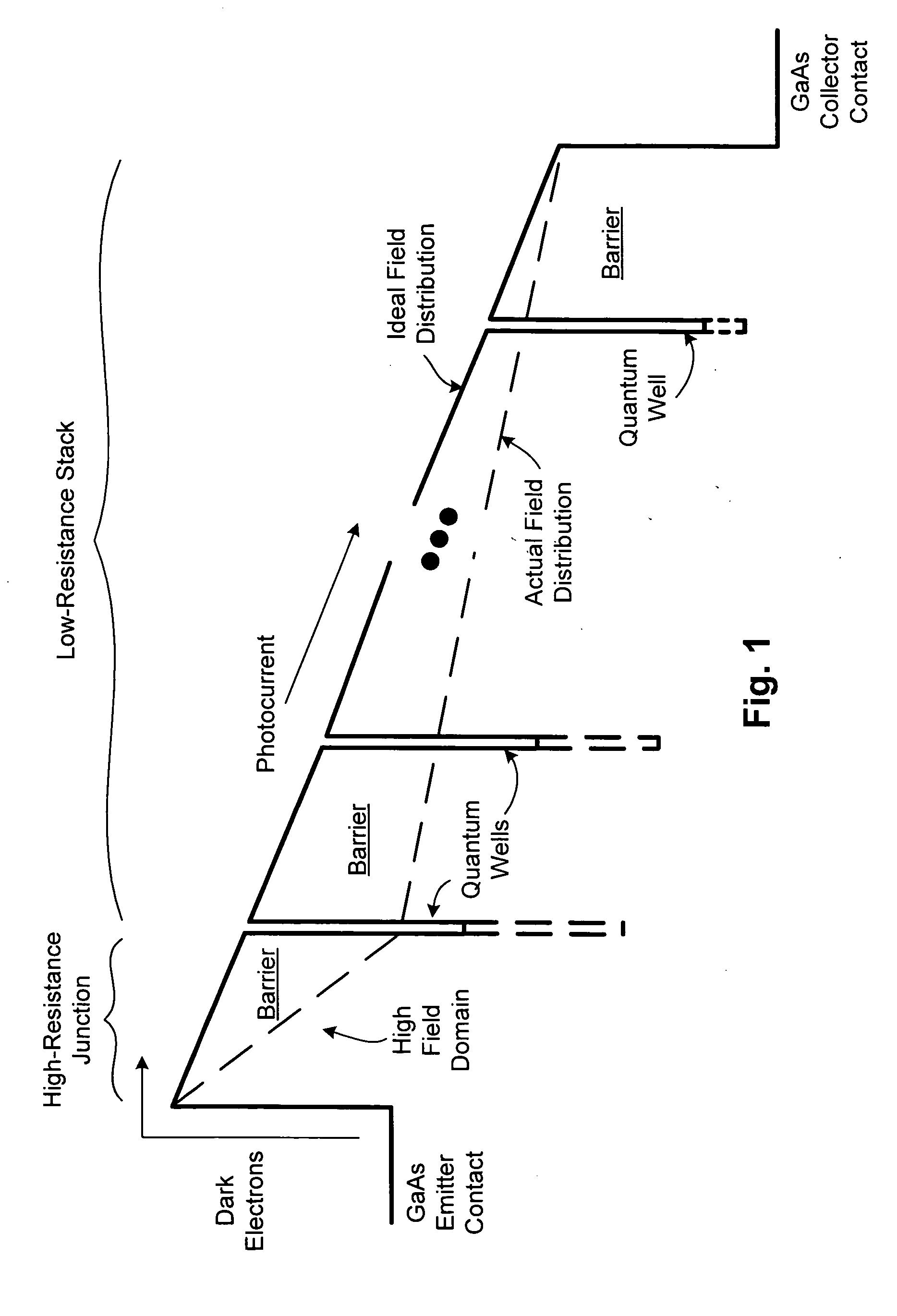
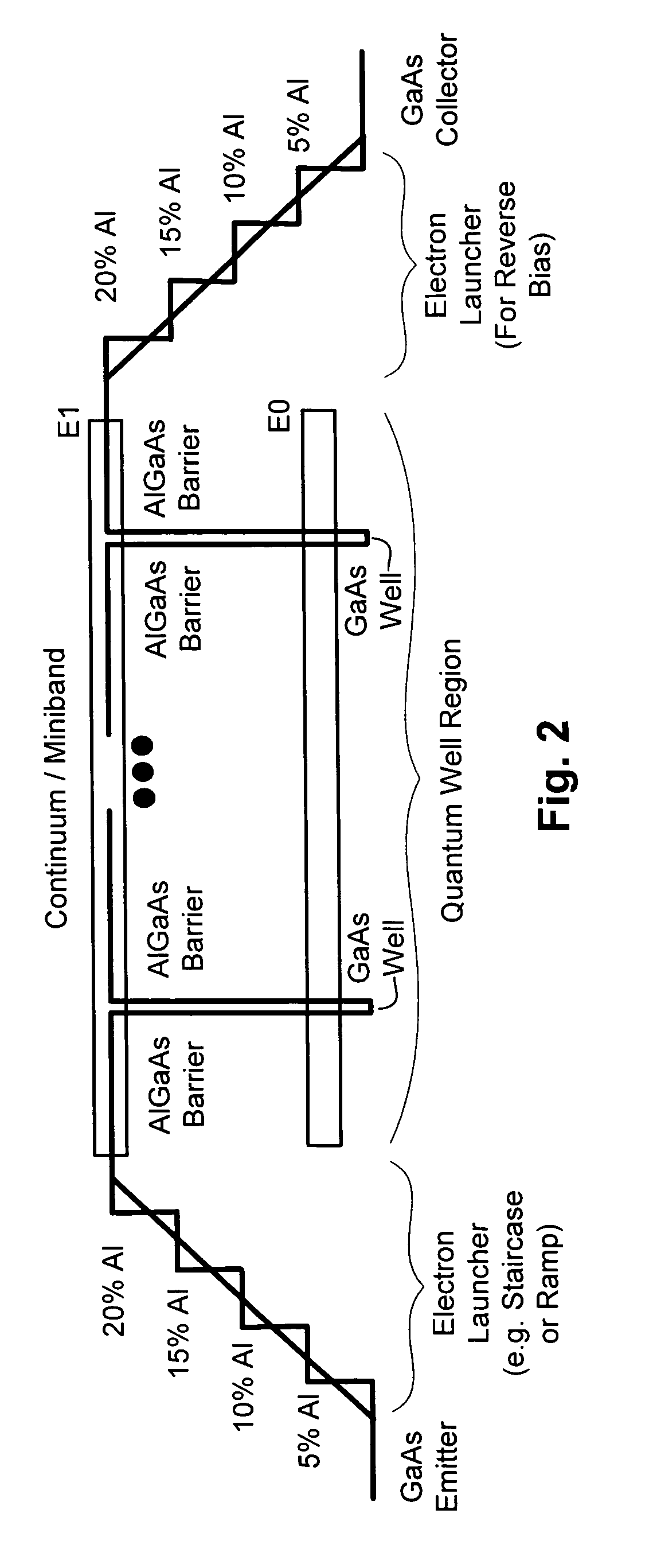
[0022] Embodiments of the present invention provide a QWIP design that effectively eliminates or otherwise reduces the dielectric relaxation effect, thereby enhancing QWIP responsivity. This can be achieved by providing a staircase or ramp from the emitter to the active quantum well region, which acts as a low resistance mechanism for launching electrons from the emitter into active quantum well region. As such, the typically high resistance point between the emitter and the active quantum well region is effectively lowered. Having reduced the dominant resistance component of the overall QWIP resistance, the active quantum well region can be configured with thicker barriers, which enable a desirable sharp spectral response. In short, grading the barrier at the emitter to launch electrons, both lowers the choke point resistance dramatically as well as restores detector sensitivity.
[0023] The present invention has many applications. For example, QWIPs configured with an electron laun...
PUM
 Login to View More
 Abstract
Description
Claims
Application Information
 Login to View More