
Method of forming a trench isolation layer and method of manufacturing a non-volatile memory device using the same
- Summary
- Abstract
- Description
- Claims
- Application Information
AI Technical Summary
Benefits of technology
Problems solved by technology
Method used
Image

Examples
embodiment 1
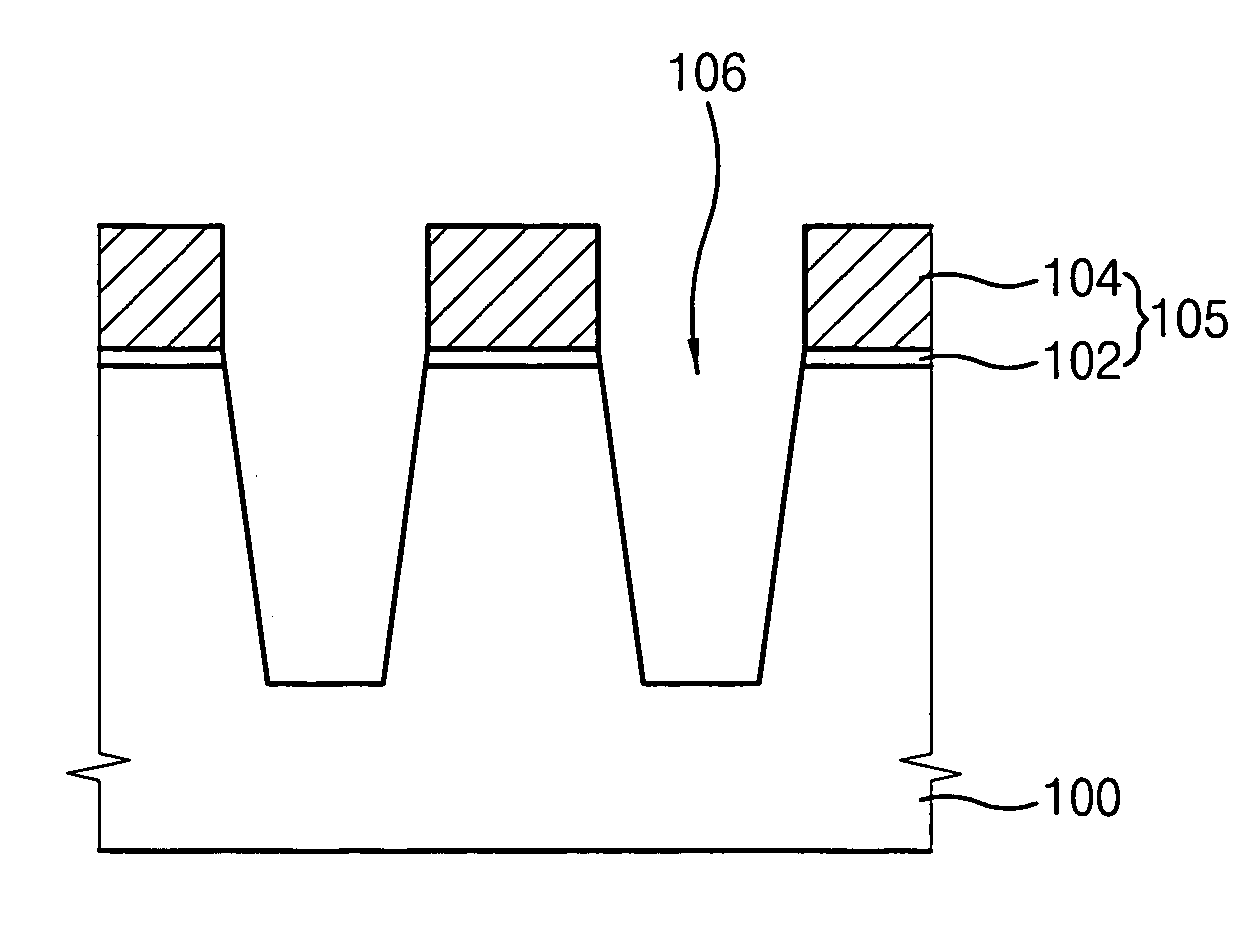
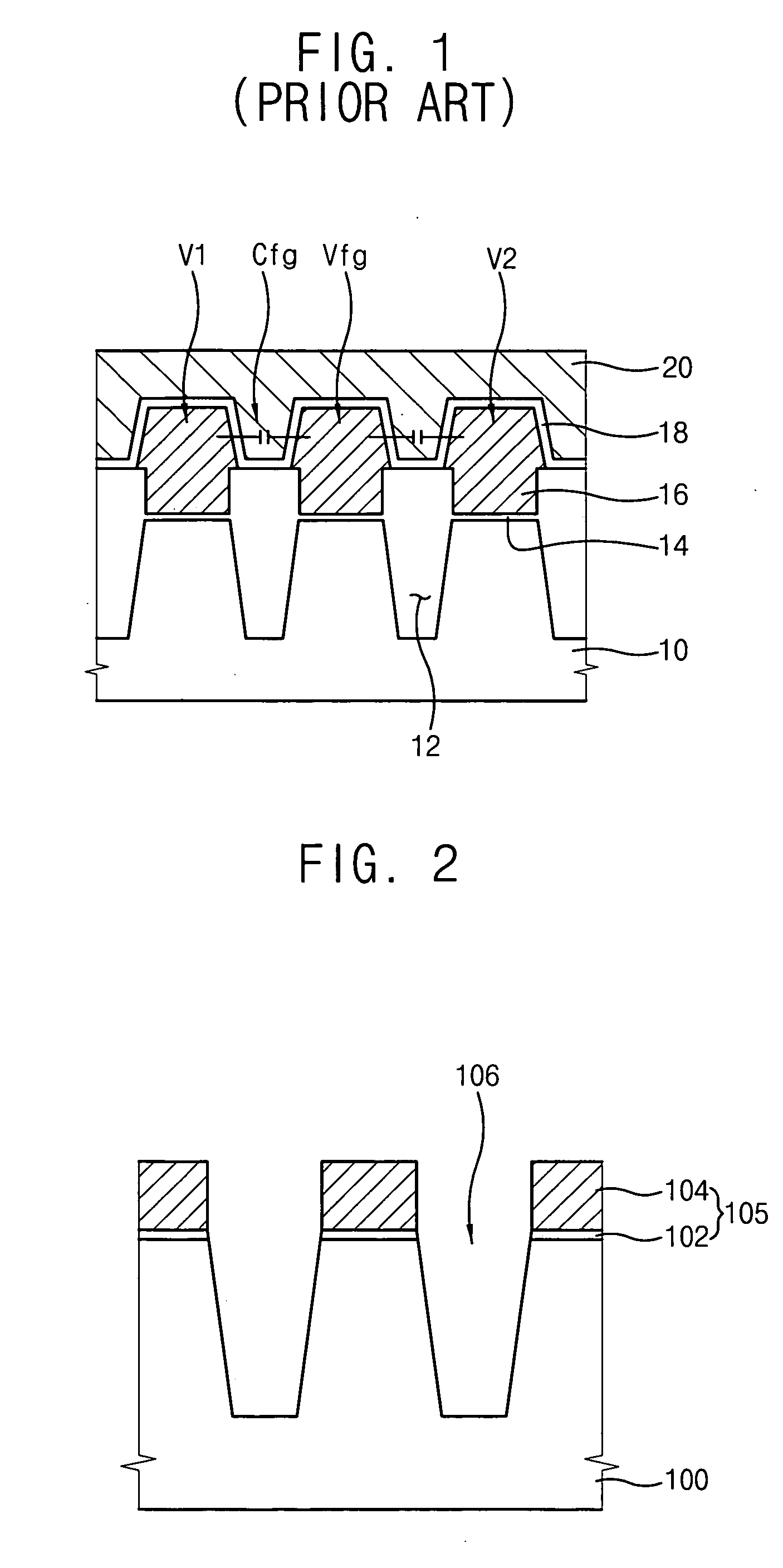
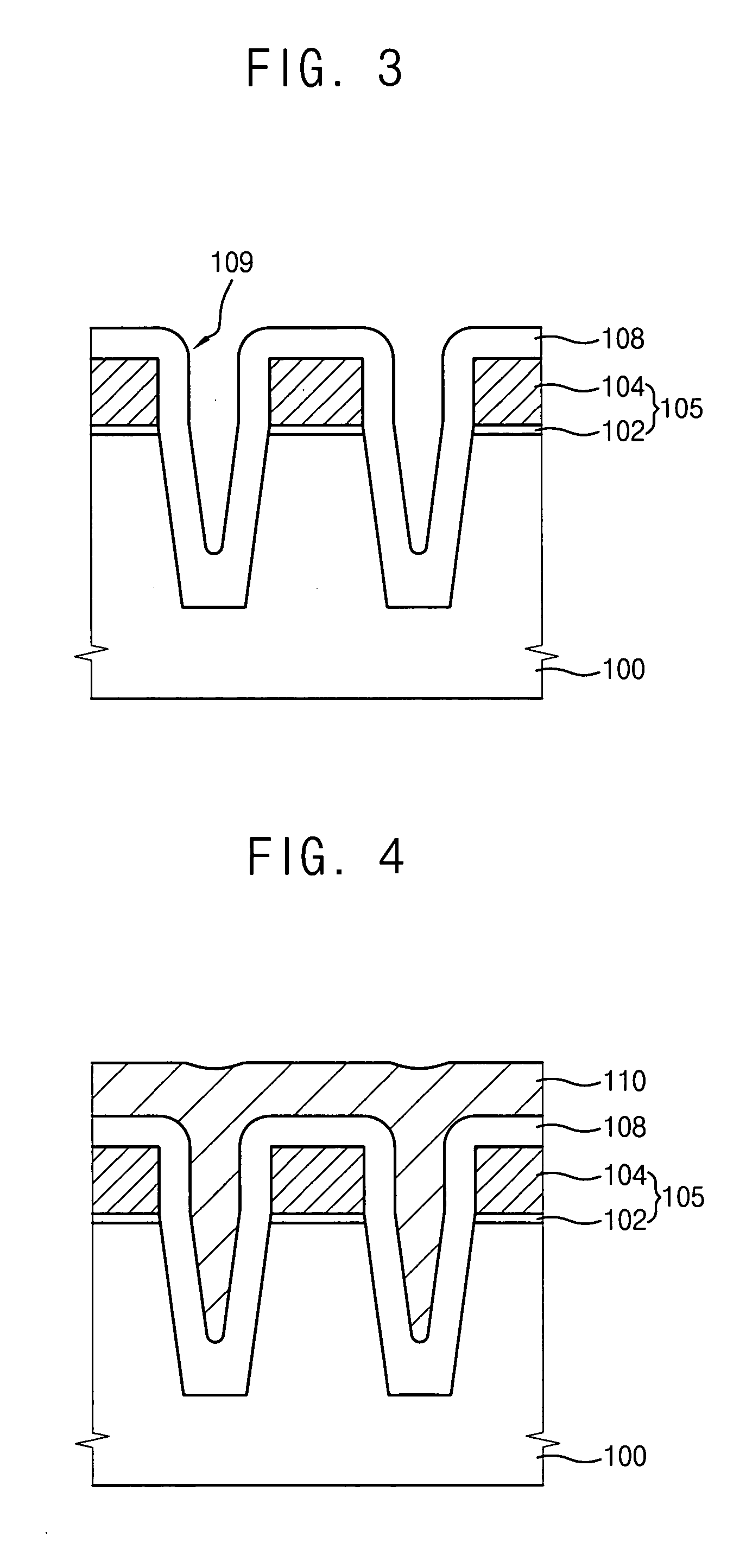
[0031] FIGS. 2 to 6 are cross-sectional views illustrating processing steps for a method of forming a device isolation layer according to a first exemplary embodiment of the present invention.
[0032] Referring to FIG. 2, a pad oxide layer (not shown) is formed on a substrate 100 to a thickness of about 50 Å to about 200 Å for reducing stress when silicon nitride is deposited in a subsequent process. A silicon nitride layer (not shown) is formed on the pad oxide layer. Then, the silicon nitride layer and the pad oxide layer are partially and sequentially etched away, thereby forming a pad oxide pattern 102 and a silicon nitride pattern 104 sequentially stacked on the substrate 100. In the present embodiment, the pad oxide pattern 102 and the silicon nitride pattern 104 function as a hard mask pattern 105 in a subsequent process. The surface portion of the substrate 100 is etched away using the hard mask pattern 105 as an etching mask, thereby forming a trench 106 by which conductive ...
embodiment 2
[0051] FIGS. 7 to 12 are cross-sectional views illustrating processing steps for a method of manufacturing a semiconductor device according to a second exemplary embodiment of the present invention. A device isolation layer for the semiconductor device is formed in the same or similar way as in Embodiment 1, described above.
[0052] Referring to FIG. 7, the same process as described with reference to FIGS. 2 to 4 is performed on a semiconductor substrate 150. As described above, a pad oxide layer (not shown) and a silicon nitride layer (not shown) are formed on the substrate 150 for reducing stress during formation of the silicon nitride layer. The silicon nitride layer functions as a mask layer for forming the device isolation layer, and also defines a floating gate region in which a floating gate is formed in subsequent processes. As a result, the silicon nitride layer is formed to a thickness greater than that of a desired floating gate.
[0053] Then, the silicon nitride layer and ...
embodiment 3
[0084] FIGS. 15 to 19 are cross-sectional views illustrating processing steps for a method of manufacturing a non-volatile memory device according to a third exemplary embodiment of the present invention.
[0085] Referring to FIG. 15, a tunnel oxide layer (not shown) is formed on a substrate 300. Examples of the tunnel oxide layer include a silicon oxide layer, a silicon oxide layer doped with fluorine, a silicon oxide layer doped with carbon, a material layer comprised of a low dielectric material such as low-k material, etc.
[0086] A first polysilicon layer (not shown) is formed on the tunnel oxide layer so as to form a lower floating gate pattern, and a silicon nitride layer (not shown) is formed on the first polysilicon layer so as to form a hard mask layer.
[0087] The silicon nitride layer is patterned through a photolithography process, thereby forming a hard mask pattern 306. The first polysilicon layer and the tunnel oxide layer are sequentially and partially etched away usin...
PUM
 Login to View More
 Abstract
Description
Claims
Application Information
 Login to View More