Genetically modified stem cells and methods for identifying tissues differentiated therefrom
a technology of stem cells and gene-modified cells, applied in the field the selection of cells therefrom, can solve the problems of uncontrolled proliferation of gene-modified stem cells, unsatisfactory gene expression profiles, and difficult to prove that tissues derived from such invasive attempts reliably represent naturally occurring cell types. expression is extremely strong
- Summary
- Abstract
- Description
- Claims
- Application Information
AI Technical Summary
Benefits of technology
Problems solved by technology
Method used
Image

Examples
example 1
Cell Culturing and Differentiation
[0048]The human embryonic stem cell line HUES9 was maintained according to the widely accepted culture protocol described in Cowan, Calif. et al., N Engl J Med 2004, 350:1353. Briefly, cells were cultured on mitomycin-C treated mouse embryonic fibroblast feeder cells in complete HUES medium consisting of 15% knockout serum replacement (Gibco, Grand Island, N.Y.), 80% knockout Dulbecco modified Eagle medium (KoDMEM) medium (Invitrogen, Carlsbad, Calif.), 1 mM L-glutamine, 0.1 mM beta-mercaptoethanol, 1% nonessential amino acids, and 4 ng / mL human fibroblast growth factor. HUES cells from passage no. 35 were used for these analyses. The differentiation of the HUES cells were initiated spontaneously. On the day of passage, undifferentiated cells at confluence in 6-well plates were treated with collagenase IV and were transferred to Poly(2 Hydroxyethyl-methacrylate) (Sigma-Aldrich, St. Louis, Mo.) treated Petri dishes to allow EB formation. Cells were k...
example 2
Transposon Constructs and Transfection Procedure
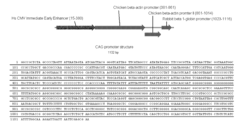
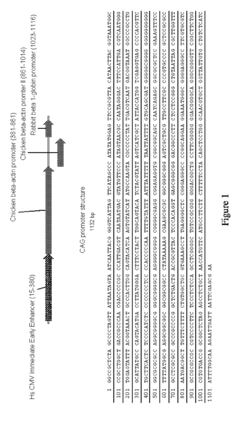
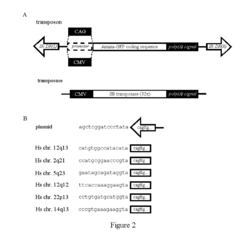
[0050]SB transposon plasmids used in this project contained the cDNA of the highly fluorescent marker Amaxa-GFP (www.amaxa.com) (FIG. 2A) or the canonical EGFP between the transposon inverted repeat sequences. Promoter sequences can be obtained from a tissue-specific promoter database, e.g. the TiProD: Tissue-Specific Promoter Database, (http: / / tiprod.cbi.pku.edu.cn:8080 / index.html), including cardiac actin or human albumin promoters. Other chemically inducible promoters, e.g. a metallothionein promoter, or artificial fusion promoters, eg. the CAG promoter can also be utilized. The CAG is a composite promoter that combines the human cytomegalovirus immediate-early enhancer, two parts of the chicken beta-actin promoter, and one part of the rabbit beta1-globin promoter. The CAG promoter is a very strong and ubiquitous promoter. It produces high levels of expression both in vitro and in vivo. The CAG promoter (SEQ ID NO:1) was successfull...
example 3
Detecting Transposon Activity and Determining Transposon Integration Sites
[0052]To provide evidence that the transposon construct is capable of transposition, the “excision PCR”, a nested PCR method was applied, as described previously. This method amplifies the “footprint” sequence left on the plasmid after transposition, whereas no PCR product is obtained if no transposition occurs (Ivics, Z et al., Mol Ther 2007, 15:1137). To determine the integration sites of the transgenes in human genomic DNA, splinkerette PCR and inverse PCR methods were applied, essentially as described earlier (Ivics, Z et al., Cell 1997, 91:501; Vigdal, T J et al., J Mol Biol 2002, 323:441). Briefly, for the splinkerette PCR, either a Sau3AI restriction enzyme, or the BfaI / NdeI / AseI enzyme cocktail was used to digest the genomic DNA, followed by a nested PCR using primers described earlier (Ivics, Z et al., Cell 1997, 91:501; Vigdal, T J et al., J Mol Biol 2002, 323:441). For the inverse PCR, the BamHI / Bc1...
PUM
| Property | Measurement | Unit |
|---|---|---|
| concentration | aaaaa | aaaaa |
| Fluorescent | aaaaa | aaaaa |
| Yellow | aaaaa | aaaaa |
Abstract
Description
Claims
Application Information
 Login to View More