Check patentability & draft patents in minutes with Patsnap Eureka AI!

Microfluidic microarray system and method for the multiplexed analysis of biomolecules

a microarray and biomolecule technology, applied in the field of microfluidic systems and methods for biomolecule analysis, can solve the problems of increasing the difficulty of developing multiplexed assays, increasing the difficulty of developing non-interactional sets of sandwich assays, and remaining very difficult to develop multiplexed assays

Inactive Publication Date: 2010-11-25
MCGILL UNIV
View PDF7 Cites 23 Cited by
  • Summary
  • Abstract
  • Description
  • Claims
  • Application Information

AI Technical Summary

Benefits of technology

[0020]In accordance with an embodiment of the present invention, there is provided a device that can complete multiplex analysis of biomolecules with limited sample volume.
[0032]In accordance with another aspect of the present invention, there is provided a method of delivering multiple solutions to a plurality of microcompartments in an microarray while avoiding cross-contamination between the solutions, the method comprising: contacting a first portion of an edge of the microcompartments with a first liquid solution; rinsing away the first liquid solution; and contacting a second portion of the edge of the microcompartments with a second liquid solution, the first and second portions of the edge of the microcompartments being different.

Problems solved by technology

However, for protein analysis it remains very challenging to develop multiplexed assays.
In contrast to traditional monoplex enzyme-linked immunoassays, generally agreed specifications and standards for antibody microarrays have not yet been formulated.
The challenge of multiplexed immunoassay is further compounded when using complex biological samples, such as blood and its plasma and serum derivatives or other bodily fluids.
It is also well known that developing non-interacting sets of sandwich assays becomes exponentially more difficult as the size of the array increases.
Optimization of multiplexed assays is a challenging enterprise that has been presented by Perlee et al.
This represents a significant amount of work, yet it only uncovers cross-reactivities within about one to two orders of magnitude, because 10% of the maximal concentration were used and the assays typically covered only 2-3 orders of magnitude; and yet because each sample from each patient is different, and may contain a protein with a mutation that leads to cross-reactivity, it is impossible to test beforehand all cross-reactivities.
However in the method proposed by Forrester, S. et al., 192 partitions with 12 spots are provided, which limits the number of analyses that can be made to 12 per slide.
Since 6 microliters are required with each application, this approach necessitates 865 microliters of sample for analyzing 144 analytes, which constitutes an excessively large amount for many applications.
Whereas their approach solves the issue of cross-reactivity, it comes at the expense of repetition of experiments and of large sample consumption.
However, it is currently not generally feasible using current microarray methods to measure the concentration while simultaneously probing protein isoforms, protein maturation, post-translational modifications and activity on the same microarray.
Mass spectrometry however typically requires close to milliliter quantities, is a serial method, necessitates important capital investment, heavily relies on bioinformatics and databases making the interpretation difficult and prone to errors.
Such a scheme would however entail complicated liquid handling, because multiple different solutions would need to be delivered to different wells, which is impractical with known systems.
In addition, the requirement for multiplexing entail miniaturizations, because only a limited amount of sample is available, and hence the different reactions have to be performed using little sample.
However, multiplexed liquid handling, at a microscale, of large numbers of samples without incurring significant dead volumes, is to date a largely unsolved problem.
However, pin spotters typically need to contact the surface, which can compromise the quality of the pattern that has been spotted.
The quantity of liquid deposited is typically minute, and is susceptible to evaporation.
However, it is well known that bio-ink-jet printers suffer from shortcomings for biological applications.
First, they require a large volume to fill their reservoir and generally suffer from dead volumes of close to 1 microliter or more.
Second, they are prone to malfunction, and in commercial instruments such as the GeSIM Nanoplotter™, a special software was installed to repair missing spots on microarrays in case of malfunction of a nozzle.
However, this approach is not 100% successful, and it is time consuming.
Third, the spotting parameters have to be readjusted whenever a new solution with a different viscosity is loaded.
Fourth, electrostatic charges between the nozzles and the substrate can lead to non-straight spotting and misalignment of the spotted drops on the microarray.
Whereas in conventional applications precise alignment is not critical, in a case where multiple spots of different solutions need to be spotted on the same location it becomes a problem.
Finally, commonly used bio-ink-jets use nozzles in the shape of needles or capillaries, which are fragile, easily break, and which are expensive.
Most recently, a new technology with 32 nozzles has been proposed by Arrayjet™, but it is unclear how robust this technology is in practice.

Finally, all inkjet type systems need complex electronic equipment to control droplet delivery.

Method used

the structure of the environmentally friendly knitted fabric provided by the present invention; figure 2 Flow chart of the yarn wrapping machine for environmentally friendly knitted fabrics and storage devices; image 3 Is the parameter map of the yarn covering machine
View more

Image

Smart Image Click on the blue labels to locate them in the text.
Viewing Examples
Smart Image
  • Microfluidic microarray system and method for the multiplexed analysis of biomolecules
  • Microfluidic microarray system and method for the multiplexed analysis of biomolecules
  • Microfluidic microarray system and method for the multiplexed analysis of biomolecules

Examples

Experimental program
Comparison scheme
Effect test

Embodiment Construction

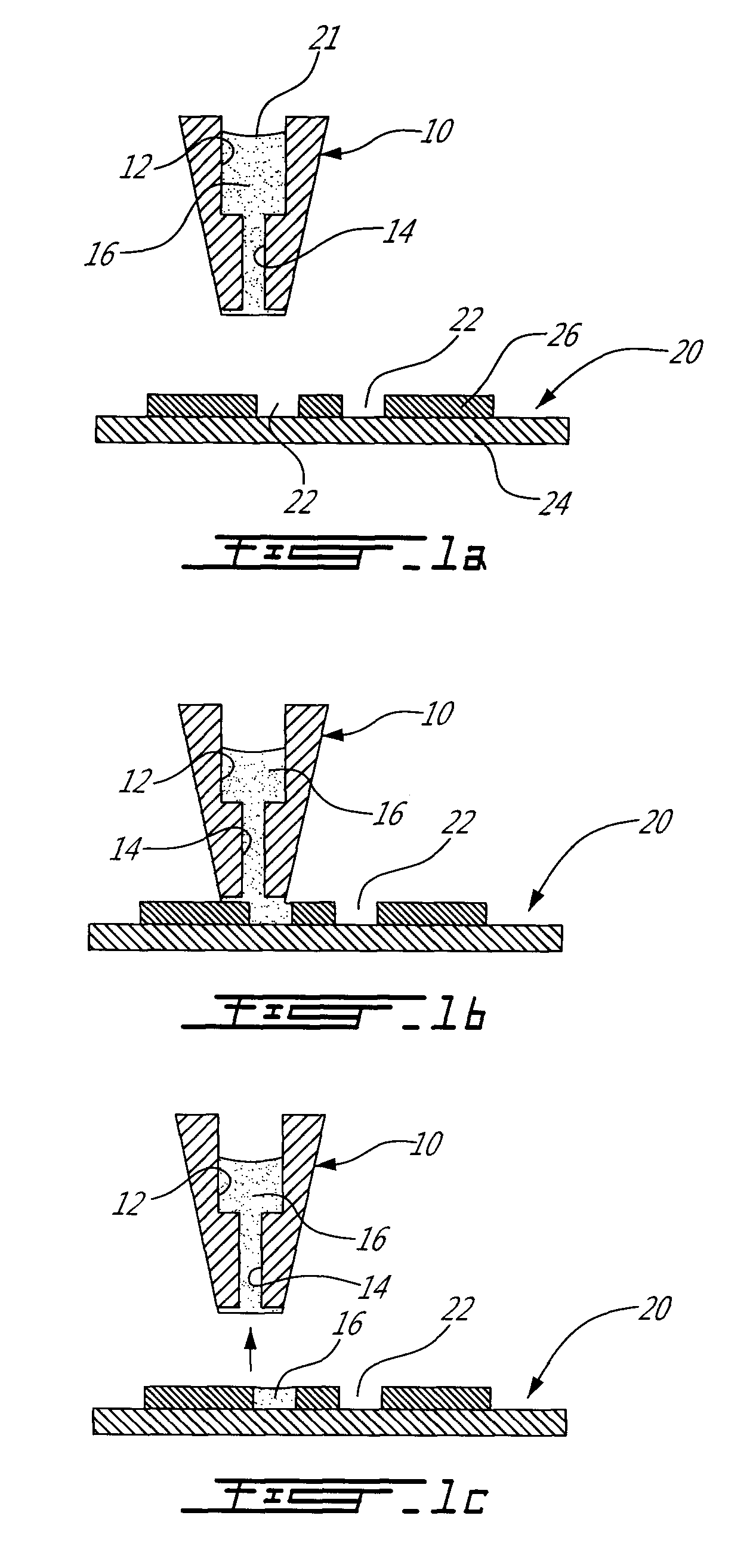
[0065]Referring to FIGS. 1a-1c, the method and system used to deliver one or more fluid solutions to the microcompartments of a microarray is shown. As seen in FIG. 1a, a reservoir or liquid transfer needle 10 of a microfluidic microarray system includes a reservoir 12 therein which is filled with a liquid 16. The reservoir 12 is in fluid flow communication with, and makes up part of, a fluid conduit 14 defined in the tip of the liquid transfer needle 10. The terms “needle” and “pin” and “capillary” will both be used herein to describe such a liquid transfer needle in a fluid handling and distribution portion of larger microfluidic microarray system of the present invention. The liquid 16 is maintained and thus held back within the fluid conduit 14 by a capillary pressure P1 generated at the interface 21 of the liquid 16 in the reservoir 12. The needle 10 is located above a microarray 20 having at least one microfluidic microcompartment 22 defined therein. Although a variety of diff...

the structure of the environmentally friendly knitted fabric provided by the present invention; figure 2 Flow chart of the yarn wrapping machine for environmentally friendly knitted fabrics and storage devices; image 3 Is the parameter map of the yarn covering machine
Login to View More

PUM

No PUM Login to View More

Abstract

A microfluidic system for fluid transfer to a microarray includes a liquid transfer needle having a fluid conduit therein within which is defined a withholding pressure P1, and a microcompartment defined within the microarray, the microcompartment being configured to generate a capillary pressure P2 therein. The capillary pressure P2 is less than the withholding pressure P1, such that a defined amount of liquid is transferred from the liquid transfer needle into the microcompartment when the liquid transfer needle and the microcompartment are disposed in fluid flow communication. A method of delivering multiple solutions to a plurality of microcompartments in an microarray while avoiding cross-contamination between the solutions is also provided.

Description

CROSS-REFERENCE TO RELATED APPLICATIONS[0001]The present application claims priority on U.S. provisional patent application No. 60 / 019,128 filed Jan. 4, 2008, the entire contents of which is incorporated herein by reference.TECHNICAL FIELD[0002]The present invention relates generally to the field of bio-analysis and microfluidics. More specifically, the invention relates to a microfluidic system and method for the analysis of biomolecules such as proteins, DNA, RNA, etc. in bodily fluids and tissues.BACKGROUND OF THE INVENTION[0003]Rapid and specific detection of biological cells and biomolecules, such as red blood cells, white blood cells, platelets, proteins, DNAs, and RNAs, have become more and more important to biological assays crucial to fields such as genomics, proteomics, diagnoses, and pathological studies. For example, the rapid and accurate detection of specific antigens and viruses is critical for combating pandemic diseases such as AIDS, flu, and other infectious diseas...

Claims

the structure of the environmentally friendly knitted fabric provided by the present invention; figure 2 Flow chart of the yarn wrapping machine for environmentally friendly knitted fabrics and storage devices; image 3 Is the parameter map of the yarn covering machine
Login to View More

Application Information

Patent Timeline
no application Login to View More
IPC IPC(8): C40B30/04C40B60/00C40B50/14
CPCB01J2219/00317G01N2035/1037B01J2219/00373B01J2219/00533B01J2219/00619B01J2219/00621B01J2219/00644B01J2219/00659B01J2219/00662B01J2219/00691B01J2219/00693B01L3/0248B01L3/0262B01L3/5085B01L3/5088B01L2200/0642B01L2300/0819B01L2300/0887B01L2400/0688G01N35/1011B01J2219/00367
Inventor JUNCKER, DAVIDPLA, MATEU
Owner MCGILL UNIV
Features
  • R&D
  • Intellectual Property
  • Life Sciences
  • Materials
  • Tech Scout
Why Patsnap Eureka
  • Unparalleled Data Quality
  • Higher Quality Content
  • 60% Fewer Hallucinations
Social media
Patsnap Eureka Blog
Learn More